we provide Downloadable Amazon AWS-Certified-Security-Specialty practice test which are the best for clearing AWS-Certified-Security-Specialty test, and to get certified by Amazon Amazon AWS Certified Security - Specialty. The AWS-Certified-Security-Specialty Questions & Answers covers all the knowledge points of the real AWS-Certified-Security-Specialty exam. Crack your Amazon AWS-Certified-Security-Specialty Exam with latest dumps, guaranteed!
Online AWS-Certified-Security-Specialty free questions and answers of New Version:
NEW QUESTION 1
A company uses identity federation to authenticate users into an identity account (987654321987) where the users assume an IAM role named IdentityRole. The users then assume an IAM role named JobFunctionRole in the target IAM account (123456789123) to perform their job functions.
A user is unable to assume the IAM role in the target account. The policy attached to the role in the identity account is: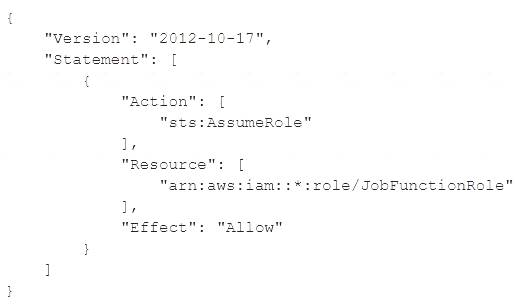
What should be done to enable the user to assume the appropriate role in the target account?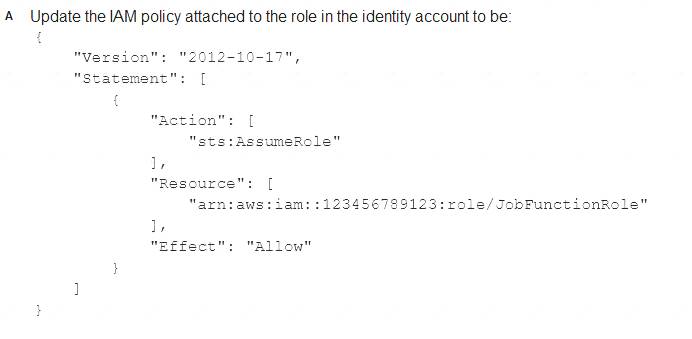
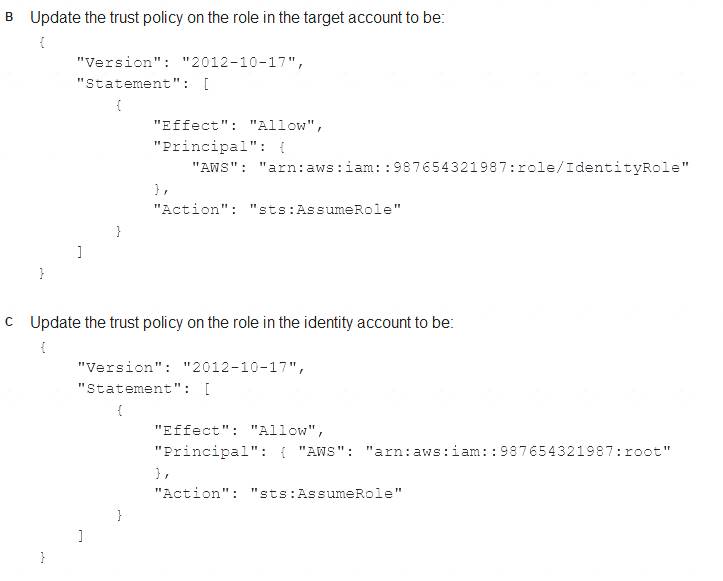
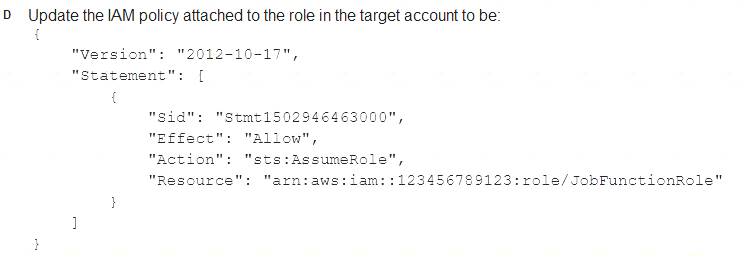
- A. Option A
- B. Option B
- C. Option C
- D. Option D
Answer: B
Explanation:
https://aws.amazon.com/blogs/security/how-to-use-trust-policies-with-iam-roles/
NEW QUESTION 2
A company that uses AWS Organizations wants to see AWS Security Hub findings for many AWS accounts and AWS Regions. Some of the accounts are in the company's organization, and some accounts are in organizations that the company manages for customers. Although the company can see findings in the Security Hub administrator account for accounts in the company's organization, there are no findings from accounts in other organizations.
Which combination of steps should the company take to see findings from accounts that are outside the organization that includes the Security Hub administrator account? (Select TWO.)
- A. Use a designated administration account to automatically set up member accounts.
- B. Create the AWS Service Role ForSecurrty Hub service-linked rote for Security Hub.
- C. Send an administration request from the member accounts.
- D. Enable Security Hub for all member accounts.
- E. Send invitations to accounts that are outside the company's organization from the Security Hub administrator account.
Answer: CE
Explanation:
To see Security Hub findings for accounts that are outside the organization that includes the Security Hub administrator account, the following steps are required: Send invitations to accounts that are outside the company’s organization from the Security Hub administrator account. This will allow the administrator account to view and manage findings from those accounts. The administrator account can send invitations by using the Security Hub console, API, or CLI. For more information, see Sending invitations to member accounts. Send an administration request from the member accounts. This will allow the member accounts to accept the invitation from the administrator account and establish a relationship with it. The member accounts can send administration requests by using the Security Hub console, API, or CLI. For more information, see Sending administration requests.
This solution will enable the company to see Security Hub findings for many AWS accounts and AWS Regions, including accounts that are outside its own organization.
The other options are incorrect because they either do not establish a relationship between the administrator and member accounts (A, B), do not enable Security Hub for all member accounts (D), or do not use a valid service for Security Hub (F).
Verified References: https://docs.aws.amazon.com/securityhub/latest/userguide/securityhub-member-accounts.html
NEW QUESTION 3
Within a VPC, a corporation runs an Amazon RDS Multi-AZ DB instance. The database instance is connected to the internet through a NAT gateway via two subnets.
Additionally, the organization has application servers that are hosted on Amazon EC2 instances and use the RDS database. These EC2 instances have been deployed onto two more private subnets inside the same VPC. These EC2 instances connect to the internet through a default route via the same NAT gateway. Each VPC subnet has its own route table.
The organization implemented a new security requirement after a recent security examination. Never allow the database instance to connect to the internet. A security engineer must perform this update promptly without interfering with the network traffic of the application servers.
How will the security engineer be able to comply with these requirements?
- A. Remove the existing NAT gatewa
- B. Create a new NAT gateway that only the application server subnets can use.
- C. Configure the DB instance€™s inbound network ACL to deny traffic from the security group ID of the NAT gateway.
- D. Modify the route tables of the DB instance subnets to remove the default route to the NAT gateway.
- E. Configure the route table of the NAT gateway to deny connections to the DB instance subnets.
Answer: C
Explanation:
Each subnet has a route table, so modify the routing associated with DB instance subnets to prevent internet access.
NEW QUESTION 4
A company needs a security engineer to implement a scalable solution for multi-account authentication and authorization. The solution should not introduce additional user-managed architectural components. Native IAM features should be used as much as possible The security engineer has set up IAM Organizations w1th all features activated and IAM SSO enabled.
Which additional steps should the security engineer take to complete the task?
- A. Use AD Connector to create users and groups for all employees that require access to IAM accounts.Assign AD Connector groups to IAM accounts and link to the IAM roles in accordance with the employees‘job functions and access requirements Instruct employees to access IAM accounts by using the IAM Directory Service user portal.
- B. Use an IAM SSO default directory to create users and groups for all employees that require access to IAM account
- C. Assign groups to IAM accounts and link to permission sets in accordance with the employees‘job functions and access requirement
- D. Instruct employees to access IAM accounts by using the IAM SSO user portal.
- E. Use an IAM SSO default directory to create users and groups for all employees that require access to IAM account
- F. Link IAM SSO groups to the IAM users present in all accounts to inherit existing permission
- G. Instruct employees to access IAM accounts by using the IAM SSO user portal.
- H. Use IAM Directory Service tor Microsoft Active Directory to create users and groups for all employees that require access to IAM accounts Enable IAM Management Console access in the created directory and specify IAM SSO as a source cl information tor integrated accounts and permission set
- I. Instruct employees to access IAM accounts by using the IAM Directory Service user portal.
Answer: B
NEW QUESTION 5
Your CTO thinks your IAM account was hacked. What is the only way to know for certain if there was unauthorized access and what they did, assuming your hackers are very sophisticated IAM engineers and doing everything they can to cover their tracks?
Please select:
- A. Use CloudTrail Log File Integrity Validation.
- B. Use IAM Config SNS Subscriptions and process events in real time.
- C. Use CloudTrail backed up to IAM S3 and Glacier.
- D. Use IAM Config Timeline forensics.
Answer: A
Explanation:
The IAM Documentation mentions the following
To determine whether a log file was modified, deleted, or unchanged after CloudTrail delivered it you can use CloudTrail log file integrity validation. This feature is built using industry standard algorithms: SHA-256 for hashing and SHA-256 with RSA for digital signing. This makes it computationally infeasible to modify, delete or forge CloudTrail log files without detection. You can use the IAM CLI to validate the files in the location where CloudTrail delivered them
Validated log files are invaluable in security and forensic investigations. For example, a validated log file enables you to assert positively that the log file itself has not changed, or that particular user credentials performed specific API activity. The CloudTrail log file integrity validation process also lets you know if a log file has been deleted or changed, or assert positively that no log files were delivered to your account during a given period of time.
Options B.C and D is invalid because you need to check for log File Integrity Validation for cloudtrail logs For more information on Cloudtrail log file validation, please visit the below URL: http://docs.IAM.amazon.com/IAMcloudtrail/latest/userguide/cloudtrail-log-file-validation-intro.html
The correct answer is: Use CloudTrail Log File Integrity Validation. omit your Feedback/Queries to our Expert
NEW QUESTION 6
Amazon GuardDuty has detected communications to a known command and control endpoint from a company's Amazon EC2 instance. The instance was found to be running a vulnerable version of a common web framework. The company's security operations team wants to quickly identity other compute resources with the specific version of that framework installed.
Which approach should the team take to accomplish this task?
- A. Scan all the EC2 instances for noncompliance with IAM Confi
- B. Use Amazon Athena to query IAM CloudTrail logs for the framework installation
- C. Scan all the EC2 instances with the Amazon Inspector Network Reachability rules package to identity instances running a web server with RecognizedPortWithListener findings
- D. Scan all the EC2 instances with IAM Systems Manager to identify the vulnerable version of the web framework
- E. Scan an the EC2 instances with IAM Resource Access Manager to identify the vulnerable version of the web framework
Answer: C
Explanation:
To quickly identify other compute resources with the specific version of the web framework installed, the team should do the following: Scan all the EC2 instances with AWS Systems Manager to identify the vulnerable version of the web framework. This allows the team to use AWS Systems Manager Inventory to collect and query
information about the software installed on their EC2 instances, and to filter the results by software name and version.
NEW QUESTION 7
A security engineer is designing an IAM policy to protect AWS API operations. The policy must enforce multi-factor authentication (MFA) for IAM users to access certain services in the AWS production account. Each session must remain valid for only 2 hours. The current version of the IAM policy is as follows: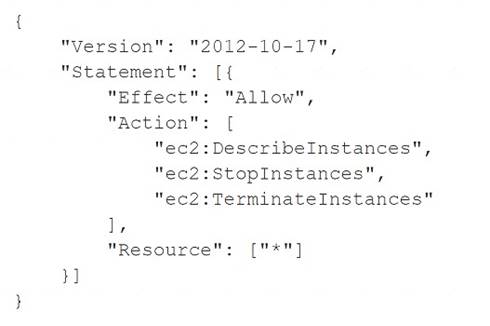
Which combination of conditions must the security engineer add to the IAM policy to meet these
requirements? (Select TWO.)
- A. "Bool " : " aws : Multi FactorAuthPresent": "true" }
- B. "B001 " : " aws : MultiFactorAuthPresent": "false" }
- C. "NumericLessThan" : { " aws : Multi FactorAuthAge" : "7200"}
- D. "NumericGreaterThan" : { " aws : MultiFactorAuthAge " : "7200"
- E. "NumericLessThan" : { "MaxSessionDuration " : "7200"}
Answer: AC
Explanation:
The correct combination of conditions to add to the IAM policy is A and C. These conditions will ensure that IAM users must use MFA to access certain services in the AWS production account, and that each session will expire after 2 hours. Option A: “Bool” : { “aws:MultiFactorAuthPresent” : “true” } is a valid condition that checks if the principal (the IAM user) has authenticated with MFA before making the request. This condition will enforce MFA for the IAM users to access the specified services. This condition key is supported by all AWS services that support IAM policies1. Option B: “Bool” : { “aws:MultiFactorAuthPresent” : “false” } is the opposite of option A. This condition will allow access only if the principal has not authenticated with MFA, which is not the desired requirement. This condition key is supported by all AWS services that support IAM policies1. Option C: “NumericLessThan” : { “aws:MultiFactorAuthAge” : “7200” } is a valid condition that checks if the time since the principal authenticated with MFA is less than 7200 seconds (2 hours). This condition will enforce the session duration limit for the IAM users. This condition key is supported by all AWS services that support IAM policies1. Option D: “NumericGreaterThan” : { “aws:MultiFactorAuthAge” : “7200” } is the opposite of option C. This condition will allow access only if the time since the principal authenticated with MFA is more than 7200 seconds (2 hours), which is not the desired requirement. This condition key is supported by all AWS services that support IAM policies1. Option E: “NumericLessThan” : { “MaxSessionDuration” : “7200” } is not a valid condition key.
MaxSessionDuration is a property of an IAM role, not a condition key. It specifies the maximum session duration (in seconds) for the role, which can be between 3600 and 43200 seconds (1 to 12 hours). This property can be set when creating or modifying a role, but it cannot be used as a condition in a policy2.
NEW QUESTION 8
A company maintains an open-source application that is hosted on a public GitHub repository. While creating a new commit to the repository, an engineer uploaded their IAM access key and secret access key. The engineer reported the mistake to a manager, and the manager immediately disabled the access key.
The company needs to assess the impact of the exposed access key. A security engineer must recommend a solution that requires the least possible managerial overhead.
Which solution meets these requirements?
- A. Analyze an IAM Identity and Access Management (IAM) use report from IAM Trusted Advisor to see when the access key was last used.
- B. Analyze Amazon CloudWatch Logs for activity by searching for the access key.
- C. Analyze VPC flow logs for activity by searching for the access key
- D. Analyze a credential report in IAM Identity and Access Management (IAM) to see when the access key was last used.
Answer: A
Explanation:
To assess the impact of the exposed access key, the security engineer should recommend the following solution: Analyze an IAM use report from AWS Trusted Advisor to see when the access key was last used. This allows the security engineer to use a tool that provides information about IAM entities and credentials in their account, and check if there was any unauthorized activity with the exposed access key.
NEW QUESTION 9
A System Administrator is unable to start an Amazon EC2 instance in the eu-west-1 Region using an IAM role The same System Administrator is able to start an EC2 instance in the eu-west-2 and eu-west-3 Regions. The IAMSystemAdministrator access policy attached to the System Administrator IAM role allows unconditional access to all IAM services and resources within the account
Which configuration caused this issue?
A) An SCP is attached to the account with the following permission statement: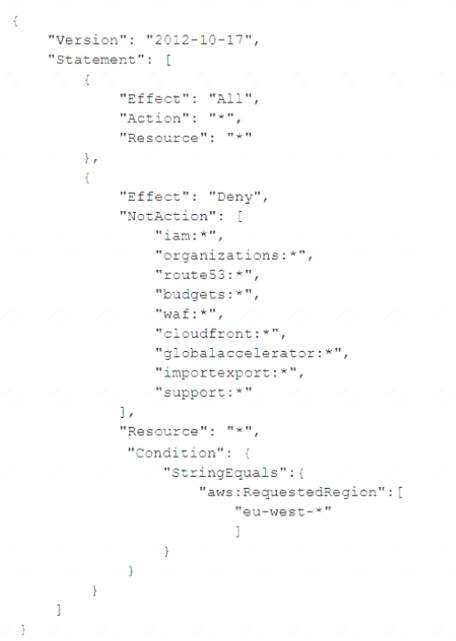
B)
A permission boundary policy is attached to the System Administrator role with the following permission statement: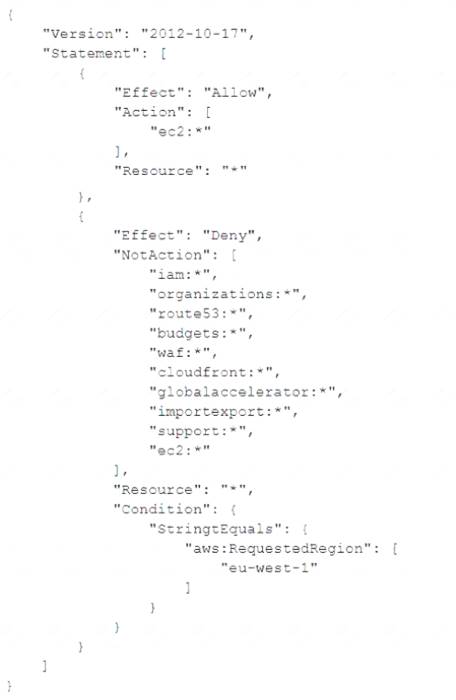
C)
A permission boundary is attached to the System Administrator role with the following permission statement: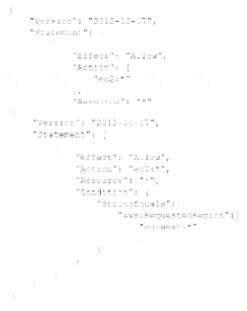
D)
An SCP is attached to the account with the following statement: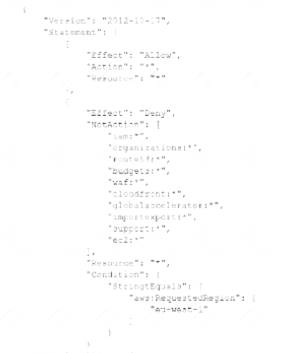
- A. Option A
- B. Option B
- C. Option C
- D. Option D
Answer: B
NEW QUESTION 10
A security engineer is configuring a new website that is named example.com. The security engineer wants to secure communications with the website by requiring users to connect to example.com through HTTPS.
Which of the following is a valid option for storing SSL/TLS certificates?
- A. Custom SSL certificate that is stored in AWS Key Management Service (AWS KMS)
- B. Default SSL certificate that is stored in Amazon CloudFront.
- C. Custom SSL certificate that is stored in AWS Certificate Manager (ACM)
- D. Default SSL certificate that is stored in Amazon S3
Answer: C
NEW QUESTION 11
A company is evaluating the use of AWS Systems Manager Session Manager to gam access to the company's Amazon EC2 instances. However, until the company implements the change, the company must protect the key file for the EC2 instances from read and write operations by any other users.
When a security administrator tries to connect to a critical EC2 Linux instance during an emergency, the security administrator receives the following error. "Error Unprotected private key file - Permissions for' ssh/my_private_key pern' are too open".
Which command should the security administrator use to modify the private key Me permissions to resolve this error?
- A. chmod 0040 ssh/my_private_key pern
- B. chmod 0400 ssh/my_private_key pern
- C. chmod 0004 ssh/my_private_key pern
- D. chmod 0777 ssh/my_private_key pern
Answer: B
Explanation:
The error message indicates that the private key file permissions are too open, meaning that other users can read or write to the file. This is a security risk, as the private key should be accessible only by the owner of the file. To fix this error, the security administrator should use the chmod command to change the permissions of the private key file to 0400, which means that only the owner can read the file and no one else can read or write to it.
The chmod command takes a numeric argument that represents the permissions for the owner, group, and others in octal notation. Each digit corresponds to a set of permissions: read (4), write (2), and execute (1). The digits are added together to get the final permissions for each category. For example, 0400 means that the owner has read permission (4) and no other permissions (0), and the group and others have no permissions at all (0).
The other options are incorrect because they either do not change the permissions at all (D), or they give too much or too little permissions to the owner, group, or others (A, C).
Verified References: https://superuser.com/questions/215504/permissions-on-private-key-in-ssh-folder https://www.baeldung.com/linux/ssh-key-permissions
NEW QUESTION 12
A company needs to use HTTPS when connecting to its web applications to meet compliance requirements. These web applications run in Amazon VPC on Amazon EC2 instances behind an Application Load Balancer (ALB). A security engineer wants to ensure that the load balancer win only accept connections over port 443. even if the ALB is mistakenly configured with an HTTP listener
Which configuration steps should the security engineer take to accomplish this task?
- A. Create a security group with a rule that denies Inbound connections from 0.0.0 0/0 on port 00. Attach this security group to the ALB to overwrite more permissive rules from the ALB's default securitygroup.
- B. Create a network ACL that denies inbound connections from 0 0.0.0/0 on port 80 Associate the network ACL with the VPC s internet gateway
- C. Create a network ACL that allows outbound connections to the VPC IP range on port 443 only.Associate the network ACL with the VPC's internet gateway.
- D. Create a security group with a single inbound rule that allows connections from 0.0.0 0/0 on port 443.Ensure this security group is the only one associated with the ALB
Answer: D
Explanation:
To ensure that the load balancer only accepts connections over port 443, the security engineer should do the following: Create a security group with a single inbound rule that allows connections from 0.0.0.0/0 on port 443.
This means that the security group allows HTTPS traffic from any source IP address. Ensure this security group is the only one associated with the ALB. This means that the security group overrides any other rules that might allow HTTP traffic on port 80.
NEW QUESTION 13
A security engineer needs to implement a solution to create and control the keys that a company uses for cryptographic operations. The security engineer must create symmetric keys in which the key material is generated and used within a custom key store that is backed by an AWS CloudHSM cluster.
The security engineer will use symmetric and asymmetric data key pairs for local use within applications. The security engineer also must audit the use of the keys.
How can the security engineer meet these requirements?
- A. To create the keys use AWS Key Management Service (AWS KMS) and the custom key stores with the CloudHSM cluste
- B. For auditing, use Amazon Athena
- C. To create the keys use Amazon S3 and the custom key stores with the CloudHSM cluste
- D. For auditing use AWS CloudTrail.
- E. To create the keys use AWS Key Management Service (AWS KMS) and the custom key stores with the CloudHSM cluste
- F. For auditing, use Amazon GuardDuty.
- G. To create the keys use AWS Key Management Service (AWS KMS) and the custom key stores with the CloudHSM cluste
- H. For auditing, use AWS CloudTrail.
Answer: D
Explanation:
AWS KMS supports asymmetric KMS keys that represent a mathematically related RSA, elliptic curve (ECC), or SM2 (China Regions only) public and private key pair. These key pairs are generated in AWS KMS hardware security modules certified under the FIPS 140-2 Cryptographic Module Validation Program, except in the China (Beijing) and China (Ningxia) Regions. The private key never leaves the AWS KMS HSMs unencrypted. https://docs.aws.amazon.com/kms/latest/developerguide/symmetric-asymmetric.html
NEW QUESTION 14
An international company wants to combine AWS Security Hub findings across all the company's AWS Regions and from multiple accounts. In addition, the company
wants to create a centralized custom dashboard to correlate these findings with operational data for deeper
analysis and insights. The company needs an analytics tool to search and visualize Security Hub findings. Which combination of steps will meet these requirements? (Select THREE.)
- A. Designate an AWS account as a delegated administrator for Security Hu
- B. Publish events to Amazon CloudWatch from the delegated administrator account, all member accounts, and required Regions that are enabled for Security Hub findings.
- C. Designate an AWS account in an organization in AWS Organizations as a delegated administrator for Security Hu
- D. Publish events to Amazon EventBridge from the delegated administrator account, all member accounts, and required Regions that are enabled for Security Hub findings.
- E. In each Region, create an Amazon EventBridge rule to deliver findings to an Amazon Kinesis data strea
- F. Configure the Kinesis data streams to output the logs to a single Amazon S3 bucket.
- G. In each Region, create an Amazon EventBridge rule to deliver findings to an Amazon Kinesis Data Firehose delivery strea
- H. Configure the Kinesis Data Firehose delivery streams to deliver the logs to a single Amazon S3 bucket.
- I. Use AWS Glue DataBrew to crawl the Amazon S3 bucket and build the schem
- J. Use AWS Glue Data Catalog to query the data and create views to flatten nested attribute
- K. Build Amazon QuickSight dashboards by using Amazon Athena.
- L. Partition the Amazon S3 dat
- M. Use AWS Glue to crawl the S3 bucket and build the schem
- N. Use Amazon Athena to query the data and create views to flatten nested attribute
- O. Build Amazon QuickSight dashboards that use the Athena views.
Answer: BDF
Explanation:
The correct answer is B, D, and F. Designate an AWS account in an organization in AWS Organizations as a delegated administrator for Security Hub. Publish events to Amazon EventBridge from the delegated administrator account, all member accounts, and required Regions that are enabled for Security Hub findings. In each Region, create an Amazon EventBridge rule to deliver findings to an Amazon Kinesis Data Firehose delivery stream. Configure the Kinesis Data Firehose delivery streams to deliver the logs to a single Amazon S3 bucket. Partition the Amazon S3 data. Use AWS Glue to crawl the S3 bucket and build the schema. Use Amazon Athena to query the data and create views to flatten nested attributes. Build Amazon QuickSight dashboards that use the Athena views.
According to the AWS documentation, AWS Security Hub is a service that provides you with a comprehensive view of your security state across your AWS accounts, and helps you check your environment against security standards and best practices. You can use Security Hub to aggregate security findings from various sources, such as AWS services, partner products, or your own applications.
To use Security Hub with multiple AWS accounts and Regions, you need to enable AWS Organizations with all features enabled. This allows you to centrally manage your accounts and apply policies across your organization. You can also use Security Hub as a service principal for AWS Organizations, which lets you designate a delegated administrator account for Security Hub. The delegated administrator account can enable Security Hub automatically in all existing and future accounts in your organization, and can view and manage findings from all accounts.
According to the AWS documentation, Amazon EventBridge is a serverless event bus that makes it easy to connect applications using data from your own applications, integrated software as a service (SaaS) applications, and AWS services. You can use EventBridge to create rules that match events from various sources and route them to targets for processing.
To use EventBridge with Security Hub findings, you need to enable Security Hub as an event source in EventBridge. This will allow you to publish events from Security Hub to EventBridge in the same Region. You can then create EventBridge rules that match Security Hub findings based on criteria such as severity, type, or resource. You can also specify targets for your rules, such as Lambda functions, SNS topics, or Kinesis Data Firehose delivery streams.
According to the AWS documentation, Amazon Kinesis Data Firehose is a fully managed service that delivers real-time streaming data to destinations such as Amazon S3, Amazon Redshift, Amazon Elasticsearch Service (Amazon ES), and Splunk. You can use Kinesis Data Firehose to transform and enrich your data before delivering it to your destination.
To use Kinesis Data Firehose with Security Hub findings, you need to create a Kinesis Data Firehose delivery stream in each Region where you have enabled Security Hub. You can then configure the delivery stream to receive events from EventBridge as a source, and deliver the logs to a single S3 bucket as a destination. You can also enable data transformation or compression on the delivery stream if needed.
According to the AWS documentation, Amazon S3 is an object storage service that offers scalability, data availability, security, and performance. You can use S3 to store and retrieve any amount of data from anywhere on the web. You can also use S3 features such as lifecycle management, encryption, versioning, and replication to optimize your storage.
To use S3 with Security Hub findings, you need to create an S3 bucket that will store the logs from Kinesis Data Firehose delivery streams. You can then partition the data in the bucket by using prefixes such as account ID or Region. This will improve the performance and cost-effectiveness of querying the data.
According to the AWS documentation, AWS Glue is a fully managed extract, transform, and load (ETL) service that makes it easy to prepare and load your data for analytics. You can use Glue to crawl your data sources, identify data formats, and suggest schemas and transformations. You can also use Glue Data Catalog as a central metadata repository for your data assets.
To use Glue with Security Hub findings, you need to create a Glue crawler that will crawl the S3 bucket and build the schema for the data. The crawler will create tables in the Glue Data Catalog that you can query using standard SQL.
According to the AWS documentation, Amazon Athena is an interactive query service that makes it easy to analyze data in Amazon S3 using standard SQL. Athena is serverless, so there is no infrastructure to manage, and you pay only for the queries that you run. You can use Athena with Glue Data Catalog as a metadata store for your tables.
To use Athena with Security Hub findings, you need to create views in Athena that will flatten nested attributes in the data. For example, you can create views that extract fields such as account ID, Region, resource type, resource ID, finding type, finding title, and finding description from the JSON data. You can then query the views using SQL and join them with other tables if needed.
According to the AWS documentation, Amazon QuickSight is a fast, cloud-powered business intelligence
service that makes it easy to deliver insights to everyone in your organization. You can use QuickSight to create and publish interactive dashboards that include machine learning insights. You can also use QuickSight to connect to various data sources, such as Athena, S3, or RDS.
To use QuickSight with Security Hub findings, you need to create QuickSight dashboards that use the Athena views as data sources. You can then visualize and analyze the findings using charts, graphs, maps, or tables. You can also apply filters, calculations, or aggregations to the data. You can then share the dashboards with your users or embed them in your applications.
NEW QUESTION 15
A company is using IAM Organizations. The company wants to restrict IAM usage to the eu-west-1 Region for all accounts under an OU that is named "development." The solution must persist restrictions to existing and new IAM accounts under the development OU.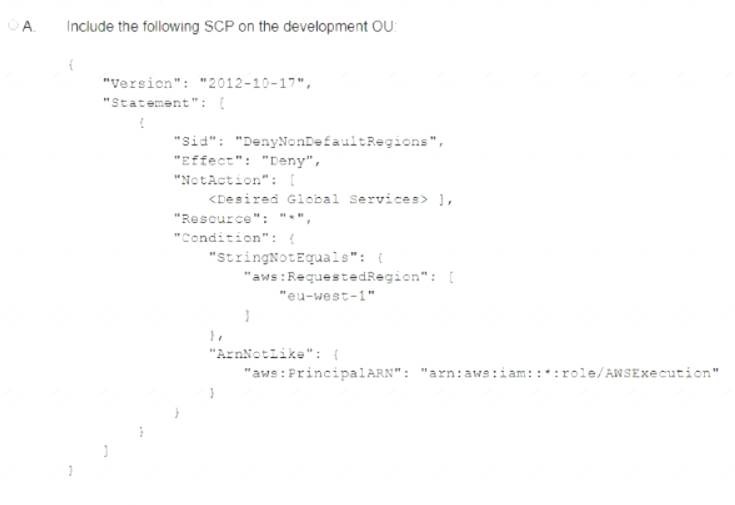
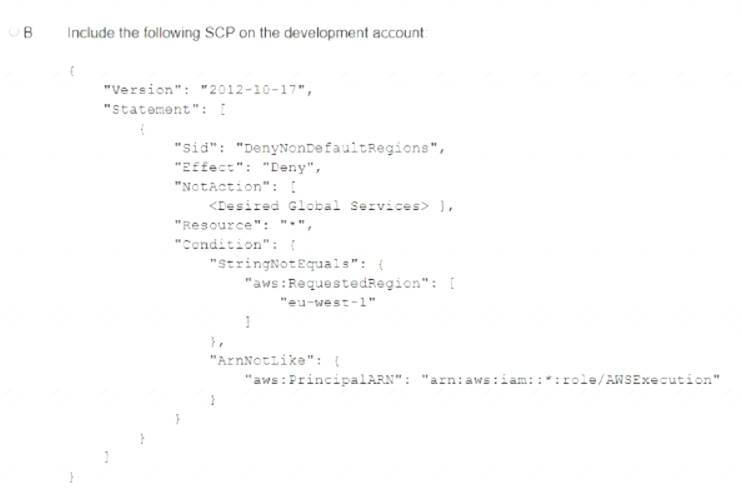
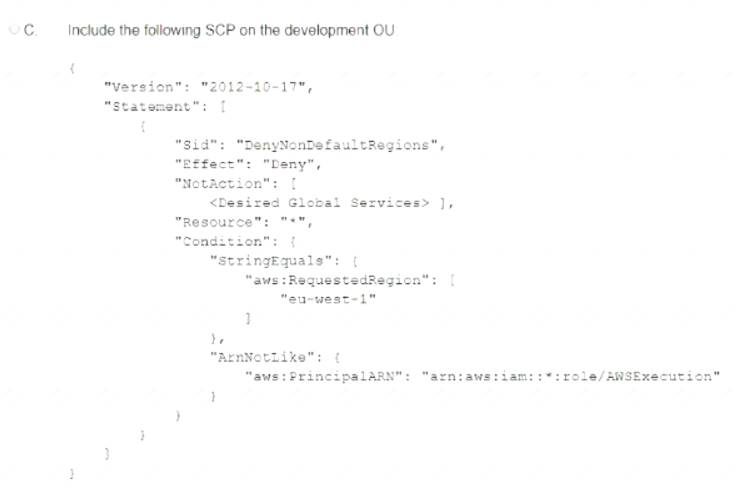
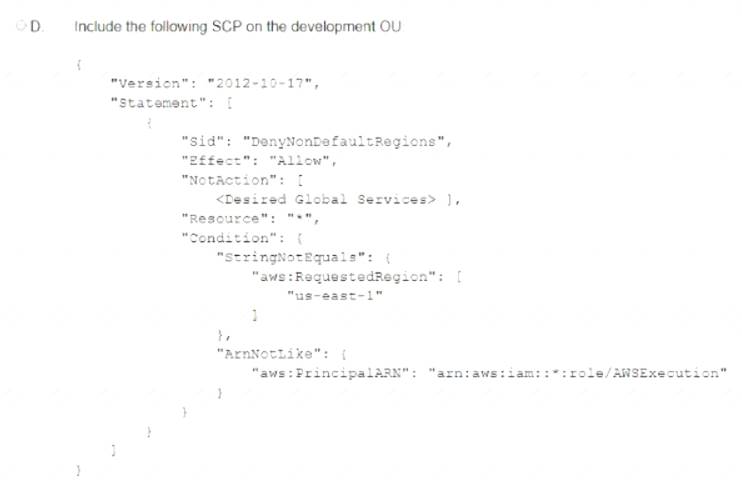
- A. Option A
- B. Option B
- C. Option C
- D. Option D
Answer: A
NEW QUESTION 16
A company is building a data processing application mat uses AWS Lambda functions. The application's Lambda functions need to communicate with an Amazon RDS OB instance that is deployed within a VPC in the same AWS account
Which solution meets these requirements in the MOST secure way?
- A. Configure the DB instance to allow public access Update the DB instance security group to allow access from the Lambda public address space for the AWS Region
- B. Deploy the Lambda functions inside the VPC Attach a network ACL to the Lambda subnet Provide outbound rule access to the VPC CIDR range only Update the DB instance security group to allow traffic from 0.0.0.0/0
- C. Deploy the Lambda functions inside the VPC Attach a security group to the Lambda functions Provide outbound rule access to the VPC CIDR range only Update the DB instance security group to allow traffic from the Lambda security group
- D. Peer the Lambda default VPC with the VPC that hosts the DB instance to allow direct network access without the need for security groups
Answer: C
Explanation:
This solution ensures that the Lambda functions are deployed inside the VPC and can communicate with the Amazon RDS DB instance securely. The security group attached to the Lambda functions only allows
outbound traffic to the VPC CIDR range, and the DB instance security group only allows traffic from the Lambda security group. This solution ensures that the Lambda functions can communicate with the DB instance securely and that the DB instance is not exposed to the public internet.
NEW QUESTION 17
A security engineer needs to build a solution to turn IAM CloudTrail back on in multiple IAM Regions in case it is ever turned off.
What is the MOST efficient way to implement this solution?
- A. Use IAM Config with a managed rule to trigger the IAM-EnableCloudTrail remediation.
- B. Create an Amazon EventBridge (Amazon CloudWatch Events) event with a cloudtrail.amazonIAM.com event source and a StartLogging event name to trigger an IAM Lambda function to call the StartLogging API.
- C. Create an Amazon CloudWatch alarm with a cloudtrail.amazonIAM.com event source and a StopLogging event name to trigger an IAM Lambda function to call the StartLogging API.
- D. Monitor IAM Trusted Advisor to ensure CloudTrail logging is enabled.
Answer: B
NEW QUESTION 18
Auditors for a health care company have mandated that all data volumes be encrypted at rest Infrastructure is deployed mainly via IAM CloudFormation however third-party frameworks and manual deployment are required on some legacy systems
What is the BEST way to monitor, on a recurring basis, whether all EBS volumes are encrypted?
- A. On a recurring basis, update an IAM user policies to require that EC2 instances are created with an encrypted volume
- B. Configure an IAM Config rule lo run on a recurring basis 'or volume encryption
- C. Set up Amazon Inspector rules tor volume encryption to run on a recurring schedule
- D. Use CloudWatch Logs to determine whether instances were created with an encrypted volume
Answer: B
Explanation:
To support answer B, use the reference https://d1.IAMstatic.com/whitepapers/IAM-security-whitepaper.pdf "For example, IAM Config provides a managed IAM Config Rules to ensure that encryption is turned on for
all EBS volumes in your account."
NEW QUESTION 19
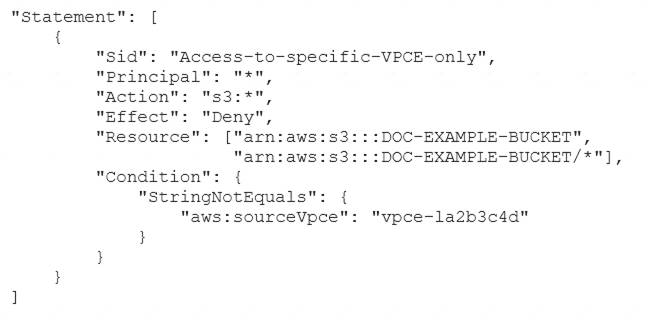
A security engineer needs to configure an Amazon S3 bucket policy to restrict access to an S3 bucket that is named DOC-EXAMPLE-BUCKET. The policy must allow access to only DOC-EXAMPLE-BUCKET from only the following endpoint: vpce-1a2b3c4d. The policy must deny all access to DOC-EXAMPLE-BUCKET if the specified endpoint is not used.
Which bucket policy statement meets these requirements?
- A. A computer code with black text Description automatically generated
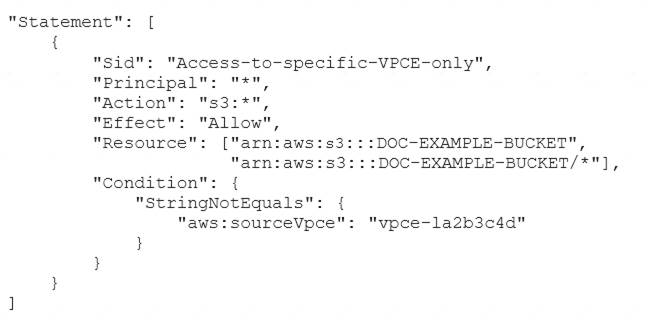
- B. A computer code with black text Description automatically generated
- C. A computer code with black text Description automatically generated
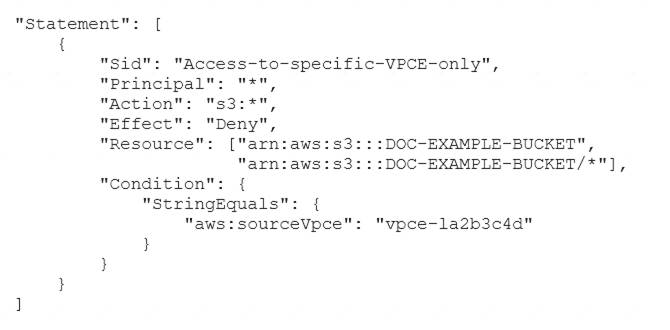
- D. A computer code with black text Description automatically generated
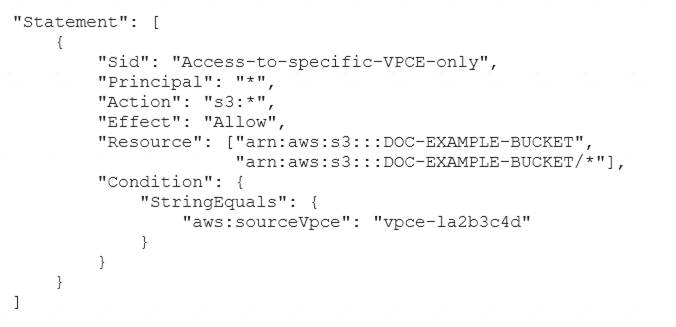
Answer: B
Explanation:
https://docs.aws.amazon.com/AmazonS3/latest/userguide/example-bucket-policies-vpc-endpoint.html
NEW QUESTION 20
......
P.S. Easily pass AWS-Certified-Security-Specialty Exam with 372 Q&As Thedumpscentre.com Dumps & pdf Version, Welcome to Download the Newest Thedumpscentre.com AWS-Certified-Security-Specialty Dumps: https://www.thedumpscentre.com/AWS-Certified-Security-Specialty-dumps/ (372 New Questions)