Your success in Microsoft AZ-140 is our sole target and we develop all our AZ-140 braindumps in a way that facilitates the attainment of this target. Not only is our AZ-140 study material the best you can find, it is also the most detailed and the most updated. AZ-140 Practice Exams for Microsoft AZ-140 are written to the highest standards of technical accuracy.
Online AZ-140 free questions and answers of New Version:
NEW QUESTION 1
You have a Windows Virtual Desktop deployment.
You need to provide external users with access to the deployment. The external users have computers that run Windows 10 Pro and Windows 10 Enterprise. The users do not have the ability to install applications.
What should you recommend that the users use to connect to the deployment?
- A. Microsoft Edge
- B. RemoteApp and Desktop Connection
- C. Remote Desktop Manager
- D. Remote Desktop Connection
Answer: A
Explanation:
Reference:
https://docs.microsoft.com/en-us/azure/active-directory/governance/entitlement-management-external-users
https://docs.microsoft.com/en-us/azure/virtual-desktop/connect-web
NEW QUESTION 2
You have a Azure Virtual Desktop deployment.
In Azure Advisor, you discover the following recommendation related to Azure Virtual Desktop:
• Impact Medium
• Description: No validation environment enabled
• Potential Benefit Ensure business continuity through AVD service deployments
• Impacted Resource:1 Host Pool
What can you validate by implementing the recommendations?
- A. Capacity requirements of the session hosts
- B. Security settings of Azure Virtual Desktop
- C. Preview features for Azure Virtual Desktop
- D. Azure Site Recovery failover of the session hosts
Answer: D
Explanation:
Validation environments are used to test and validate Azure Virtual Desktop
deployments before they are made available to users. This can include testing the capacity of the session hosts, the performance of the deployment, and the configuration of security settings. By implementing a validation environment, you can ensure that the Azure Virtual Desktop deployment is working correctly and that there are no issues that could impact business continuity. This can help to ensure a smooth user experience and minimize downtime.
NEW QUESTION 3
HOTSPOT
You have an Azure Virtual Desktop host pool that contains 10 session hosts.
You plan to configure each session host to use an FSLogix profile container that will exclude specific folders in the user profile.
You need to perform the following configurations:
• Create a configuration file to list the excluded profile folders.
• Identify which registry setting will distribute the file to each session host automatically.
What should you name the configuration file, and which registry setting should you identify?
NOTE: Each correct selection is worth one point.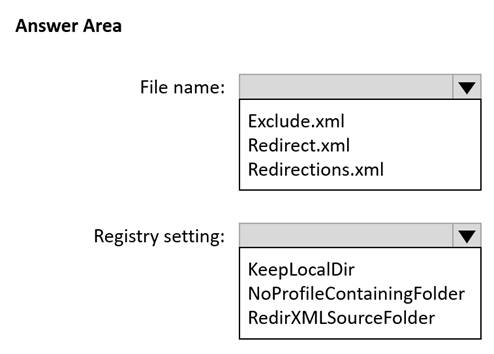
Solution:
Graphical user interface, text, application Description automatically generated
Does this meet the goal?
- A. Yes
- B. Not Mastered
Answer: A
NEW QUESTION 4
You have an Azure Virtual Desktop deployment.
You plan to create a new host pool named Pool1 that will contain five Windows 11 session hosts.
You need to enable secure boot and vTPM on the session hosts. How should you configure the Virtual Machines settings?
- A. Enable encryption at rest and a platform-managed key.
- B. Enable a system-assigned managed identity.
- C. Set Network security group to Advanced.
Answer: B
NEW QUESTION 5
You have an on-premises network and an Azure subscription. The subscription contains the following:
• A virtual network
• An Azure Firewall instance
• A Azure Virtual Desktop host pool
The virtual network connects to the on-premises network by using a site-to-site VPN.
You need to ensure that only users from the on-premises network can connect to the Azure Virtual Desktop managed resources in the host pool. The solution must minimize administrator effort.
What should you configure?
- A. an Azure Firewall rule
- B. a conditional access policy
- C. a network security group (NSG) rule
- D. a user-defined route
Answer: A
NEW QUESTION 6
You have an Azure Virtual Desktop deployment.
The session hosts are joined to an on-premises Active Directory domain named contoso.com.
You need to limit user sessions to three hours. What should you configure?
- A. a Group Policy Object (GPO) in contoso.com.
- B. the properties of the workspace
- C. the RDP Properties of a host pool
- D. just-in-time (JIT) VM access
Answer: A
NEW QUESTION 7
Your network contains an on-premises Active Directory domain named contoso.com. You have an Azure subscription that contains the resources shown in the following table.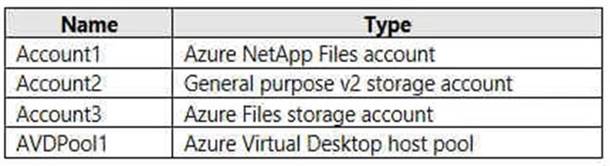
You need to create a share that will host FSLogix profiles for AVDPool1. The solution must meet the following requirements:
* Maximize read and write performance for the profiles.
* Control access to the SMB share by using the users and groups stored in contoso.com. Which account should you use to host the share?
- A. Account1
- B. Account2
- C. Account3
Answer: A
Explanation:
https://learn.microsoft.com/en-us/azure/storage/files/storage-files-netapp-comparison
NEW QUESTION 8
You have an Azure subscription. The subscription contains a virtual machine named Server1 that runs Windows Server and is deployed to the West US Azure region.
You deploy a new Azure Virtual Desktop host pool named HostPool1 to the East US Azure region.
You need to ensure that all the traffic between HostPool1 and Server1 is routed via the Microsoft backbone network.
What should you use?
- A. service endpoints
- B. virtual network peering
- C. routing tables
- D. Azure Traffic Manager
Answer: A
Explanation:
"Virtual Network (VNet) service endpoint provides secure and direct connectivity to Azure services over an optimized route over the Azure backbone network." https://learn.microsoft.com/en-us/azure/virtual-network/virtual-network-service-endpoints- overview
NEW QUESTION 9
You have an Azure Virtual Desktop host pool.
You add a French language pack to each session host in the host pool.
Several days later, users report that English displays when they connect to Azure Virtual Desktop.
After an investigation, you discover that the French language pack was removed, and the session hosts reverted to English.
You need to ensure that the French language pack is always available on the session hosts.
What should you do?
- A. Apply a Group Policy setting that blocks the cleanup of unused language packs.
- B. Apply a Group Policy setting to disable the Time & language settings.
- C. Configure the international settings on each host.
- D. Assign a default time zone on each host.
Answer: B
Explanation:
https://docs.microsoft.com/en-us/windows-hardware/manufacture/desktop/languages-overview?view=windows-11#block-cleanup-of- unused-language-packs
NEW QUESTION 10
You have an Azure Active Directory Domain Services (Azure AD DS) managed domain named conioso.com.
You create a Azure Virtual Desktop host pool named Pool1. You assign the Virtual Machine Contributor role for the Azure subscription to a user named Admin1.
You need to ensure that Admin1 can add session hosts to Pool1. The solution must use the principle of least privilege.
Which two actions should you perform? Each correct answer presents part of the solution. NOTE: Each correct selection is worth one point.
- A. Add Admin1 to the AAD DC Administrators group.
- B. Assign a Microsoft 36S Enterprise E3 license to Admin1.
- C. Assign Admin1 the Desktop Virtualization Session Host Operator role tor Pool1.
- D. Assign Admin1 the Desktop Virtualization Host Pool Contributor role for Pool1.
- E. Generate a registration token.
Answer: CE
Explanation:
Reference:
https://docs.microsoft.com/en-us/azure/virtual-desktop/rbac
NEW QUESTION 11
You have an Azure Virtual Desktop host pool named Pool1. Pool1 contains session hosts that have a third-party application named App1. App1 is published by using a RemoteApp group.
A new MSI-based version of App1 is installed each month to each host. The name of the executable file is different for each version of App1.
You need to automate the process of making a new version of App1 available via RemoteApp. The process must ensure that the user experience remains the same when launching the application from the Windows Desktop client.
Which two cmdlets should you run? Each correct answer presents part of the solution.
NOTE: Each correct selection is worth one point.
- A. Remove-AzWvdApplication
- B. New-AzWvdApplicacionGroup
- C. New-AzWvdMsixPackage
- D. New-AzRoleAssignmenc
- E. Remove-AzWvdMsixPackage
Answer: BD
Explanation:
Reference:
https://docs.microsoft.com/en-us/azure/virtual-desktop/what-is-app-attach
https://docs.microsoft.com/en-us/powershell/module/az.desktopvirtualization/new- azwvdapplication?view=azps-6.4.0
NEW QUESTION 12
DRAG DROP
You have an Azure Virtual Desktop host pool named Pool1.
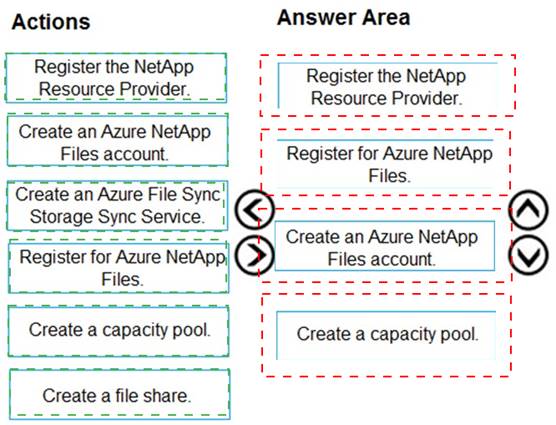
You need to ensure that you can create an Azure NetApp Files volume that will host user profiles for Pool1.
Which four actions should you perform in sequence? To answer, move the appropriate actions from the list of actions to the answer area and arrange them in the correct order.
NOTE: More than one order of answer choices is correct. You will receive credit for any of the correct orders you select.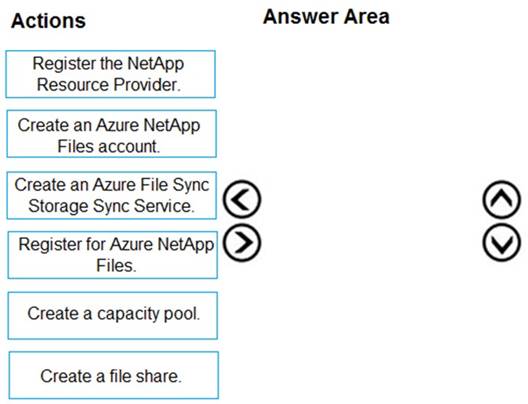
Solution:
Does this meet the goal?
- A. Yes
- B. Not Mastered
Answer: A
NEW QUESTION 13
Which three PowerShell modules should you install on Server1 to meet the technical requirements? Each correct answer presents part of the solution.
NOTE: Each correct selection is worth one point.
- A. Pester
- B. RemoteDesktop
- C. ServerManager
- D. ActiveDirectory
- E. Hyper-V
Answer: ADE
Explanation:
Contoso identifies the following technical requirements:
✑ From a server named Server1, convert the user profile disks to the FSLogix profile containers.
The PowerShell modules for Hyper-V, Active Directory, and Pester are prerequisites to running the cmdlets to convert user profile disks to FSLogix.
Reference:
https://docs.microsoft.com/en-us/azure/cloud-adoption-framework/migrate/azure-best-
NEW QUESTION 14
HOTSPOT
You have an Azure Virtual Desktop host pool named HostPool1 that must support 60 sessions.
The session hosts for HostPool1 are configured as shown in the following exhibit.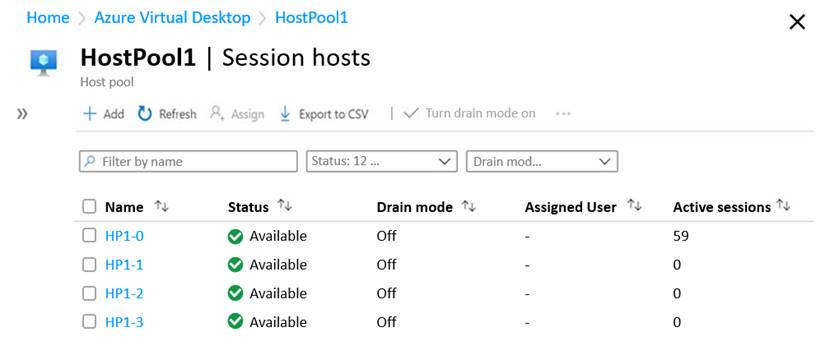
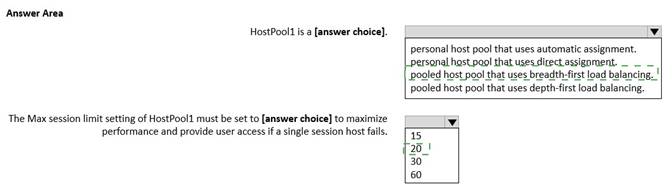
Use the drop-down menus to select the answer choice that completes each statement based on the information presented in the graphic.
NOTE: Each correct selection is worth one point.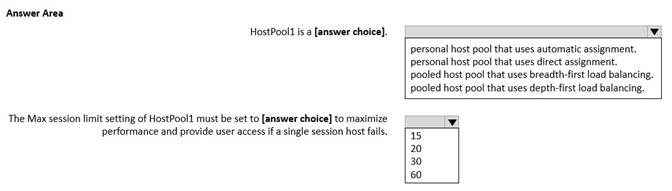
Solution:
Does this meet the goal?
- A. Yes
- B. Not Mastered
Answer: A
NEW QUESTION 15
You have the devices shown in the following table.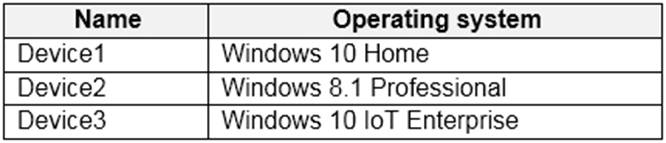
You plan to deploy Windows Virtual Desktop for client access to remove virtualized apps. Which devices support the Remote Desktop client?
- A. Device1 and Device2 only
- B. Device1 and Device3 only
- C. Device1, Device2, and Device3
- D. Device1 only
Answer: B
Explanation:
Reference:
https://docs.microsoft.com/en-us/windows-server/remote/remote-desktop-services/clients/windowsdesktop
Applies to: Windows 10, Windows 10 IoT Enterprise, and Windows 7
You can use the Remote Desktop client for Windows Desktop to access Windows apps and desktops remotely from a different Windows device.
The new Remote Desktop client (MSRDC) supports Windows 10, Windows 10 IoT Enterprise, and Windows 7 client devices:
Windows 64-bit Windows 32-bit Windows ARM64
NEW QUESTION 16
You have an Azure Virtual Desktop deployment. You plan to use FSLogix profile containers.
You need to recommend a solution that will be used to store the containers. The solution must meet the following requirements:
* The containers must be stored on solid-state drives (SSDs)
* Minimize administrative effort
* Minimize cost
the What should you recommend?
- A. Azure NetApp Files
- B. Azure Files Standard
- C. Azure Blob Storage Premium
- D. Azure Files Premium
Answer: D
Explanation:
"Use Azure Files for FSLogix user profile data with Azure Virtual Desktop Azure Files provides multiple tiers that you can select based on your cost and performance needs."
- https://azure.microsoft.com/en-us/services/storage/files/#security
"Premium file shares enable highly I/O-intensive workloads, with high throughput and low latency. Premium file shares are offered on high-performance solid-state drive (SSD) based storage."
- https://azure.microsoft.com/en-us/pricing/details/storage/files/
NEW QUESTION 17
HOTSPOT
You have two Azure subscriptions that are linked to an Azure Active Directory (Azure AD) tenant named contoso.com and contain an Azure Virtual Desktop deployment. The tenant contains a user named User1.
When User1 signs in to Azure Security Center, the user receives the message shown in the following exhibit.
You need to ensure that User1 can manage security information for the tenant. The solution must use the principle of least privilege.
What should you do? To answer, select the appropriate options in the answer area. NOTE: Each correct selection is worth one point.
Hot Area: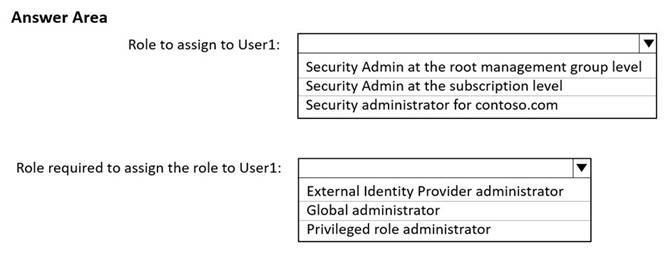
Solution:
Graphical user interface, text, application Description automatically generated
Does this meet the goal?
- A. Yes
- B. Not Mastered
Answer: A
NEW QUESTION 18
......
Thanks for reading the newest AZ-140 exam dumps! We recommend you to try the PREMIUM Certshared AZ-140 dumps in VCE and PDF here: https://www.certshared.com/exam/AZ-140/ (190 Q&As Dumps)