
It is impossible to pass Microsoft AZ-400 exam without any help in the short term. Come to Examcollection soon and find the most advanced, correct and guaranteed Microsoft AZ-400 practice questions. You will get a surprising result by our Most up-to-date Microsoft Azure DevOps Solutions (beta) practice guides.
Online Microsoft AZ-400 free dumps demo Below:
NEW QUESTION 1
You have a Microsoft ASP.NET Core web app in Azure that is accessed worldwide.
You need to run a URL ping test once every five minutes and create an alert when the web app is unavailable from specific Azure regions. The solution must minimize development time.
What should you do?
- A. Create an Azure Application Insights availability test and alert.
- B. Create an Azure Service Health alert for the specific regions.
- C. Create an Azure Monitor Availability metric and alert
- D. Write an Azure function and deploy the function to the specific regions.
Answer: A
Explanation:
There are three types of Application Insights availability tests:
✑ URL ping test: a simple test that you can create in the Azure portal.
✑ Multi-step web test
✑ Custom Track Availability Tests
Note: After you've deployed your web app/website, you can set up recurring tests to monitor availability and responsiveness. Azure Application Insights sends web requests to your application at regular intervals from points around the world. It can alert you if your application isn't responding, or if it responds too slowly.
You can set up availability tests for any HTTP or HTTPS endpoint that is accessible from the public internet. You don't have to make any changes to the website you're testing. In fact, it doesn't even have to be a site you own. You can test the availability of a REST API that your service depends on.
Reference:
https://docs.microsoft.com/en-us/azure/azure-monitor/app/monitor-web-app-availability#create-a-url-ping-test
NEW QUESTION 2
You manage an Azure web app that supports an e-commerce website.
You need to increase the logging level when the web app exceeds normal usage patterns. The solution must minimize administrative overhead.
Which two resources should you include in the solution? Each correct answer presents part of the solution.
NOTE: Each correct selection is worth one point.
- A. an Azure Monitor alert that has a dynamic threshold
- B. an Azure Automation runbook
- C. an Azure Monitor alert that uses an action group that has an email action
- D. the Azure Monitor autoscale settings
- E. an Azure Monitor alert that has a static threshold
Answer: BC
NEW QUESTION 3
HOTSPOT
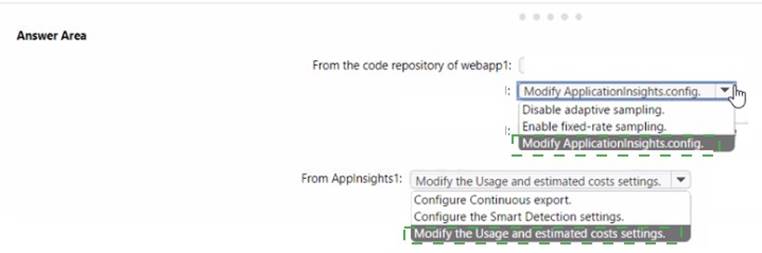
You have an Azure web app named webapp1 that uses the .NET Core runtime slack. You have an Azure Application insights resource named Applnsights1 that collects telemetry data generated by webapp1
You plan to deploy webapp1 by using an Azure DevOps pipeline.
You need to modify the sampling rate of the telemetry data processed by Applnsights1 without having to redeploy webapp1 after each modification.
What should you do? To answer, select the appropriate options in the answer area. NOTE: Each correct selection is worth one point.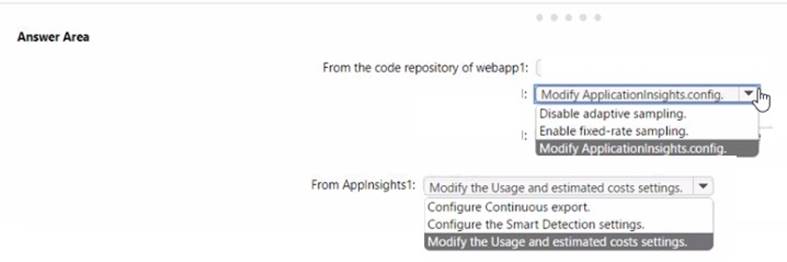
Solution:
Does this meet the goal?
- A. Yes
- B. Not Mastered
Answer: A
NEW QUESTION 4
After you answer a question in this section, you will NOT be able to return to it As a result, these questions will not appear in the review screen.
You use Azure Pipelines to build and test a React js application You have a pipeline that has a single job.
You discover that installing JavaScript packages from npm lakes approximately five minutes each time you run the pipeline.
You need to recommend a solution to reduce the pipeline execution time. Solution: You recommend enabling pipeline caching.
Does this meet the goal?
- A. Yes
- B. No
Answer: A
Explanation:
npm-cache is a command line utility that caches dependencies installed via npm, bower, jspm and composer.
It is useful for build processes that run [npm|bower|composer|jspm] install every time as part of their build process. Since dependencies don't change often, this often means slower build times. npm-cache helps alleviate this problem by caching previously installed dependencies on the build machine.
Reference: https://www.npmjs.com/package/npm-cache
NEW QUESTION 5
HOTSPOT
You company uses Azure DevOps to deploy infrastructures to Azure. Pipelines are developed by using YAML.
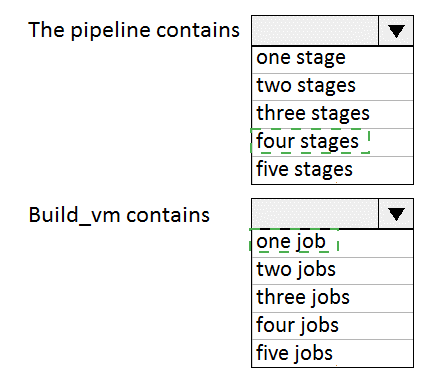
You execute a pipeline and receive the results in the web portal for Azure Pipelines as shown in the following exhibit.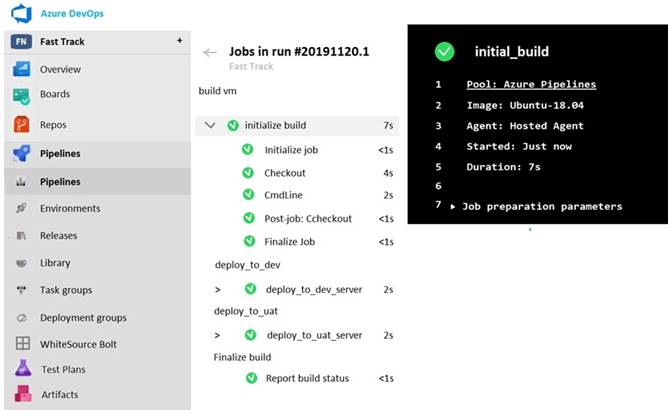
Use the drop-down menus to select the answer choice that completes each statement based on the information presented in the graphic.
NOTE: Each correct selection is worth one point.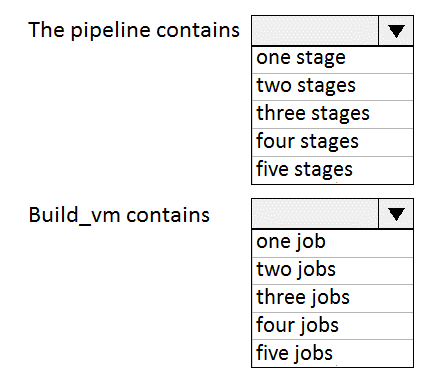
Solution:
Does this meet the goal?
- A. Yes
- B. Not Mastered
Answer: A
NEW QUESTION 6
You have a project in Azure DevOps named Project1. Project1 contains a published wiki.
You need to change the order of pages in the navigation pane of the published wiki in the Azure DevOps portal.
What should you do?
- A. At the root of the wiki, create a file named order that defines the page hierarchy.
- B. At the root of the wiki, create a file named wiki.md that defines the page hierarchy.
- C. Rename the pages in the navigation pane.
- D. Drag and drop the pages in the navigation pane.
Answer: D
Explanation:
Reorder a wiki page
You can reorder pages within the wiki tree view to have pages appear in the order and hierarchy you want. You can drag-and-drop a page title in the tree view to do the following operations:
Change the parent-child relationship of a page Change the order of the page within the hierarchy Reference:
https://docs.microsoft.com/en-us/azure/devops/project/wiki/add-edit-wiki
NEW QUESTION 7
Note: This question is part of a series of questions that present the same scenario. Each question in the series contains a unique solution that might meet the stated goals. Some question sets might have more than one correct solution, while others might not have a correct solution.
After you answer a question in this section, you will NOT be able to return to it as a result, these questions will not appear in the review screen.
You have an Azure pipeline that is used to deploy a web app. The pipeline includes a test suite named TestSuite1. TestSuite1 is used to validate the operations of the web app.
TestSuite1 fails intermittently.
You identify that the failures are unrelated to changes in the source code and execution environment.
You need to minimize troubleshooting effort for the TestSuite1 failures. Solution: You enable flaky test management.
Does this meet the goal?
- A. Yes
- B. No
Answer: A
NEW QUESTION 8
You use Azure Pipelines to manage build pipelines. GitHub to store source code, and Dependabot to manage dependencies.
You have an app named App1.
Dependabot detects a dependency in App1 that requires an update. What should you do first to apply the update?
- A. Perform a commit.
- B. Create a pull request.
- C. Approve the pull request
- D. Create a branch.
Answer: C
Explanation:
DependaBot is a useful tool to regularly check for dependency updates. By helping to keep your project up to date, DependaBot can reduce technical debt and immediately apply security vulnerabilities when patches are released. How does DependaBot work?
✑ DependaBot regularly checks dependencies for updates
✑ If an update is found, DependaBot creates a new branch with this upgrade and Pull Request for approval
✑ You review the new Pull Request, ensure the tests passed, review the code, and decide if you can merge the change
Reference:
https://samlearnsazure.blog/2019/12/20/github-using-dependabot/
NEW QUESTION 9
DRAG DROP
Your company plans to deploy an application to the following endpoints:
• Ten virtual machines hosted in Azure.
• Ten virtual machines hosted in an on-premises data center environment All the virtual machines have the- Azure Pipelines agent.
You need to implement a release strategy for deploying the application to the endpoints.
What should you recommend using to deploy the application to the endpoints? To answer, drag the appropriate components to the correct endpoint.
Each component may be used once, more than once, or not at all. You may need to drag the split bar between panes or soon to view content
NOTE: Each correct selection n worth one point.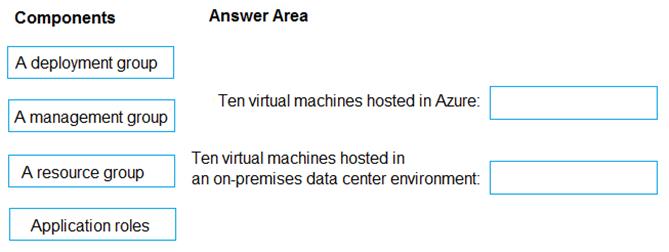
Solution:
Box 1: A deployment group
When authoring an Azure Pipelines or TFS Release pipeline, you can specify the deployment targets for a job using a deployment group.
If the target machines are Azure VMs, you can quickly and easily prepare them by installing the Azure Pipelines Agent Azure VM extension on each of the VMs, or by using the Azure Resource Group Deployment task in your release pipeline to create a deployment group dynamically.
Box 2: A deployment group
References: https://docs.microsoft.com/en-us/azure/devops/pipelines/release/deployment- groups
Does this meet the goal?
- A. Yes
- B. Not Mastered
Answer: A
NEW QUESTION 10
DRAG DROP
You have an Azure Repos repository named repo1. You delete a branch named features/feature11. You need to recover the deleted branch.
Which three commands should you run in sequence? To answer, move the appropriate commands from the list of commands to the answer area and arrange them in the correct order.
Solution:

Does this meet the goal?
- A. Yes
- B. Not Mastered
Answer: A
NEW QUESTION 11
DRAG DROP
Your company has a project in Azure DevOps named Project1. All the developers at the company have Windows 10 devices.
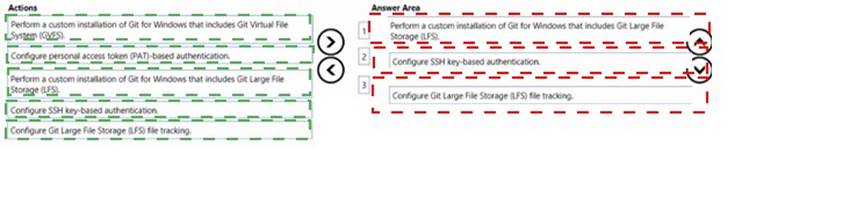
You need to create a Get repository for Project1. The solution must meet the following requirements:
• Support large binary files.
• Store binary files outside of the repository.
• Use a standard Get workflow to maintain the metadata of the binary files by using commits to the repository.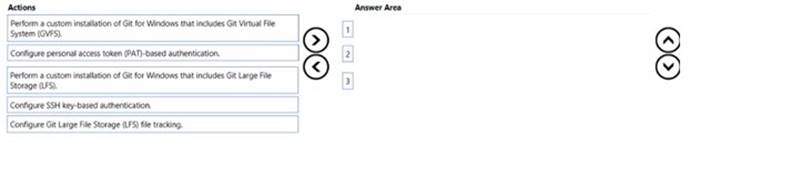
Solution:
Does this meet the goal?
- A. Yes
- B. Not Mastered
Answer: A
NEW QUESTION 12
DRAG DROP
You need to use Azure Automation Sure Configuration to manage the ongoing consistency of virtual machine configurations.
Which five actions should you perform in sequence? To answer, move the appropriate actions from the list of actions to the answer area and arrange them in the correct order.
NOTE: More than one order of answer choices in correct. You writ receive credit for any of the orders you select.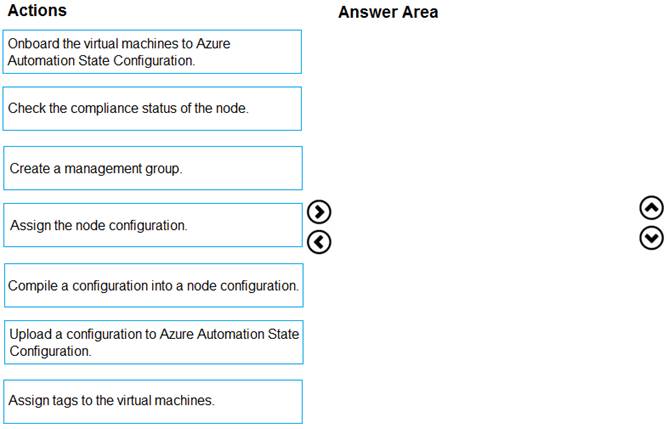
Solution:
Step 1: Assign the node configuration.
You create a simple DSC configuration that ensures either the presence or absence of the Web-Server Windows Feature (IIS), depending on how you assign nodes.
Step 2: Upload a configuration to Azure Automation State Configuration. You import the configuration into the Automation account.
Step 3: Compiling a configuration into a node configuration Compiling a configuration in Azure Automation
Before you can apply a desired state to a node, a DSC configuration defining that state must be compiled into one or more node configurations (MOF document), and placed on the Automation DSC Pull Server.
Step 4: Onboard the virtual machines to Azure State Configuration
Onboarding an Azure VM for management with Azure Automation State Configuration
Step 5: Check the compliance status of the node.
Viewing reports for managed nodes. Each time Azure Automation State Configuration performs a consistency check on a managed node, the node sends a status report back to the pull server. You can view these reports on the page for that node.
On the blade for an individual report, you can see the following status information for the corresponding consistency check:
The report status — whether the node is "Compliant", the configuration "Failed", or the node is "Not Compliant" (when the node is in ApplyandMonitor mode and the machine is not in the desired state).
References: https://docs.microsoft.com/en-us/azure/automation/automation-dsc-getting- started
Does this meet the goal?
- A. Yes
- B. Not Mastered
Answer: A
NEW QUESTION 13
DRAG DROP
You need to recommend project metrics for dashboards in Azure DevOps.
Which chart widgets should you recommend for each metric? To answer, drag the appropriate chart widgets to the correct metrics. Each chart widget may be used once, more than once, or not at all. You may need to drag the split bar between panes or scroll to view content.
NOTE: Each correct selection is worth one point.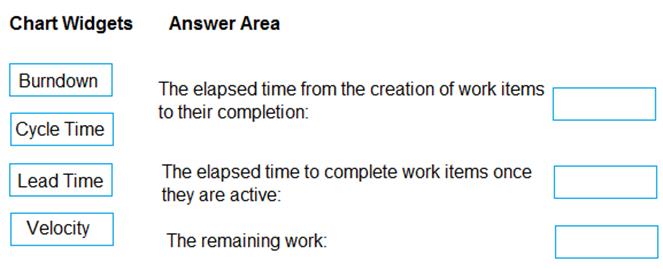
Solution:
Box 1: Lead time
Lead time measures the total time elapsed from the creation of work items to their completion.
Box 2: Cycle time
Cycle time measures the time it takes for your team to complete work items once they begin actively working on them.
Box 3: Burndown
Burndown charts focus on remaining work within a specific time period.
Does this meet the goal?
- A. Yes
- B. Not Mastered
Answer: A
NEW QUESTION 14
You add the virtual machines as managed nodes in Azure Automation State Configuration. You need to configure the computer in Group7.
What should you do?
- A. Run the Register-AzureRmAutomationDscNode Azure Powershell cmdlet.
- B. Modify the ConfigurationMode property of the Local Configuration Manager (LCM).
- C. Install PowerShell Core.
- D. Modify the RefreshMode property of the Local Configuration Manager (LCM).
Answer: A
Explanation:
The Register-AzureRmAutomationDscNode cmdlet registers an Azure virtual machine as an APS Desired State Configuration (DSC) node in an Azure Automation account.
Scenario: The Azure DevOps organization includes: The Docker extension
A deployment pool named Pool7 that contains 10 Azure virtual machines that run Windows Server 2016
References: https://docs.microsoft.com/en- us/powershell/module/azurerm.automation/register-azurermautomationdscnode
NEW QUESTION 15
You have a project in Azure DevOps named Project1 that contains two environments named environment1 and envkonment2.
When a new version of Project1 is released, the latest version is deployed to environment2, and the previous version is redeployed to environments
You need to distribute users across the environments. The solution must meet the following requirements:
• New releases must be available to only a subset of the users.
• You must gradually increase the number of users that can access environment2. What should you use?
- A. web app deployment slots
- B. Azure Traffic Manager
- C. VIP swapping
- D. Azure Load Balancer
Answer: A
NEW QUESTION 16
......
Thanks for reading the newest AZ-400 exam dumps! We recommend you to try the PREMIUM Dumpscollection.com AZ-400 dumps in VCE and PDF here: https://www.dumpscollection.net/dumps/AZ-400/ (509 Q&As Dumps)