
High value of AZ-400 actual test materials and dumps for Microsoft certification for IT engineers, Real Success Guaranteed with Updated AZ-400 pdf dumps vce Materials. 100% PASS Microsoft Azure DevOps Solutions (beta) exam Today!
Check AZ-400 free dumps before getting the full version:
NEW QUESTION 1
You are building a Microsoft ASP.NET application that requires authentication.
You need to authenticate users by using Azure Active Directory (Azure AD). What should you do first?
- A. Create a membership database in an Azure SQL database.
- B. Assign an enterprise application to users and groups.
- C. Create an app registration in Azure AD.
- D. Configure the application to use a SAML endpoint.
- E. Create a new OAuth token from the application.
Answer: C
Explanation:
Register your application to use Azure Active Directory. Registering the application means that your developers can use Azure AD to authenticate users and request access to user resources such as email, calendar, and documents.
Reference:
https://docs.microsoft.com/en-us/azure/active-directory/manage-apps/developer-guidance- for-integrating-applications
https://docs.microsoft.com/en-us/azure/active-directory/develop/quickstart-v2-aspnet- webapp
NEW QUESTION 2
You have an Azure subscription that contains multiple Azure pipelines.
You need to deploy a monitoring solution for the pipelines. The solution must meet the following requirements:
• Parse togs from multiple sources
• Identify the root cause of issues.
What advanced feature of a monitoring tool should you include in the solution?
- A. synthetic monitoring
- B. Alert Management
- C. analytics
- D. directed monitoring
Answer: C
Explanation:
An analytics feature in a monitoring solution would allow you to parse logs from multiple sources and analyze them to identify the root cause of issues in your Azure pipelines. This feature would typically provide tools for searching, filtering, and visualizing log data, as well as for identifying patterns and anomalies. With analytics, you can also create custom dashboards and alerts to monitor your pipelines and quickly identify and troubleshoot any issues.
NEW QUESTION 3
DRAG DROP
You need to find and isolate shared code. The shared code will be maintained in a series of packages.
Which three actions should you perform in sequence? To answer, move the appropriate actions from the list of actions to the answer area and arrange them in the correct order.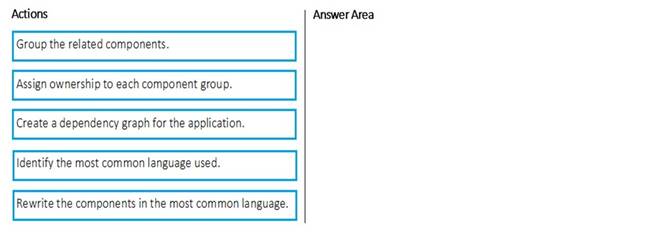
Solution:
Step 1: Create a dependency graph for the application
By linking work items and other objects, you can track related work, dependencies, and changes made over time. All links are defined with a specific link type. For example, you can use Parent/Child links to link work items to support a hierarchical tree structure. Whereas, the Commit and Branch link types support links between work items and commits and branches, respectively.
Step 2: Group the related components.
Packages enable you to share code across your organization: you can compose a large
product, develop multiple products based on a common shared framework, or create and share reusable components and libraries.
Step 3: Assign ownership to each component graph References:
https://docs.microsoft.com/en-us/azure/devops/boards/queries/link-work-items-support-
traceability?view=azure-devops&tabs=new-web-form https://docs.microsoft.com/en-us/visualstudio/releasenotes/tfs2017-relnotes
Does this meet the goal?
- A. Yes
- B. Not Mastered
Answer: A
NEW QUESTION 4
HOTSPOT
You have an Azure web app named Webapp1.
You need to use an Azure Monitor query to create a report that details the top 10 pages of Webapp1 that failed.
How should you complete the query? To answer, select the appropriate options in the answer area.
NOTE: Each correct selection is worth one point.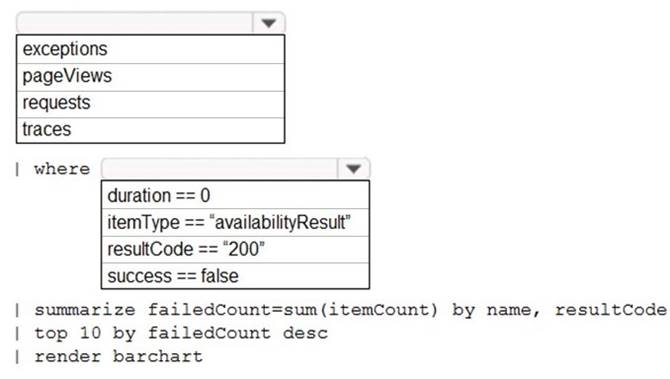
Solution:
Box 1: requests
Failed requests (requests/failed):
The count of tracked server requests that were marked as failed. Kusto code:
requests
| where success == 'False' Box 2: success == false
Does this meet the goal?
- A. Yes
- B. Not Mastered
Answer: A
NEW QUESTION 5
DRAG DROP
You need to configure access to Azure DevOps Agent pools to meet the forwarding requirements:
• Use a project agent pool when authoring build release pipelines.
• View the agent pool and agents of the organization.
• Use the principle of least privilege.
Which role memberships are required for the Azure 0e%Oos organization and the project? To answer, drag the appropriate role membership to the correct targets. Each role membership may be used once, more than once, or not at all. You may need to drag the split bar between panes or scroll to content
NOTE: Each correct selection is worth one point.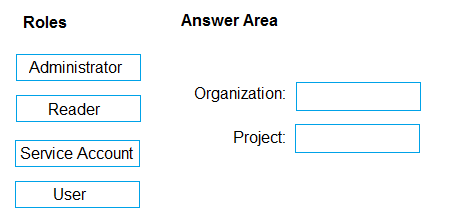
Solution:
project level role: UserOrganization level role: Reader
References: https://docs.microsoft.com/en-us/azure/devops/pipelines/agents/pools-queues
Does this meet the goal?
- A. Yes
- B. Not Mastered
Answer: A
NEW QUESTION 6
SIMULATION
You need to prepare a network security group (NSG) named az400-9940427-nsg1 to host an Azure DevOps pipeline agent. The solution must allow only the required outbound port for Azure DevOps and deny all other inbound and outbound access to the Internet.
To complete this task, sign in to the Microsoft Azure portal.
Solution:
* 1. Open Microsoft Azure Portal and Log into your Azure account.
* 2. Select network security group (NSG) named az400-9940427-nsg1
* 3. Select Settings, Outbound security rules, and click Add
* 4. Click Advanced
* 5. Change the following settings:
✑ Destination Port range: 8080
✑ Protocol. TCP
✑ Action: Allow
Note: By default, Azure DevOps Server uses TCP Port 8080. References:
https://robertsmit.wordpress.com/2017/09/11/step-by-step-azure-network-security-groups-nsg-security-center-azure-nsg-network/
https://docs.microsoft.com/en-us/azure/devops/server/architecture/required- ports?view=azure-devops
Does this meet the goal?
- A. Yes
- B. Not Mastered
Answer: A
NEW QUESTION 7
Note: This question n part of a series of questions that present the same scenario. Each question in the series contains a unique solution that might meet the stated goals. Some question sets might have more than one correct solution, while others might not have a correct solution
After you answer a question in this section, you will NOT be able to return to it. As a result these questions will not appear in the review screen.
You have an approval process that contains a condition. The condition requires that releases be approved by a team leader before they are deployed.
You have a policy stating that approvals must occur within eight hours.
You discover that deployments fail if the approvals lake longer than two hours.
You need to ensure that the deployments only fail if the approvals take longer than eight hours.
Solution: From Pre-deployment conditions, you modify the Timeout setting for pre- deployment approvals.
Does this meet the goal?
- A. Yes
- B. No
Answer: B
Explanation:
Use a gate instead of an approval instead.
References: https://docs.microsoft.com/en- us/azure/devops/pipelines/release/approvals/gates
NEW QUESTION 8
You use Azure Artifacts to host NuGet packages that you create.
You need to make one of the packages available to anonymous users outside your organization. The solution must minimize the number of publication points.
What should you do?
- A. Create a new feed for the package
- B. Publish the package to a public NuGet repository.
- C. Promote the package to a release view.
- D. Change the feed URL of the package.
Answer: A
Explanation:
Azure Artifacts introduces the concept of multiple feeds that you can use to organize and control access to your packages.
Packages you host in Azure Artifacts are stored in a feed. Setting permissions on the feed allows you to share your packages with as many or as few people as your scenario requires.
Feeds have four levels of access: Owners, Contributors, Collaborators, and Readers.
References: https://docs.microsoft.com/en-us/azure/devops/artifacts/feeds/feed- permissions?view=vsts&tabs=new-nav
NEW QUESTION 9
You have an Azure web app named webapp1 that uses the .NET Core runtime stack. You have an Azure Application Insights resource named Applnsight1. Webapp1 sends telemetry data to Applnsights1.
You need to ensure that webapp1 sends the telemetry data at a fixed sampling rate. What should you do?
- A. From the code repository of webapp1, modify the Applicationlnsights.config file.
- B. From the code repository of webapp1, modify the Startup.cs file.
- C. From Applnsights1. modify the Usage and estimated costs settings.
- D. From Applnsights1, configure the Continuous export settings.
Answer: B
NEW QUESTION 10
Note: This question is part of a series of questions that present the same scenario. Each question in the series contains a unique solution that might meet the stated goals. Some question sets might have more than one correct solution, while others might not have a correct solution.
After you answer a question in this section, you will NOT be able to return to it. As a result, these questions will not appear in the review screen.
You plan to create a release pipeline that will deploy Azure resources by using Azure Resource Manager templates. The release pipeline will create the following resources:
Two resource groups
Four Azure virtual machines in one resource group Two Azure SQL databases in other resource group
You need to recommend a solution to deploy the resources.
Solution: Create a single standalone template that will deploy all the resources. Does this meet the goal?
- A. Yes
- B. No
Answer: A
Explanation:
Use two templates, one for each resource group, and link the templates.
References:
https://docs.microsoft.com/en-us/azure/azure-resource-manager/resource-group-linked- templates
NEW QUESTION 11
You have a project in Azure DevOps. You have an Azure Resource Group deployment project in Microsoft
Visual Studio that is checked in to the Azure DevOps project.
You need to create a release pipeline that will deploy resources by using Azure Resource Manager templates.
The solution must minimize administrative effort. Which task type should you include in the solution?
- A. Azure Cloud Service Deployment
- B. Azure RM Web App Deployment
- C. Azure PowerShell
- D. Azure App Service Manage
Answer: C
Explanation:
There are two different ways to deploy templates to Azure DevOps Services. Both methods provide the same results, so choose the one that best fits your workflow.
* 1. Add a single step to your build pipeline that runs the PowerShell script that’s included in the Azure
Resource Group deployment project (Deploy-AzureResourceGroup.ps1). The script copies artifacts and
then deploys the template.
* 2. Add multiple Azure DevOps Services build steps, each one performing a stage task. The first option has the advantage of using the same script used by developers in Visual Studio and providing
consistency throughout the lifecycle. References:
https://docs.microsoft.com/en-us/azure/vs-azure-tools-resource-groups-ci-in-vsts
NEW QUESTION 12
SIMULATION
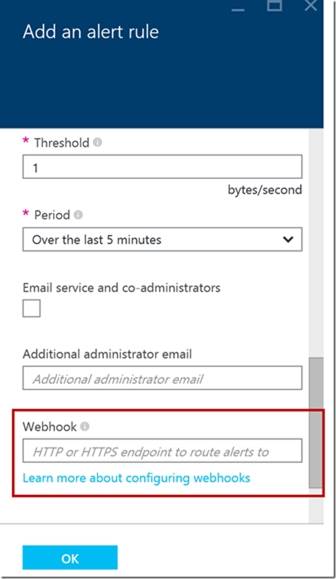
You need to create a notification if the peak average response time of an Azure web app named az400-9940427-main is more than five seconds when evaluated during a five- minute period. The notification must trigger the “https://contoso.com/notify” webhook.
To complete this task, sign in to the Microsoft Azure portal.
Solution:
* 1. Open Microsoft Azure Portal
* 2. Log into your Azure account and go to App Service and look under Monitoring then you will see Alert.
* 3. Select Add an alert rule
* 4. Configure the alert rule as per below and click Ok.
Source: Alert on Metrics
Resource Group: az400-9940427-main
Resource: az400-9940427-main
Threshold: 5
Period: Over the last 5 minutes
Webhook: https://contoso.com/notify
Does this meet the goal?
- A. Yes
- B. Not Mastered
Answer: A
NEW QUESTION 13
SIMULATION
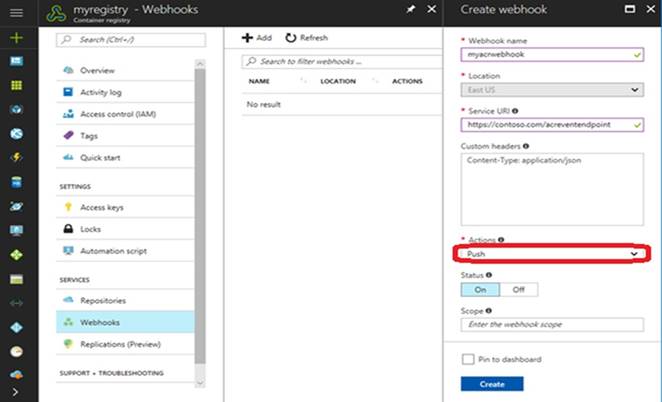
You need to ensure that the https://contoso.com/statushook webhook is called every time a repository named az40010480345acr1 receives a new version of an image named dotnetapp.
To complete this task, sign in to the Microsoft Azure portal.
Solution:
✑ Sign in to the Azure portal.
✑ Navigate to the container registry az40010480345acr1.
✑ Under Services, select Webhooks.
✑ Select the existing webhook https://contoso.com/statushook, and double-click on it to get its properties.
✑ For Trigger actions select image push
Example web hook:
Does this meet the goal?
- A. Yes
- B. Not Mastered
Answer: A
NEW QUESTION 14
DRAG DROP
You have a GitHub organization named org1 and an Azure tenant named Tenant1.
You need to enable single sign-on (SSO) in Azure Active Directory (Azure AD) for the users in org1.
Which URIs should you use for the SAML configuration in Azure AD? To answer, drag the appropriate URIs to the correct settings. Each URI may be used once, more than once, or not at all. You may need to drag the split bar between panes or scroll to view content.
NOTE: Each correct selection is worth one point.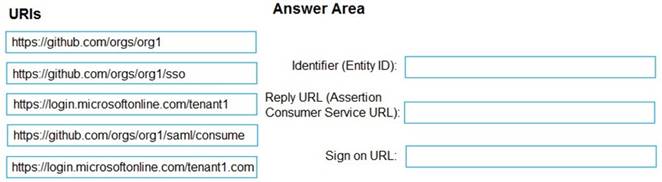
Solution:
Graphical user interface, text, application Description automatically generated
Does this meet the goal?
- A. Yes
- B. Not Mastered
Answer: A
NEW QUESTION 15
You have an Azure virtual machine that is monitored by using Azure Monitor. The virtual machine has the Azure Log Analytics agent installed.
You plan to deploy the Service Map solution from Azure Marketplace.
What should you deploy to the virtual machine to support the Service Map solution?
- A. the Telegraf agent
- B. the Azure Monitor agent
- C. the Dependency agent
- D. the Windows Azure diagnostics extension (WAD)
Answer: C
NEW QUESTION 16
......
Recommend!! Get the Full AZ-400 dumps in VCE and PDF From Surepassexam, Welcome to Download: https://www.surepassexam.com/AZ-400-exam-dumps.html (New 509 Q&As Version)