
Your success in Juniper JN0-105 is our sole target and we develop all our JN0-105 braindumps in a way that facilitates the attainment of this target. Not only is our JN0-105 study material the best you can find, it is also the most detailed and the most updated. JN0-105 Practice Exams for Juniper JN0-105 are written to the highest standards of technical accuracy.
Free JN0-105 Demo Online For Juniper Certifitcation:
NEW QUESTION 1
Exhibit
[edit]
user@routerl set interfaces ge-0/1/2 unit 0 family inet address 172.16.101.1/24 [edit]
user@router# commit check
configuration check succeeds
[edit]
user@router#
You need to configure interface ge-0/1/2 with an IP address of 172.16.100.1/24. You have accidentally entered 172.16.101.1/24 as shown in the exhibit.
Which command should you issue to solve the problem?
- A. (edit] user@router# rollback 1
- B. [edit] user@router# rollback 2
- C. [edit] userOrouter# rollback 0
- D. [edit] user@routeri rollback rescue
Answer: A
Explanation:
If you've committed a configuration and then need to revert to the previous configuration, the rollback command is used. Since the incorrect IP address has not been committed, as indicated by the commit check command being successful, issuing rollback 1 will undo the changes made in the current session, which includes the accidental entry of the IP address.
NEW QUESTION 2
You configured your system authentication order using the set authentication-order tacplus radius password command.
Which statement is correct in this scenario?
- A. A rejection by TACACS+ will prevent a login and bypass the other two authentication methods.
- B. The password authentication will only be used if the TACACS+ and RADIUS servers fail to respond.
- C. All authentication methods are used with the most restrictive permission set used.
- D. The password authentication method is evaluated if the TACACS+ and RADIUS servers respond with a reject message.
Answer: B
Explanation:
In the scenario where the system authentication order is set to "tacplus radius password," the correct statement is (B). If the TACACS+ and RADIUS servers are unreachable or fail to respond, the system will fall back to using password authentication. This ensures that users can still authenticate using locally stored passwords if external
authentication servers are unavailable.
NEW QUESTION 3
Which two external authentication methods does Junos support for administrative access? (Choose two.)
- A. TACACS+
- B. NIS
- C. RADIUS
- D. ACE
Answer: A
Explanation:
Junos OS supports several external authentication methods for administrative access, with TACACS+ (Terminal Access Controller Access-Control System Plus) and RADIUS (Remote Authentication Dial-In User Service) being among the most commonly used. Both TACACS+ and RADIUS are protocols that allow network devices to communicate with a central authentication server, enabling centralized control over user authentication and authorization. This centralization simplifies the management of user credentials and access policies, especially in larger networks with multiple devices.
NEW QUESTION 4
Your network infrastructure transports data, voice, and video traffic. Users are complaining that voice and video calls are not performing to their expectations.
In this scenario, which technology would you implement to improve voice and video performance on your network?
- A. NAT
- B. CoS
- C. STP
- D. IPv6
Answer: B
Explanation:
In a network that carries diverse types of traffic like data, voice, and video, ensuring the performance of latency-sensitive applications such as voice and video calls is crucial. Class of Service (CoS) is a technology designed to prioritize network traffic, ensuring that critical applications like voice and video receive the necessary bandwidth and minimal latency. CoS mechanisms can include traffic classification, traffic policing, queue management, and scheduling. By implementing CoS, network administrators can assign higher priority to voice and video traffic, thus improving their performance across the network and addressing the users' complaints about call quality.
NEW QUESTION 5
Exhibit
Exhibit
[edit]
root# set system host-name TEST_DEVICE [edit]
root# commit
[edit]
'system’
Missing mandatory statement: ’root-authentication’ error: commit failed: (missing mandatory statements) [edit] root#
You are configuring a new device.
Which action solves the error shown in the exhibit?
- A. configuring a non-root username and password
- B. configuring a password for the root account
- C. loading the factory-default configuration
- D. reinstalling Junos
Answer: B
Explanation:
The error message in the exhibit indicates that the root-authentication statement is missing, which is mandatory for committing the configuration. In Junos OS, it is required to set a password for the root account to commit any configuration changes. This is a security measure to ensure that unauthorized users cannot access the device's configuration mode. To solve the error shown in the exhibit, configuring a password for the root account is necessary. This can be done by using the set system root-authentication plain-text-password command, after which the user will be prompted to enter a new password for the root account.
NEW QUESTION 6
Which protocol would you configure to synchronize the time and date on a Junos device?
- A. SNMP
- B. RIP
- C. NTP
- D. NMP
Answer: C
Explanation:
The Network Time Protocol (NTP) is designed to synchronize the clocks of computers over a network. Configuring NTP on a Junos device ensures that its clock is set accurately, which is crucial for logging, troubleshooting, and maintaining the integrity of time-sensitive operations and security protocols. NTP allows devices to use a hierarchy of time sources, from primary servers synchronized to a reference clock (such as an atomic clock or GPS time) to secondary servers that distribute the time to other devices on the network.
NEW QUESTION 7
What are two examples of exception traffic? (Choose two.)
- A. transit packets
- B. routing updates
- C. log messages
- D. ping to the local device
Answer: BC
Explanation:
Exception traffic includes traffic that is not simply forwarded by the router but requires special handling, such as routing updates (B) and log messages (C). These types of traffic are processed by the router's control plane rather than just being forwarded through the data plane.
NEW QUESTION 8
You want to find out the chassis serial number of a Junos device. Which command would display this information?
- A. show chassis environment
- B. show chassis hardware
- C. show chassis routing-engine
- D. show chassis location
Answer: B
Explanation:
The show chassis hardware command in Junos OS displays detailed information about the hardware installed in the device, including the chassis itself. This command provides a list of all hardware components, their serial numbers, part numbers, and version information. When looking for the chassis serial number specifically, this command is the most direct and comprehensive way to retrieve that information, as it includes the serial number of the chassis among the details provided.
NEW QUESTION 9
You are trying to diagnose packet loss at interface ge-0/0/3.
In this scenario, which command would help you view error statistics in real time?
- A. show interface terse
- B. show interface ge-0/0/3
- C. monitor interface traffic
- D. monitor interface ge-0/0/3
Answer: D
Explanation:
The monitor interface ge-0/0/3 command is used in Junos OS to view real- time statistics for a specific interface. This command helps in diagnosing issues like packet loss by displaying real-time updates of traffic and error statistics for the specified interface.
NEW QUESTION 10
Which two functions are performed by the PFE? (Choose two.)
- A. It implements firewall filters.
- B. It selects active routes.
- C. It forwards transit traffic.
- D. It maintains the routing table.
Answer: AC
Explanation:
The Packet Forwarding Engine (PFE) in Junos OS performs several key functions, including implementing firewall filters (A) and forwarding transit traffic (C). The PFE applies firewall filter rules to incoming and outgoing traffic and is responsible for the high-speed forwarding of packets based on the information in the forwarding table.
NEW QUESTION 11
Exhibit.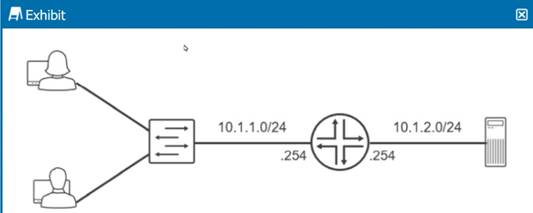
Referring to the exhibit, which routing configuration is required for these two users to access the remote server?
- A. Users must connect directly to the router.
- B. Users and the server require a default gateway.
- C. Trunk ports must be enabled on the switch.
- D. A routing protocol must be enabled on the router.
Answer: B
Explanation:
For the users in the 10.1.1.0/24 subnet and the server in the 10.1.2.0/24 subnet to communicate with each other, they need to route packets through the router that connects these two subnets. Each user and the server need to have their default gateway set to the IP address of the router interface on their respective subnet (.254). This ensures that packets destined for other subnets are sent to the router, which then routes them to the correct destination subnet.
References:
✑ Juniper official documentation: Configuring Basic Routing.
✑ General networking principles.
NEW QUESTION 12
Which two addresses are included in an Ethernet frame header? (Choose two.)
- A. source IP address
- B. source MAC address
- C. destination IP address
- D. destination MAC address
Answer: BD
Explanation:
An Ethernet frame header includes the source MAC address (B) and the destination MAC address (D). These addresses are used to deliver the frame from one Ethernet device to another directly connected Ethernet device on the same network segment. Ethernet frames do not include IP addresses, as those are part of the IP packet encapsulated within the Ethernet frame.
NEW QUESTION 13
Which prompt indicates that you are using configuration mode?
- A. >
- B. $
- C. #
- D. %
Answer: C
Explanation:
In Junos OS, the # prompt indicates that you are in configuration mode. This mode is used for making changes to the configuration of the device.
Reference: Juniper Networks CLI Modes
"The # prompt indicates that you are in configuration mode."
NEW QUESTION 14
Which criteria does the Junos OS use to select an active route when two entries exist in the routing table?
- A. the route with the lowest preference number
- B. the most recently learned dynamic route
- C. the route with the highest preference number
- D. the route with the highest metric
Answer: A
Explanation:
In Junos OS, when two entries for the same destination exist in the routing table, the route with the lowest preference number is selected as the active route. This preference number, also known as the route preference or administrative distance, is used to prioritize routes received from different routing protocols.
NEW QUESTION 15
Which statement is correct when multiple users are configuring a Junos device using the configure private command?
- A. A commit by any user will commit changes made by all active users.
- B. A commit will not succeed until there is only a single user in configuration mode.
- C. Each user gets their own candidate configuration.
- D. Each user shares the same candidate configuration.
Answer: C
Explanation:
When multiple users are configuring a Junos device using the "configure private" command, each user gets their own candidate configuration (C). This allows for isolated configuration sessions, where changes made by one user do not impact or interfere with the changes made by another user in their private session.
NEW QUESTION 16
How many login classes are assignable to a user account?
- A. 3
- B. 2
- C. 4
- D. 1
Answer: D
Explanation:
https://www.juniper.net/documentation/us/en/software/junos/user-access-evo/user-access/topics/topic-map/junos-os-login- class.html#:~:text=You%20can%20define%20any%20number,to%20an%20individual%20u ser%20account.
In Junos OS, each user account can be assigned only one login class. Login classes in Junos OS define the permissions for users, controlling what they can access and modify within the system. This setup helps in maintaining a clear and secure access control mechanism.
Reference:
Junos OS Documentation on User Accounts and Login Classes.
NEW QUESTION 17
You are asked to convert the number 7 from decimal to binary. Which number is correct in this scenario?
- A. 00001000
- B. 00010000
- C. 00000111
- D. 11100000
Answer: C
Explanation:
To convert the decimal number 7 to binary, the correct representation is 00000111 (C). In binary, 7 is represented as 1+2+4 (2^0 + 2^1 + 2^2), which corresponds to the last three digits being 1 in the binary format, with leading zeros added for clarity.
NEW QUESTION 18
Which two common routing policy actions affect the flow of policy evaluation? (Choose two.)
- A. next policy
- B. community
- C. next term
- D. next hop
Answer: AC
Explanation:
In Junos OS routing policy evaluation, "next policy" (A) and "next term" (C) are common actions that affect the flow of policy evaluation. "Next policy" directs the evaluation to the next policy in the sequence, whereas "next term" moves the evaluation to the next term within the current policy, allowing for granular control over routing decisions.
NEW QUESTION 19
After the factory default configuration is loaded, which configuration object must be created prior to the first commit?
- A. root authentication
- B. loopback IP address
- C. out-of-band connectivity
- D. host name
Answer: A
Explanation:
In Juniper Networks devices, when the factory default configuration is loaded, the first step before committing any configuration is to set up root authentication. This is crucial because it secures the device by ensuring that only authorized users have administrative access. Without setting up a root password, the device will not allow any commit operations, which is a safety measure to prevent unauthorized access. This requirement emphasizes the importance Juniper places on security right from the initial setup of the device.
NEW QUESTION 20
Click the Exhibit button.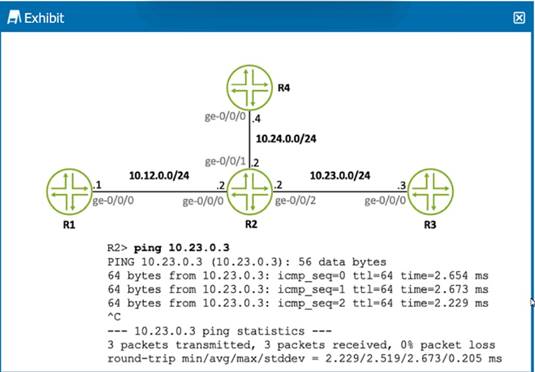
Referring to the exhibit, what is the source IP address of the ping that was executed?
- A. 10.12.0.2
- B. 10.23.0.2
- C. 10.23.0.3
- D. 10.24.0.4
Answer: B
Explanation:
The exhibit shows a ping test being executed from router R2 to the IP address 10.23.0.3. Since the ping command is issued on R2 and we see successful replies from 10.23.0.3, it means the source of the ping must be an interface on R2. Given the network diagram and the IP address scheme, the source IP address of the ping is on the interface ge-0/0/2 of R2, which is in the subnet 10.23.0.0/24. The only logical IP address for R2's interface in this subnet, based on standard networking practices and the given options, would be 10.23.0.2. The other addresses provided in the options belong to different subnets or are the destination of the ping itself.
NEW QUESTION 21
......
Recommend!! Get the Full JN0-105 dumps in VCE and PDF From Surepassexam, Welcome to Download: https://www.surepassexam.com/JN0-105-exam-dumps.html (New 100 Q&As Version)