
Proper study guides for Leading The-Open-Group TOGAF Enterprise Architecture Part 1 Exam (English) certified begins with The-Open-Group OGEA-101 preparation products which designed to deliver the Breathing OGEA-101 questions by making you pass the OGEA-101 test at your first time. Try the free OGEA-101 demo right now.
Online The-Open-Group OGEA-101 free dumps demo Below:
NEW QUESTION 1
Complete the sentence. When considering agile development, Architecture to Support Portfolio will identify what products the Enterprise needs, the boundary of the products, and what constraints a product owner has; this defines the Enterprise's
- A. risk tolerance
- B. business continuity
- C. backlog
- D. operating model
Answer: C
Explanation:
When considering agile development,Architecture to Support Portfoliowill identify the necessary products for the enterprise, define their boundaries, and outline the constraints for a product owner. This process directly relates to defining the enterprise'sbacklog, which in agile methodologies, is a prioritized list of work for the development team that is derived from the roadmap and its requirements.
NEW QUESTION 2
Which of the following best describes a purpose of the Gap Analysis technique?
- A. To validate non-functional requirements
- B. To establish quality metrics for the architecture
- C. To determine service levels for the architecture
- D. To identify missing functions
Answer: D
Explanation:
Gap analysis is a technique that is used to validate an architecture by highlighting the shortfall between the Baseline Architecture and the Target Architecture. One of the purposes of gap analysis is to identify missing functions that are either deliberately omitted, accidentally left out,or not yet defined in the Target Architecture. Missing functions are marked as gaps that need to be filled by developing or procuring the building blocks.
NEW QUESTION 3
Which of the following best describes the need for the ADM process to be governed?
- A. To enable development of reference architectures
- B. To verify that the method is being applied correctly
- C. To enable a fast response to market changes
- D. To permit the architecture domains to be integrated
Answer: B
Explanation:
According to the TOGAF standard, the need for the ADM process to be governed is to ensure that the architecture development and implementation activities are conducted in a consistent, coherent, and compliant manner1. Governance provides the means to verify that the method is being applied correctly and effectively, and that the architecture deliverables and artifacts meet the quality and standards criteria1. Governance also enables the management of risks, issues, changes, and dependencies that may arise during the ADM process1.
Some of the benefits of governing the ADM process are2:
•Improved alignment of the architecture with the business strategy and objectives
•Enhanced stakeholder engagement and communication
•Increased reuse and integration of architecture assets and resources
•Reduced complexity and duplication of architecture efforts
•Increased agility and adaptability of the architecture to changing needs and requirements
•Improved compliance and auditability of the architecture outcomes and outputs References: 1: Architecture Governance 2: Architecture Governance Benefits
NEW QUESTION 4
Consider the following statement:
According to the TOGAF Standard a governed approach of a particular deliverable will ensure a system of continuous monitoring to check integrity changes decision-making and audit of all architecture-related activities
Which deliverable is being referred to?
- A. An Architecture Contract
- B. The Architecture Definition Document
- C. The Architecture Vision
- D. The Statement of Architecture Work
Answer: A
Explanation:
An Architecture Contract is a deliverable that specifies the responsibilities and obligations of the parties involved in the implementation and governance of an architecture. It ensures a system of continuous monitoring to check integrity changes decision-making and audit of all architecture-related activities. Reference: The TOGAF® Standard | The Open Group Website, Section 3.3.4 Architecture Contracts.
NEW QUESTION 5
Consider the following descriptions of deliverables consumed and produced across the TOGAF ADM cycle.
✑ General rules and guidelines, intended to be enduring and seldom amended, that inform and support the way in which an organization sets
about fulfilling its mission
✑ The joint agreements between development partners and sponsors on the deliverables, quality, and fitness-for-purpose of an architecture.
✑ A document that is sent from the sponsoring organization to the architecture organization to trigger the start of an architecture
development cycle
✑ A set of quantitative statements that outline what an implementation project must do in order to comply with the architecture.
Which deliverables match these descriptions?
- A. 1 Architecture Principles -2 Architecture Contracts - 3 Request for Architecture Work - 4 Architecture Requirements Specification
- B. 1 Architecture Contracts - 2 Architecture Requirements Specification - 3 Architecture Vision - 4 Architecture Principles
- C. 1 Architecture Requirements Specification -2 Architecture Principles - 3 Architecture Vision - 4 Architecture Contracts
- D. 1 Architecture Principles -2 Architecture Contracts - 3 Architecture Requirements Specification-4 Request for Architecture Work
Answer: A
Explanation:
According to the TOGAF standard, the deliverables that match the descriptions are as follows:
✑ 1 Architecture Principles: These are general rules and guidelines, intended to be enduring and seldom amended, that inform and support the way in which an organization sets about fulfilling its mission1. They reflect a level of consensus among the various elements of the enterprise, and form the basis for making future IT decisions1.
✑ 2 Architecture Contracts: These are the joint agreements between development partners and sponsors on the deliverables, quality, and fitness-for-purpose of an architecture2. They are used to ensure that the architecture is implemented and governed according to the agreed-upon specifications and standards2.
✑ 3 Request for Architecture Work: This is a document that is sent from the sponsoring organization to the architecture organization to trigger the start of an architecture development cycle3. It defines the scope, schedule, budget, deliverables, and stakeholders of the architecture project3.
✑ 4 Architecture Requirements Specification: This is a set of quantitative statements that outline what an implementation project must do in order to comply with the architecture4. It defines the requirements for each architecture domain, as well as the relationships and dependencies among them4.
References: 1: Architecture Principles 2: Architecture Contracts 3: Request for Architecture Work 4: Architecture Requirements Specification
NEW QUESTION 6
What is an objective of the ADM Preliminary Phase?
- A. To develop a vision of the business value to be delivered by the proposed enterprise architecture
- B. To select and implement tools to support the Architecture Capability
- C. To obtain approval for the Statement of Architecture Work
- D. To create the initial version of the Architecture Roadmap
Answer: B
Explanation:
The Preliminary Phase is the preparatory phase of the Architecture Development Method (ADM) cycle, which sets the context and direction for the architecture work. One of the objectives of this phase is to select and implement tools to support the Architecture Capability, which is the ability of an organization to perform enterprise architecture effectively and efficiently. Tools can include software applications, methods, techniques, standards, and frameworks that assist the architecture development and governance processes. The selection and implementation of tools should be based on the requirements and constraints of the organization, and the alignment with the Architecture Principles and the Architecture Vision3 References: 3: The TOGAF Standard, Version 9.2, Part II: Architecture Development Method (ADM), Chapter 6: Preliminary Phase : The TOGAF Standard, Version 9.2, Part VI: Architecture Capability Framework, Chapter 45: Establishing and Maintaining an Enterprise Architecture Capability : The TOGAF Standard, Version 9.2, Part VI: Architecture Capability Framework, Chapter 46: Tools for Architecture Development
NEW QUESTION 7
Complete the sentence When considering agile development Architecture to Support Project will identify what products the Enterprise needs the boundary of the products and what constraints a product owner has. this defines the Enterprise's .
- A. operations
- B. backlog
- C. workflow management
- D. lifecycle economics
Answer: B
Explanation:
When considering agile development, Architecture to Support Project will identify what products the enterprise needs, the boundary of the products, and what constraints a product owner has. This defines the enterprise??s backlog. A backlog is a list of features or tasks that need to be done to deliver a product or service. It is prioritized by the product owner based on the value and urgency of each item. Reference: The TOGAF® Standard | The Open Group Website, Section 3.3.5 Architecture to Support Project.
NEW QUESTION 8
Which of the following best describes the purpose of the Architecture Requirements Specification?
- A. It contains an assessment of the current architecture requirements
- B. It provides a set of statements that outline what a project must do to comply with the architecture
- C. It is sent from the sponsor and triggers the start of an architecture development cycle
- D. It defines the scope and approach to complete an architecture project
Answer: B
Explanation:
The Architecture Requirements Specification is one of the TOGAF deliverables that provides a set of quantitative statements that outline what an implementation project must do in order to comply with the architecture12. It is a companion to the Architecture Definition Document, which provides a qualitative view of the solution and aims to communicate the intent of the architect. The Architecture Requirements Specification provides a quantitative view of the solution, stating measurable criteria that must be met during the implementation of the architecture3. It typically forms a major component of an implementation contract or contract for more detailed Architecture Definition4. References:
•Deliverable: Architecture Requirements Specification - The Open Group
•Architecture Requirements Specification - Visual Paradigm Community Circle
•The TOGAF Standard, Version 9.2 - Definitions - The Open Group
•The TOGAF Standard, Version 9.2 - Architecture Requirements Specification - The Open Group
NEW QUESTION 9
Complete the sentence A set of architecture principles that cover every situation perceived meets the recommended criteria of ________
- A. consistency
- B. robustness
- C. stability
- D. completeness
Answer: D
Explanation:
A set of architecture principles that cover every situation perceived meets the recommended criteria of completeness. Completeness is one of the six criteria that should be applied when developing or assessing architecture principles. Completeness means that there are no gaps or overlaps in the coverage of principles across all relevant aspects of the enterprise??s architecture. Reference: The TOGAF® Standard | The Open Group Website, Section 3.3.7 Architecture Principles.
NEW QUESTION 10
Which of the following describes a purpose of Architecture Principles?
- A. To describe likely impacts resulting from successful deployment of the target architecture.
- B. To establish a common understanding of how to control the business in pursuit of strategic objectives
- C. To provide a better understanding about the enterprise's culture and values
- D. To form a contract between sponsoring organization and the enterprise architects
Answer: B
Explanation:
Architecture Principles are general rules and guidelines that inform and support the way in which an organization sets about fulfilling its mission. They reflect a level of consensus among the various elements of the enterprise, and form the basis for making future IT decisions. One of the purposes of Architecture Principles is to establish a common understanding of how to control the business in pursuit of strategic objectives, by providing a framework for evaluating and agreeing on the changes that affect the enterprise??s architecture3 References: 3: The TOGAF Standard, Version 9.2, Part III: ADM Guidelines and Techniques, Chapter 23: Architecture Principles : The TOGAF Standard, Version 9.2, Part IV: Architecture Content Framework, Chapter 31: Architecture Principles
NEW QUESTION 11
Which of the following describes the practice by which the enterprise architecture is managed and controlled at an enterprise-wide level?
- A. Corporate governance
- B. Architecture governance
- C. IT governance
- D. Technology governance
Answer: B
Explanation:
According to the TOGAF Standard, 10th Edition, architecture governance is ??the practice by which enterprise architectures and other architectures are managed and controlled at an enterprise-wide level?? 1. Architecture governance ensures that the architecture development and implementation are aligned with the strategic objectives, principles, standards, and requirements of the enterprise, and that they deliver the expected value and outcomes. Architecture governance also involves establishing and maintaining the architecture framework, repository, board, contracts, and compliance reviews 1. The other options are not correct, as they are not the term used by the TOGAF Standard to describe the practice by which the enterprise architecture is managed and controlled at an enterprise-wide level. Corporate governance is ??the system by which an organization is directed and controlled?? 2, and it covers aspects such as leadership, strategy, performance, accountability, and ethics. IT governance is ??the system by which the current and future use of IT is directed and controlled?? 2, and it covers aspects such as IT strategy, policies, standards, and services. Technology governance is ??the system by which the technology decisions and investments are directed and controlled?? 3, and it covers aspects such as technology selection, acquisition, deployment, and maintenance. References: 1: TOGAF Standard, 10th Edition, Part VI: Architecture Governance, Chapter 44: Introduction. 2: TOGAF Standard, 10th Edition, Part I: Introduction, Chapter 3: Definitions. 3: TOGAF Series Guide: Using the TOGAF Framework to Define and Govern Service-Oriented Architectures, Part II: Using the TOGAF Framework to Define and Govern Service-Oriented Architectures, Chapter 5: Technology Governance.
NEW QUESTION 12
What is present in all phases within the ADM and should be identified, classified and mitigated before starting a transformation effort?
- A. Budgetary constraints
- B. Risk
- C. Schedule constraints
- D. Information gaps
Answer: B
Explanation:
According to the TOGAF Standard, 10th Edition, risk is present in all phases within the Architecture Development Method (ADM), and it should be identified, classified, and mitigated before starting a transformation effort 1. Risk is defined as ??the effect of uncertainty on objectives?? 2, and it can have positive or negative impacts on the architecture project. Risk management is a technique that helps to assess and address the potential risks that may affect the achievement of the architecture objectives, and to balance the trade-offs between opportunities and threats. Risk management is applied throughout the ADM cycle, from the Preliminary Phase to the Requirements Management Phase, and it is integrated with other techniques, such as stakeholder management, business transformation readiness assessment, gap analysis, and migration planning 1. The other options are not correct, as they are not present in all phases within the ADM, and they are not necessarily identified, classified, and mitigated before starting a transformation effort. Budgetary constraints are the limitations on the financial resources available for the architecture project, and they are usually considered in Phase E: Opportunities and Solutions, and Phase F: Migration Planning 3. Schedule constraints are the limitations on the time available for the architecture project, and they are also usually considered in Phase E and F 3. Information gaps are the missing or incomplete data or knowledge that may affect the architecture project, and they are usually identified in Phase B: Business Architecture, Phase C: Information Systems Architecture, and Phase D: Technology Architecture . References: 1: TOGAF Standard, 10th Edition, Part III: ADM Guidelines and Techniques, Chapter 32: Risk Management. 2: TOGAF Standard, 10th Edition, Part I: Introduction, Chapter 3: Definitions. 3: TOGAF Standard, 10th Edition, Part II: Architecture Development Method, Chapter 16: Phase E: Opportunities and Solutions, and Chapter 17: PhaseF: Migration Planning. : TOGAF Standard, 10th Edition, Part II: Architecture Development Method, Chapter 13: Phase B: Business Architecture, Chapter 14: Phase C: Information Systems Architecture, and Chapter 15: Phase D: Technology Architecture.
NEW QUESTION 13
What is defined as the effect of uncertainty on objectives?
- A. Vulnerability
- B. Risk
- C. Continuity
- D. Threat
Answer: B
Explanation:
Risk is defined as the effect of uncertainty on objectives, according to the ISO 31000 standard, which provides principles and guidelines for risk management1 Risk can be positive or negative, depending on whether the uncertainty affects the achievement or the failure of the objectives. Risk can also be expressed in terms of likelihood and impact, which indicate the probability and the consequence of the risk occurrence. Risk management is the coordinated activities to direct and control an organization with regard to risk. Risk management is an integral part of the TOGAF standard, as it helps to identify, assess, and treat the risks that may affect the architecture development and implementation2 References: 1: ISO 31000:2018, Risk management — Guidelines, Clause 3.1 2: The TOGAF Standard, Version 9.2, Part III: ADM Guidelines and Techniques, Chapter 32: Risk Management
NEW QUESTION 14
The ensures that a project transitioning into implementation also smoothly transitions into appropriate Architecture Governance.
- A. Migration Plan
- B. Transition Plan
- C. Implementation Governance Model
- D. Implementation Strategy
Answer: C
Explanation:
The Implementation Governance Model is a framework that defines the roles, responsibilities, processes, and standards for governing the implementation of the target architecture. It ensures that a project transitioning into implementation also smoothly transitions into appropriate Architecture Governance, which is the practice of ensuring compliance with the enterprise architecture and its principles, standards, and goals. The Implementation Governance Model is part of the Implementation and Migration Plan, which is the output of Phase F: Migration Planning of the Architecture Development Method (ADM)12 References: 1: The TOGAF Standard, Version 9.2, Part II: Architecture Development Method (ADM), Chapter 21: Phase F: Migration Planning 2: The TOGAF Standard, Version 9.2, Part VI: Architecture Capability Framework, Chapter 50: Architecture Governance
NEW QUESTION 15
Complete the sentence A business scenario describes
- A. shortfalls between the Baseline and Target Architectures
- B. business domain gaps such as cross-training requirements
- C. business and technology environment in which those problems occur
- D. general rules and guidelines tor the architecture being developed
Answer: C
Explanation:
A business scenario describes business and technology environment in which those problems occur. It provides a realistic context for identifying and addressing business problems and opportunities, as well as their impact on the enterprise??s architecture. Reference: The TOGAF® Standard | The Open Group Website, Section 3.3.1 Business Scenarios.
NEW QUESTION 16
Consider the following ADM phases objectives.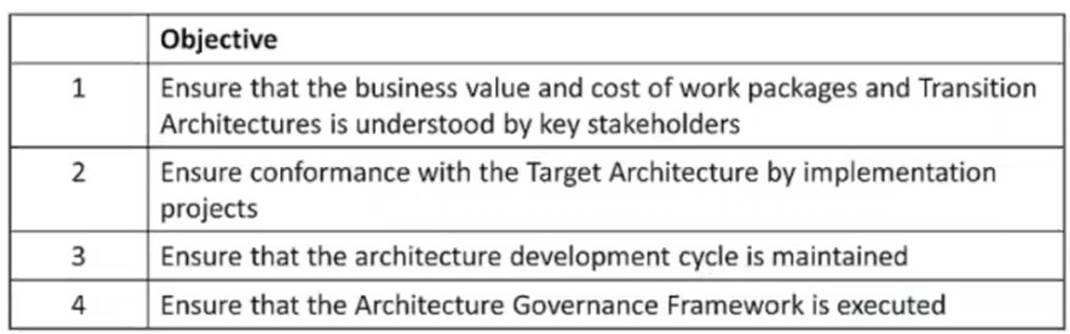
Which phase does each objective match?
- A. 1F-2G-3G-4H
- B. 1H-2F-3F-4G
- C. 1F-2G-3H-4H
- D. 1G-2H-3H-4F
Answer: B
Explanation:
✑ According to the TOGAF Standard, Version 9.2, the ADM phases and their objectives are as follows1:
✑ Based on the above definitions, we can match each objective with the corresponding phase as follows:
References:
✑ 1: The TOGAF Standard, Version 9.2, Chapter 5: Architecture Development Method (ADM)
✑ 2: The TOGAF Standard, Version 9.2, Chapter 21: Architecture Change Management
✑ 3: The TOGAF Standard, Version 9.2, Chapter 20: Migration Planning
✑ 4: The TOGAF Standard, Version 9.2, Chapter 19: Implementation Governance
NEW QUESTION 17
What provides context for architecture work, by describing the needs and ways of working employed by the enterprise?
- A. Architecture Contracts
- B. Business principles business goals, and business drivers
- C. Strategy and vision
- D. Stakeholder needs
Answer: B
Explanation:
Business principles business goals, and business drivers provide context for architecture work, by describing the needs and ways of working employed by the enterprise. They define what the enterprise wants to achieve, how it wants to operate, and what factors influence its decisions and actions. Reference: The TOGAF® Standard | The Open Group Website, Section 3.2 Preliminary Phase.
NEW QUESTION 18
......
100% Valid and Newest Version OGEA-101 Questions & Answers shared by Certleader, Get Full Dumps HERE: https://www.certleader.com/OGEA-101-dumps.html (New 92 Q&As)