Your success in Amazon-Web-Services SCS-C02 is our sole target and we develop all our SCS-C02 braindumps in a way that facilitates the attainment of this target. Not only is our SCS-C02 study material the best you can find, it is also the most detailed and the most updated. SCS-C02 Practice Exams for Amazon-Web-Services SCS-C02 are written to the highest standards of technical accuracy.
Amazon-Web-Services SCS-C02 Free Dumps Questions Online, Read and Test Now.
NEW QUESTION 1
A company wants to establish separate IAM Key Management Service (IAM KMS) keys to use for different IAM services. The company's security engineer created the following key policy lo allow the infrastructure deployment team to create encrypted Amazon Elastic Block Store (Amazon EBS) volumes by assuming the InfrastructureDeployment IAM role: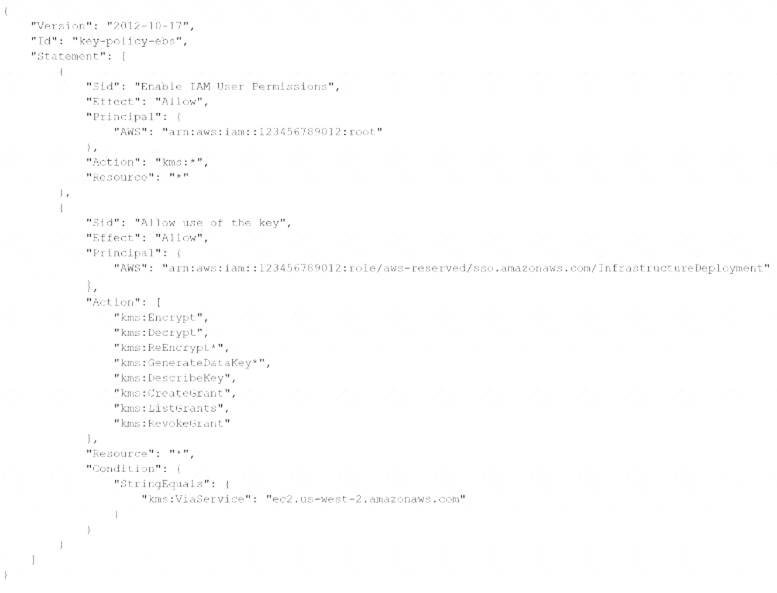
The security engineer recently discovered that IAM roles other than the InfrastructureDeployment role used this key (or other services. Which change to the policy should the security engineer make to resolve these issues?
- A. In the statement block that contains the Sid "Allow use of the key", under the "Condition" block, change StringEquals to StringLike.
- B. In the policy document, remove the statement Dlock that contains the Sid "Enable IAM User Permissions". Add key management policies to the KMS policy.
- C. In the statement block that contains the Sid "Allow use of the Key", under the "Condition" block, change the Kms:ViaService value to ec2.us-east-1 .amazonIAM com.
- D. In the policy document, add a new statement block that grants the kms:Disable' permission to the security engineer's IAM role.
Answer: C
Explanation:
To resolve the issues, the security engineer should make the following change to the policy: In the statement block that contains the Sid “Allow use of the key”, under the “Condition” block, change the Kms:ViaService value to ec2.us-east-1.amazonaws.com. This allows the security engineer to restrict the use of the key to only EC2 service in the us-east-1 region, and prevent other services from using the key.
NEW QUESTION 2
An international company wants to combine AWS Security Hub findings across all the company's AWS Regions and from multiple accounts. In addition, the company
wants to create a centralized custom dashboard to correlate these findings with operational data for deeper
analysis and insights. The company needs an analytics tool to search and visualize Security Hub findings. Which combination of steps will meet these requirements? (Select THREE.)
- A. Designate an AWS account as a delegated administrator for Security Hu
- B. Publish events to Amazon CloudWatch from the delegated administrator account, all member accounts, and required Regions that are enabled for Security Hub findings.
- C. Designate an AWS account in an organization in AWS Organizations as a delegated administrator for Security Hu
- D. Publish events to Amazon EventBridge from the delegated administrator account, all member accounts, and required Regions that are enabled for Security Hub findings.
- E. In each Region, create an Amazon EventBridge rule to deliver findings to an Amazon Kinesis data strea
- F. Configure the Kinesis data streams to output the logs to a single Amazon S3 bucket.
- G. In each Region, create an Amazon EventBridge rule to deliver findings to an Amazon Kinesis Data Firehose delivery strea
- H. Configure the Kinesis Data Firehose delivery streams to deliver the logs to a single Amazon S3 bucket.
- I. Use AWS Glue DataBrew to crawl the Amazon S3 bucket and build the schem
- J. Use AWS Glue Data Catalog to query the data and create views to flatten nested attribute
- K. Build Amazon QuickSight dashboards by using Amazon Athena.
- L. Partition the Amazon S3 dat
- M. Use AWS Glue to crawl the S3 bucket and build the schem
- N. Use Amazon Athena to query the data and create views to flatten nested attribute
- O. Build Amazon QuickSight dashboards that use the Athena views.
Answer: BDF
Explanation:
The correct answer is B, D, and F. Designate an AWS account in an organization in AWS Organizations as a delegated administrator for Security Hub. Publish events to Amazon EventBridge from the delegated administrator account, all member accounts, and required Regions that are enabled for Security Hub findings. In each Region, create an Amazon EventBridge rule to deliver findings to an Amazon Kinesis Data Firehose delivery stream. Configure the Kinesis Data Firehose delivery streams to deliver the logs to a single Amazon S3 bucket. Partition the Amazon S3 data. Use AWS Glue to crawl the S3 bucket and build the schema. Use Amazon Athena to query the data and create views to flatten nested attributes. Build Amazon QuickSight dashboards that use the Athena views.
According to the AWS documentation, AWS Security Hub is a service that provides you with a comprehensive view of your security state across your AWS accounts, and helps you check your environment against security standards and best practices. You can use Security Hub to aggregate security findings from various sources, such as AWS services, partner products, or your own applications.
To use Security Hub with multiple AWS accounts and Regions, you need to enable AWS Organizations with all features enabled. This allows you to centrally manage your accounts and apply policies across your organization. You can also use Security Hub as a service principal for AWS Organizations, which lets you designate a delegated administrator account for Security Hub. The delegated administrator account can enable Security Hub automatically in all existing and future accounts in your organization, and can view and manage findings from all accounts.
According to the AWS documentation, Amazon EventBridge is a serverless event bus that makes it easy to connect applications using data from your own applications, integrated software as a service (SaaS) applications, and AWS services. You can use EventBridge to create rules that match events from various sources and route them to targets for processing.
To use EventBridge with Security Hub findings, you need to enable Security Hub as an event source in EventBridge. This will allow you to publish events from Security Hub to EventBridge in the same Region. You can then create EventBridge rules that match Security Hub findings based on criteria such as severity, type, or resource. You can also specify targets for your rules, such as Lambda functions, SNS topics, or Kinesis Data Firehose delivery streams.
According to the AWS documentation, Amazon Kinesis Data Firehose is a fully managed service that delivers real-time streaming data to destinations such as Amazon S3, Amazon Redshift, Amazon Elasticsearch Service (Amazon ES), and Splunk. You can use Kinesis Data Firehose to transform and enrich your data before delivering it to your destination.
To use Kinesis Data Firehose with Security Hub findings, you need to create a Kinesis Data Firehose delivery stream in each Region where you have enabled Security Hub. You can then configure the delivery stream to receive events from EventBridge as a source, and deliver the logs to a single S3 bucket as a destination. You can also enable data transformation or compression on the delivery stream if needed.
According to the AWS documentation, Amazon S3 is an object storage service that offers scalability, data availability, security, and performance. You can use S3 to store and retrieve any amount of data from anywhere on the web. You can also use S3 features such as lifecycle management, encryption, versioning, and replication to optimize your storage.
To use S3 with Security Hub findings, you need to create an S3 bucket that will store the logs from Kinesis Data Firehose delivery streams. You can then partition the data in the bucket by using prefixes such as account ID or Region. This will improve the performance and cost-effectiveness of querying the data.
According to the AWS documentation, AWS Glue is a fully managed extract, transform, and load (ETL) service that makes it easy to prepare and load your data for analytics. You can use Glue to crawl your data sources, identify data formats, and suggest schemas and transformations. You can also use Glue Data Catalog as a central metadata repository for your data assets.
To use Glue with Security Hub findings, you need to create a Glue crawler that will crawl the S3 bucket and build the schema for the data. The crawler will create tables in the Glue Data Catalog that you can query using standard SQL.
According to the AWS documentation, Amazon Athena is an interactive query service that makes it easy to analyze data in Amazon S3 using standard SQL. Athena is serverless, so there is no infrastructure to manage, and you pay only for the queries that you run. You can use Athena with Glue Data Catalog as a metadata store for your tables.
To use Athena with Security Hub findings, you need to create views in Athena that will flatten nested attributes in the data. For example, you can create views that extract fields such as account ID, Region, resource type, resource ID, finding type, finding title, and finding description from the JSON data. You can then query the views using SQL and join them with other tables if needed.
According to the AWS documentation, Amazon QuickSight is a fast, cloud-powered business intelligence
service that makes it easy to deliver insights to everyone in your organization. You can use QuickSight to create and publish interactive dashboards that include machine learning insights. You can also use QuickSight to connect to various data sources, such as Athena, S3, or RDS.
To use QuickSight with Security Hub findings, you need to create QuickSight dashboards that use the Athena views as data sources. You can then visualize and analyze the findings using charts, graphs, maps, or tables. You can also apply filters, calculations, or aggregations to the data. You can then share the dashboards with your users or embed them in your applications.
NEW QUESTION 3
A security engineer needs to see up an Amazon CloudFront distribution for an Amazon S3 bucket that hosts a static website. The security engineer must allow only specified IP addresses to access the website. The security engineer also must prevent users from accessing the website directly by using S3 URLs.
Which solution will meet these requirements?
- A. Generate an S3 bucket polic
- B. Specify cloudfront amazonaws com as the principa
- C. Use the aws Sourcelp condition key to allow access only if the request conies from the specified IP addresses.
- D. Create a CloudFront origin access identity (OAl). Create the S3 bucket policy so that only the OAl has acces
- E. Create an AWS WAF web ACL and add an IP set rul
- F. Associate the web ACL with the CloudFront distribution.
- G. Implement security groups to allow only the specified IP addresses access and to restrict S3 bucket access by using the CloudFront distribution.
- H. Create an S3 bucket access point to allow access from only the CloudFront distributio
- I. Create an AWS WAF web ACL and add an IP set rul
- J. Associate the web ACL with the CloudFront distribution.
Answer: B
NEW QUESTION 4
A security engineer needs to run an AWS CloudFormation script. The CloudFormation script builds AWS infrastructure to support a stack that includes web servers and a MySQL database. The stack has been deployed in pre-production environments and is ready for production.
The production script must comply with the principle of least privilege. Additionally, separation of duties must exist between the security engineer's IAM account and CloudFormation.
Which solution will meet these requirements?
- A. Use IAM Access Analyzer policy generation to generate a policy that allows the CloudFormation script to run and manage the stac
- B. Attach the policy to a new IAM rol
- C. Modify the security engineer's IAM permissions to be able to pass the new role to CloudFormation.
- D. Create an IAM policy that allows ec2:* and rds:* permission
- E. Attach the policy to a new IAM role.Modify the security engineer's IAM permissions to be able to assume the new role.
- F. Use IAM Access Analyzer policy generation to generate a policy that allows the CloudFormation script to run and manage the stac
- G. Modify the security engineer's IAM permissions to be able to run the CloudFormation script.
- H. Create an IAM policy that allows ec2:* and rds:* permission
- I. Attach the policy to a new IAM rol
- J. Use the IAM policy simulator to confirm that the policy allows the AWS API calls that are necessary to build the stac
- K. Modify the security engineer's IAM permissions to be able to pass the new role to CloudFormation.
Answer: A
Explanation:
The correct answer is A. Use IAM Access Analyzer policy generation to generate a policy that allows the CloudFormation script to run and manage the stack. Attach the policy to a new IAM role. Modify the security engineer’s IAM permissions to be able to pass the new role to CloudFormation.
According to the AWS documentation, IAM Access Analyzer is a service that helps you identify the resources in your organization and accounts, such as Amazon S3 buckets or IAM roles, that are shared with an external entity. You can also use IAM Access Analyzer to generate fine-grained policies that grant least privilege access based on access activity and access attempts.
To use IAM Access Analyzer policy generation, you need to enable IAM Access Analyzer in your account or organization. You can then use the IAM console or the AWS CLI to generate a policy for a resource based on its access activity or access attempts. You can review and edit the generated policy before applying it to the resource.
To use IAM Access Analyzer policy generation with CloudFormation, you can follow these steps: Run the CloudFormation script in a pre-production environment and monitor its access activity or access attempts using IAM Access Analyzer. Use IAM Access Analyzer policy generation to generate a policy that allows the CloudFormation script to run and manage the stack. The policy will include only the permissions that are necessary for the script to function. Attach the policy to a new IAM role that has a trust relationship with CloudFormation. This will allow CloudFormation to assume the role and execute the script. Modify the security engineer’s IAM permissions to be able to pass the new role to CloudFormation.
This will allow the security engineer to launch the stack using the role. Run the CloudFormation script in the production environment using the new role.
This solution will meet the requirements of least privilege and separation of duties, as it will limit the permissions of both CloudFormation and the security engineer to only what is needed for running and managing the stack.
Option B is incorrect because creating an IAM policy that allows ec2:* and rds:* permissions is not following the principle of least privilege, as it will grant more permissions than necessary for running and managing the stack. Moreover, modifying the security engineer’s IAM permissions to be able to assume the new role is not ensuring separation of duties, as it will allow the security engineer to bypass CloudFormation and directly access the resources.
Option C is incorrect because modifying the security engineer’s IAM permissions to be able to run the CloudFormation script is not ensuring separation of duties, as it will allow the security engineer to execute the script without using CloudFormation.
Option D is incorrect because creating an IAM policy that allows ec2:* and rds:* permissions is not following the principle of least privilege, as it will grant more permissions than necessary for running and managing the stack. Using the IAM policy simulator to confirm that the policy allows the AWS API calls that are necessary to build the stack is not sufficient, as it will not generate a fine-grained policy based on access activity or access attempts.
NEW QUESTION 5
A company has multiple departments. Each department has its own IAM account. All these accounts belong to the same organization in IAM Organizations.
A large .csv file is stored in an Amazon S3 bucket in the sales department's IAM account. The company wants to allow users from the other accounts to access the .csv file's content through the combination of IAM Glue and Amazon Athena. However, the company does not want to allow users from the other accounts to access other files in the same folder.
Which solution will meet these requirements?
- A. Apply a user policy in the other accounts to allow IAM Glue and Athena lo access the .csv We.
- B. Use S3 Select to restrict access to the .csv li
- C. In IAM Glue Data Catalog, use S3 Select as the source of the IAM Glue database.
- D. Define an IAM Glue Data Catalog resource policy in IAM Glue to grant cross-account S3 object access to the .csv file.
- E. Grant IAM Glue access to Amazon S3 in a resource-based policy that specifies the organization as the principal.
Answer: A
NEW QUESTION 6
A business requires a forensic logging solution for hundreds of Docker-based apps running on Amazon EC2. The solution must analyze logs in real time, provide message replay, and persist logs.
Which Amazon Web Offerings (IAM) services should be employed to satisfy these requirements? (Select two.)
- A. Amazon Athena
- B. Amazon Kinesis
- C. Amazon SQS
- D. Amazon Elasticsearch
- E. Amazon EMR
Answer: BD
NEW QUESTION 7
A security engineer has enabled IAM Security Hub in their IAM account, and has enabled the Center for internet Security (CIS) IAM Foundations compliance standard. No evaluation results on compliance are returned in the Security Hub console after several hours. The engineer wants to ensure that Security Hub can evaluate their resources for CIS IAM Foundations compliance.
Which steps should the security engineer take to meet these requirements?
- A. Add full Amazon Inspector IAM permissions to the Security Hub service role to allow it to perform the CIS compliance evaluation
- B. Ensure that IAM Trusted Advisor Is enabled in the account and that the Security Hub service role has permissions to retrieve the Trusted Advisor security-related recommended actions
- C. Ensure that IAM Confi
- D. is enabled in the account, and that the required IAM Config rules have been created for the CIS compliance evaluation
- E. Ensure that the correct trail in IAM CloudTrail has been configured for monitoring by Security Hub and that the Security Hub service role has permissions to perform the GetObject operation on CloudTrails Amazon S3 bucket
Answer: C
Explanation:
To ensure that Security Hub can evaluate their resources for CIS AWS Foundations compliance, the security engineer should do the following: Ensure that AWS Config is enabled in the account. This is a service that enables continuous assessment and audit of your AWS resources for compliance. Ensure that the required AWS Config rules have been created for the CIS compliance evaluation. These are rules that represent your desired configuration settings for specific AWS resources or for an entire AWS account.
NEW QUESTION 8
A company’s security team needs to receive a notification whenever an AWS access key has not been rotated in 90 or more days. A security engineer must develop a solution that provides these notifications automatically.
Which solution will meet these requirements with the LEAST amount of effort?
- A. Deploy an AWS Config managed rule to run on a periodic basis of 24 hour
- B. Select theaccess-keys-rotated managed rule, and set the maxAccessKeyAge parameter to 90 day
- C. Create an Amazon EventBridge (Amazon CloudWatch Events) rule with an event pattern that matches the compliance type of NON_COMPLIANT from AWS Config for the managed rul
- D. Configure EventBridge (CloudWatch Events) to send an Amazon Simple Notification Service (Amazon SNS) notification to the security team.
- E. Create a script to export a .csv file from the AWS Trusted Advisor check for IAM access key rotation.Load the script into an AWS Lambda function that will upload the .csv file to an Amazon S3 bucke
- F. Create an Amazon Athena table query that runs when the .csv file is uploaded to the S3 bucke
- G. Publish the results for any keys older than 90 days by using an invocation of an Amazon Simple Notification Service (Amazon SNS) notification to the security team.
- H. Create a script to download the IAM credentials report on a periodic basi
- I. Load the script into an AWS Lambda function that will run on a schedule through Amazon EventBridge (Amazon CloudWatch Events). Configure the Lambda script to load the report into memory and to filter the report for recordsin which the key was last rotated at least 90 days ag
- J. If any records are detected, send an Amazon Simple Notification Service (Amazon SNS) notification to the security team.
- K. Create an AWS Lambda function that queries the IAM API to list all the user
- L. Iterate through the users by using the ListAccessKeys operatio
- M. Verify that the value in the CreateDate field is not at least 90 days ol
- N. Send an Amazon Simple Notification Service (Amazon SNS) notification to the security team if the value is at least 90 days ol
- O. Create an Amazon EventBridge (Amazon CloudWatch Events) rule to schedule the Lambda function to run each day.
Answer: A
NEW QUESTION 9
A company is developing an ecommerce application. The application uses Amazon EC2 instances and an Amazon RDS MySQL database. For compliance reasons, data must be secured in transit and at rest. The company needs a solution that minimizes operational overhead and minimizes cost.
Which solution meets these requirements?
- A. Use TLS certificates from AWS Certificate Manager (ACM) with an Application Load Balancer.Deploy self-signed certificates on the EC2 instance
- B. Ensure that the database client software uses a TLS connection to Amazon RD
- C. Enable encryption of the RDS DB instanc
- D. Enable encryption on the Amazon Elastic Block Store (Amazon EBS) volumes that support the EC2 instances.
- E. Use TLS certificates from a third-party vendor with an Application Load Balance
- F. Install the same certificates on the EC2 instance
- G. Ensure that the database client software uses a TLS connection to Amazon RD
- H. Use AWS Secrets Manager for client-side encryption of application data.
- I. Use AWS CloudHSM to generate TLS certificates for the EC2 instance
- J. Install the TLS certificates on the EC2 instance
- K. Ensure that the database client software uses a TLS connection to Amazon RD
- L. Use the encryption keys form CloudHSM for client-side encryption of application data.
- M. Use Amazon CloudFront with AWS WA
- N. Send HTTP connections to the origin EC2 instance
- O. Ensure that the database client software uses a TLS connection to Amazon RD
- P. Use AWS Key Management Service (AWS KMS) for client-side encryption of application data before the data is stored in the RDS database.
Answer: A
NEW QUESTION 10
A company recently had a security audit in which the auditors identified multiple potential threats. These potential threats can cause usage pattern changes such as DNS access peak, abnormal instance traffic, abnormal network interface traffic, and unusual Amazon S3 API calls. The threats can come from different sources and can occur at any time. The company needs to implement a solution to continuously monitor its system and identify all these incoming threats in near-real time.
Which solution will meet these requirements?
- A. Enable AWS CloudTrail logs, VPC flow logs, and DNS log
- B. Use Amazon CloudWatch Logs to manage these logs from a centralized account.
- C. Enable AWS CloudTrail logs, VPC flow logs, and DNS log
- D. Use Amazon Macie to monitor these logs from a centralized account.
- E. Enable Amazon GuardDuty from a centralized accoun
- F. Use GuardDuty to manage AWS CloudTrail logs, VPC flow logs, and DNS logs.
- G. Enable Amazon Inspector from a centralized accoun
- H. Use Amazon Inspector to manage AWS CloudTrail logs, VPC flow logs, and DNS logs.
Answer: C
Explanation:
Q: Which data sources does GuardDuty analyze? GuardDuty analyzes CloudTrail management event logs, CloudTrail S3 data event logs, VPC Flow Logs, DNS query logs, and Amazon EKS audit logs. GuardDuty can also scan EBS volume data for possible malware when GuardDuty Malware Protection is enabled and identifies suspicious behavior indicative of malicious software in EC2 instance or container workloads. The service is optimized to consume large data volumes for near real-time processing of security detections. GuardDuty gives you access to built-in detection techniques developed and optimized for the cloud, which are maintained and continuously improved upon by GuardDuty engineering.
NEW QUESTION 11
An application is running on an Amazon EC2 instance that has an IAM role attached. The IAM role provides access to an AWS Key Management Service (AWS KMS) customer managed key and an Amazon S3 bucket. The key is used to access 2 TB of sensitive data that is stored in the S3 bucket.
A security engineer discovers a potential vulnerability on the EC2 instance that could result in the compromise of the sensitive data. Due to other critical operations, the security engineer cannot immediately shut down the EC2 instance for vulnerability patching.
What is the FASTEST way to prevent the sensitive data from being exposed?
- A. Download the data from the existing S3 bucket to a new EC2 instanc
- B. Then delete the data from the S3 bucke
- C. Re-encrypt the data with a client-based ke
- D. Upload the data to a new S3 bucket.
- E. Block access to the public range of S3 endpoint IP addresses by using a host-based firewal
- F. Ensure that internet-bound traffic from the affected EC2 instance is routed through the host-based firewall.
- G. Revoke the IAM role's active session permission
- H. Update the S3 bucket policy to deny access to the IAM rol
- I. Remove the IAM role from the EC2 instance profile.
- J. Disable the current ke
- K. Create a new KMS key that the IAM role does not have access to, and re-encrypt all the data with the new ke
- L. Schedule the compromised key for deletion.
Answer: D
NEW QUESTION 12
A company is evaluating its security posture. In the past, the company has observed issues with specific hosts and host header combinations that affected
the company's business. The company has configured AWS WAF web ACLs as an initial step to mitigate these issues.
The company must create a log analysis solution for the AWS WAF web ACLs to monitor problematic activity. The company wants to process all the AWS WAF logs in a central location. The company must have the ability to filter out requests based on specific hosts.
A security engineer starts to enable access logging for the AWS WAF web ACLs.
What should the security engineer do next to meet these requirements with the MOST operational efficiency?
- A. Specify Amazon Redshift as the destination for the access log
- B. Deploy the Amazon Athena Redshift connecto
- C. Use Athena to query the data from Amazon Redshift and to filter the logs by host.
- D. Specify Amazon CloudWatch as the destination for the access log
- E. Use Amazon CloudWatch Logs Insights to design a query to filter the logs by host.
- F. Specify Amazon CloudWatch as the destination for the access log
- G. Export the CloudWatch logs to an Amazon S3 bucke
- H. Use Amazon Athena to query the logs and to filter the logs by host.
- I. Specify Amazon CloudWatch as the destination for the access log
- J. Use Amazon Redshift Spectrum to query the logs and to filter the logs by host.
Answer: C
Explanation:
The correct answer is C. Specify Amazon CloudWatch as the destination for the access logs. Export the CloudWatch logs to an Amazon S3 bucket. Use Amazon Athena to query the logs and to filter the logs by host.
According to the AWS documentation1, AWS WAF offers logging for the traffic that your web ACLs analyze. The logs include information such as the time that AWS WAF received the request from your protected AWS resource, detailed information about the request, and the action setting for the rule that the request matched. You can send your logs to an Amazon CloudWatch Logs log group, an Amazon Simple Storage Service (Amazon S3) bucket, or an Amazon Kinesis Data Firehose.
To create a log analysis solution for the AWS WAF web ACLs, you can use Amazon Athena, which is an interactive query service that makes it easy to analyze data in Amazon S3 using standard SQL2. You can use Athena to query and filter the AWS WAF logs by host or any other criteria. Athena is serverless, so there is no infrastructure to manage, and you pay only for the queries that you run.
To use Athena with AWS WAF logs, you need to export the CloudWatch logs to an S3 bucket. You can do this by creating a subscription filter that sends your log events to a Kinesis Data Firehose delivery stream, which then delivers the data to an S3 bucket3. Alternatively, you can use AWS DMS to migrate your CloudWatch logs to S34.
After you have exported your CloudWatch logs to S3, you can create a table in Athena that points to your S3 bucket and use the AWS service log format that matches your log schema5. For example, if you are using JSON format for your AWS WAF logs, you can use the AWSJSONSerDe serde. Then you can run SQL queries on your Athena table and filter the results by host or any other field in your log data.
Therefore, this solution meets the requirements of creating a log analysis solution for the AWS WAF web ACLs with the most operational efficiency. This solution does not require setting up any additional infrastructure or services, and it leverages the existing capabilities of CloudWatch, S3, and Athena.
The other options are incorrect because: A. Specifying Amazon Redshift as the destination for the access logs is not possible, because AWS WAF does not support sending logs directly to Redshift. You would need to use an intermediate service such as Kinesis Data Firehose or AWS DMS to load the data from CloudWatch or S3 to Redshift. Deploying the Amazon Athena Redshift connector is not necessary, because you can query Redshift data directly from Athena without using a connector6. This solution would also incur additional costs and operational overhead of managing a Redshift cluster. B. Specifying Amazon CloudWatch as the destination for the access logs is possible, but using Amazon CloudWatch Logs Insights to design a query to filter the logs by host is not efficient or scalable. CloudWatch Logs Insights is a feature that enables you to interactively search and analyze your log data in CloudWatch Logs7. However, CloudWatch Logs Insights has some limitations, such as a maximum query duration of 20 minutes, a maximum of 20 log groups per query, and a maximum retention period of 24 months8. These limitations may affect your ability to perform complex and long-running analysis on your AWS WAF logs. D. Specifying Amazon CloudWatch as the destination for the access logs is possible, but using Amazon Redshift Spectrum to query the logs and filter them by host is not efficient or cost-effective. Redshift Spectrum is a feature of Amazon Redshift that enables you to run queries against exabytes of data in S3
without loading or transforming any data9. However, Redshift Spectrum requires a Redshift cluster to process the queries, which adds additional costs and operational overhead. Redshift Spectrum also charges you based on the number of bytes scanned by each query, which can be expensive if you have large volumes of log data10.
References:
1: Logging AWS WAF web ACL traffic - Amazon Web Services 2: What Is Amazon Athena? - Amazon Athena 3: Streaming CloudWatch Logs Data to Amazon S3 - Amazon CloudWatch Logs 4: Migrate data from CloudWatch Logs using AWS Database Migration Service - AWS Database Migration Service 5: Querying AWS service logs - Amazon Athena 6: Querying data from Amazon Redshift - Amazon Athena 7: Analyzing log data with CloudWatch Logs Insights - Amazon CloudWatch Logs 8: CloudWatch Logs Insights quotas - Amazon CloudWatch 9: Querying external data using Amazon Redshift Spectrum - Amazon Redshift 10: Amazon Redshift Spectrum pricing - Amazon Redshift
NEW QUESTION 13
A company's Security Engineer is copying all application logs to centralized Amazon S3 buckets. Currently, each of the company's applications is in its own IAM account, and logs are pushed into S3 buckets associated with each account. The Engineer will deploy an IAM Lambda function into each account that copies the relevant log files to the centralized S3 bucket.
The Security Engineer is unable to access the log files in the centralized S3 bucket. The Engineer's IAM user policy from the centralized account looks like this: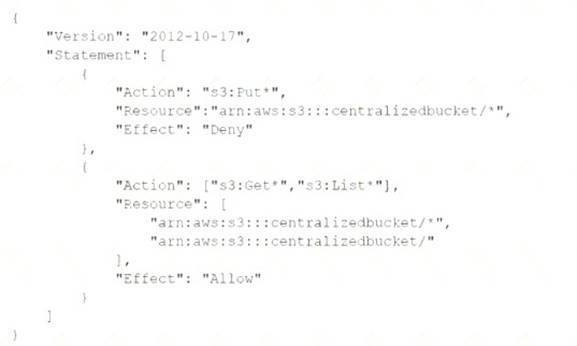
The centralized S3 bucket policy looks like this: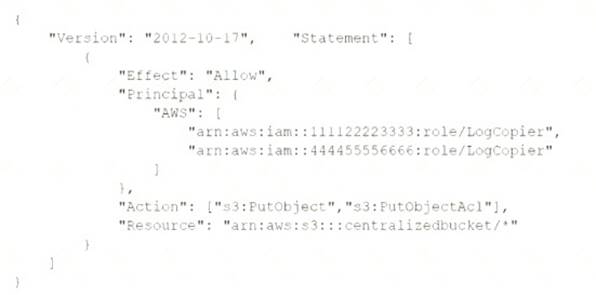
Why is the Security Engineer unable to access the log files?
- A. The S3 bucket policy does not explicitly allow the Security Engineer access to the objects in the bucket.
- B. The object ACLs are not being updated to allow the users within the centralized account to access the objects
- C. The Security Engineers IAM policy does not grant permissions to read objects in the S3 bucket
- D. The s3:PutObject and s3:PutObjectAcl permissions should be applied at the S3 bucket level
Answer: C
NEW QUESTION 14
A security engineer configures Amazon S3 Cross-Region Replication (CRR) for all objects that are in an S3 bucket in the us-east-1. Region Some objects in this S3 bucket use server-side encryption with AWS KMS keys (SSE-KMS) for encryption at test. The security engineer creates a destination S3 bucket in the us-west-2 Region. The destination S3 bucket is in the same AWS account as the source S3 bucket.
The security engineer also creates a customer managed key in us-west-2 to encrypt objects at rest in the destination S3 bucket. The replication configuration is set to use the key in us-west-2 to encrypt objects in the destination S3 bucket. The security engineer has provided the S3 replication configuration with an IAM role to perform the replication in Amazon S3.
After a day, the security engineer notices that no encrypted objects from the source S3 bucket are replicated to the destination S3 bucket. However, all the unencrypted objects are replicated.
Which combination of steps should the security engineer take to remediate this issue? (Select THREE.)
- A. Change the replication configuration to use the key in us-east-1 to encrypt the objects that are in the destination S3 bucket.
- B. Grant the IAM role the km
- C. Encrypt permission for the key in us-east-1 that encrypts source objects.
- D. Grant the IAM role the s3 GetObjectVersionForReplication permission for objects that are in the source S3 bucket.
- E. Grant the IAM role the km
- F. Decrypt permission for the key in us-east-1 that encrypts source objects.
- G. Change the key policy of the key in us-east-1 to grant the km
- H. Decrypt permission to the security engineer's IAM account.
- I. Grant the IAM role the kms Encrypt permission for the key in us-west-2 that encrypts objects that are in the destination S3 bucket.
Answer: BF
Explanation:
To enable S3 Cross-Region Replication (CRR) for objects that are encrypted with SSE-KMS, the following steps are required: Grant the IAM role the kms.Decrypt permission for the key in us-east-1 that encrypts source objects.
This will allow the IAM role to decrypt the source objects before replicating them to the destination bucket. The kms.Decrypt permission must be granted in the key policy of the source KMS key or in an IAM policy attached to the IAM role. Grant the IAM role the kms.Encrypt permission for the key in us-west-2 that encrypts objects that are in the destination S3 bucket. This will allow the IAM role to encrypt the replica objects with the destination KMS key before storing them in the destination bucket. The kms.Encrypt permission must be granted in the key policy of the destination KMS key or in an IAM policy attached to the IAM role.
This solution will remediate the issue of encrypted objects not being replicated to the destination bucket.
The other options are incorrect because they either do not grant the necessary permissions for CRR (A, C, D), or do not use a valid encryption method for CRR (E).
Verified References: https://docs.aws.amazon.com/AmazonS3/latest/userguide/replication-config-for-kms-objects.html
NEW QUESTION 15
A company wants to protect its website from man in-the-middle attacks by using Amazon CloudFront. Which solution will meet these requirements with the LEAST operational overhead?
- A. Use the SimpleCORS managed response headers policy.
- B. Use a Lambda@Edge function to add the Strict-Transport-Security response header.
- C. Use the SecurityHeadersPolicy managed response headers policy.
- D. Include the X-XSS-Protection header in a custom response headers policy.
Answer: C
Explanation:
https://docs.aws.amazon.com/AmazonCloudFront/latest/DeveloperGuide/using-managed-response-headers-poli The SecurityHeadersPolicy is a managed policy provided by Amazon CloudFront that includes a set of recommended security headers to enhance the security of your website. These headers help protect against various types of attacks, including man-in-the-middle attacks. By applying the SecurityHeadersPolicy to your CloudFront distribution, the necessary security headers will be automatically added to the responses sent by CloudFront. This reduces operational overhead because you don't have to manually configure or manage the headers yourself.
NEW QUESTION 16
A company is operating a website using Amazon CloudFornt. CloudFront servers some content from Amazon S3 and other from web servers running EC2 instances behind an Application. Load Balancer (ALB). Amazon DynamoDB is used as the data store. The company already uses IAM Certificate Manager (ACM) to store a public TLS certificate that can optionally secure connections between the website users and CloudFront. The company has a new requirement to enforce end-to-end encryption in transit.
Which combination of steps should the company take to meet this requirement? (Select THREE.)
- A. Update the CloudFront distributio
- B. configuring it to optionally use HTTPS when connecting to origins on Amazon S3
- C. Update the web application configuration on the web servers to use HTTPS instead of HTTP when connecting to DynamoDB
- D. Update the CloudFront distribution to redirect HTTP corrections to HTTPS
- E. Configure the web servers on the EC2 instances to listen using HTTPS using the public ACM TLS certificate Update the ALB to connect to the target group using HTTPS
- F. Update the ALB listen to listen using HTTPS using the public ACM TLS certificat
- G. Update the CloudFront distribution to connect to the HTTPS listener.
- H. Create a TLS certificate Configure the web servers on the EC2 instances to use HTTPS only with that certificat
- I. Update the ALB to connect to the target group using HTTPS.
Answer: BCE
Explanation:
To enforce end-to-end encryption in transit, the company should do the following: Update the web application configuration on the web servers to use HTTPS instead of HTTP when connecting to DynamoDB. This ensures that the data is encrypted when it travels from the web servers to the data store. Update the CloudFront distribution to redirect HTTP requests to HTTPS. This ensures that the viewers always use HTTPS when they access the website through CloudFront.
 Update the ALB to listen using HTTPS using the public ACM TLS certificate. Update the CloudFront distribution to connect to the HTTPS listener. This ensures that the data is encrypted when it travels from CloudFront to the ALB and from the ALB to the web servers.
NEW QUESTION 17
A Security Engineer receives alerts that an Amazon EC2 instance on a public subnet is under an SFTP brute force attack from a specific IP address, which is a known malicious bot. What should the Security Engineer do to block the malicious bot?
- A. Add a deny rule to the public VPC security group to block the malicious IP
- B. Add the malicious IP to IAM WAF backhsted IPs
- C. Configure Linux iptables or Windows Firewall to block any traffic from the malicious IP
- D. Modify the hosted zone in Amazon Route 53 and create a DNS sinkhole for the malicious IP
Answer: D
Explanation:
what the Security Engineer should do to block the malicious bot. SFTP is a protocol that allows secure file transfer over SSH. EC2 is a service that provides virtual servers in the cloud. A public subnet is a subnet that has a route to an internet gateway, which allows it to communicate with the internet. A brute force attack is a type of attack that tries to guess passwords or keys by trying many possible combinations. A malicious bot is a software program that performs automated tasks for malicious purposes. Route 53 is a service that provides DNS resolution and domain name registration. A DNS sinkhole is a technique that redirects malicious or unwanted traffic to a different destination, such as a black hole server or a honeypot. By modifying the hosted zone in Route 53 and creating a DNS sinkhole for the malicious IP, the Security Engineer can block the malicious bot from reaching the EC2 instance on the public subnet. The other options are either ineffective or inappropriate for blocking the malicious bot.
NEW QUESTION 18
......
100% Valid and Newest Version SCS-C02 Questions & Answers shared by Allfreedumps.com, Get Full Dumps HERE: https://www.allfreedumps.com/SCS-C02-dumps.html (New 372 Q&As)