
Proper study guides for Updated Amazon-Web-Services AWS Certified Security - Specialty certified begins with Amazon-Web-Services SCS-C02 preparation products which designed to deliver the Validated SCS-C02 questions by making you pass the SCS-C02 test at your first time. Try the free SCS-C02 demo right now.
Free SCS-C02 Demo Online For Amazon-Web-Services Certifitcation:
NEW QUESTION 1
A Security Engineer creates an Amazon S3 bucket policy that denies access to all users. A few days later, the Security Engineer adds an additional statement to the bucket policy to allow read-only access to one other employee. Even after updating the policy, the employee still receives an access denied message.
What is the likely cause of this access denial?
- A. The ACL in the bucket needs to be updated
- B. The IAM policy does not allow the user to access the bucket
- C. It takes a few minutes for a bucket policy to take effect
- D. The allow permission is being overridden by the deny
Answer: D
NEW QUESTION 2
A Security Engineer is troubleshooting an issue with a company's custom logging application. The application logs are written to an Amazon S3 bucket with event notifications enabled to send events lo an Amazon SNS topic. All logs are encrypted at rest using an IAM KMS CMK. The SNS topic is subscribed to an encrypted Amazon SQS queue. The logging application polls the queue for new messages that contain metadata about the S3 object. The application then reads the content of the object from the S3 bucket for indexing.
The Logging team reported that Amazon CloudWatch metrics for the number of messages sent or received is showing zero. No togs are being received.
What should the Security Engineer do to troubleshoot this issue?
A) Add the following statement to the IAM managed CMKs: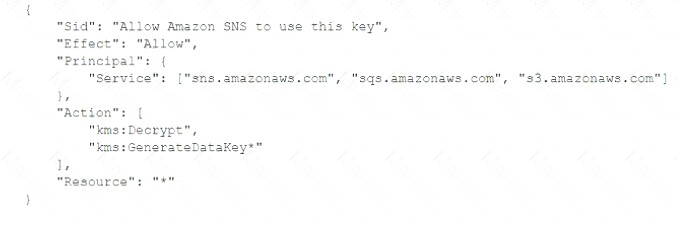
B)
Add the following statement to the CMK key policy: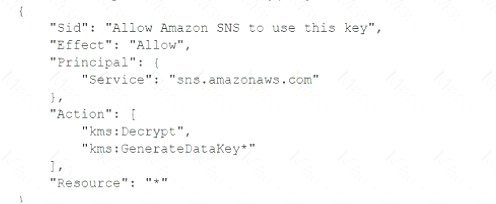
C)
Add the following statement to the CMK key policy: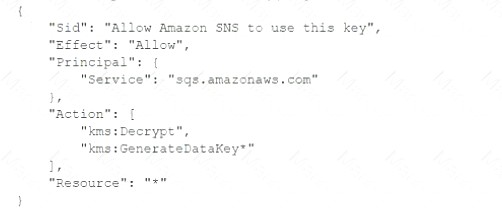
D)
Add the following statement to the CMK key policy: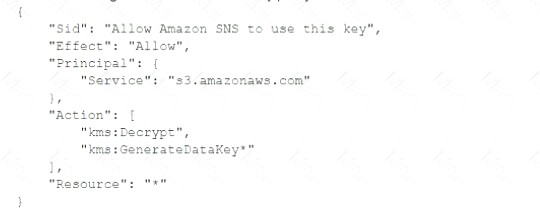
- A. Option A
- B. Option B
- C. Option C
- D. Option D
Answer: D
NEW QUESTION 3
Your CTO thinks your IAM account was hacked. What is the only way to know for certain if there was unauthorized access and what they did, assuming your hackers are very sophisticated IAM engineers and doing everything they can to cover their tracks?
Please select:
- A. Use CloudTrail Log File Integrity Validation.
- B. Use IAM Config SNS Subscriptions and process events in real time.
- C. Use CloudTrail backed up to IAM S3 and Glacier.
- D. Use IAM Config Timeline forensics.
Answer: A
Explanation:
The IAM Documentation mentions the following
To determine whether a log file was modified, deleted, or unchanged after CloudTrail delivered it you can use CloudTrail log file integrity validation. This feature is built using industry standard algorithms: SHA-256 for hashing and SHA-256 with RSA for digital signing. This makes it computationally infeasible to modify, delete or forge CloudTrail log files without detection. You can use the IAM CLI to validate the files in the location where CloudTrail delivered them
Validated log files are invaluable in security and forensic investigations. For example, a validated log file enables you to assert positively that the log file itself has not changed, or that particular user credentials performed specific API activity. The CloudTrail log file integrity validation process also lets you know if a log file has been deleted or changed, or assert positively that no log files were delivered to your account during a given period of time.
Options B.C and D is invalid because you need to check for log File Integrity Validation for cloudtrail logs For more information on Cloudtrail log file validation, please visit the below URL: http://docs.IAM.amazon.com/IAMcloudtrail/latest/userguide/cloudtrail-log-file-validation-intro.html
The correct answer is: Use CloudTrail Log File Integrity Validation. omit your Feedback/Queries to our Expert
NEW QUESTION 4
A company is deploying an Amazon EC2-based application. The application will include a custom health-checking component that produces health status data in JSON format. A Security Engineer must
implement a secure solution to monitor application availability in near-real time by analyzing the hearth status data.
Which approach should the Security Engineer use?
- A. Use Amazon CloudWatch monitoring to capture Amazon EC2 and networking metrics Visualizemetrics using Amazon CloudWatch dashboards.
- B. Run the Amazon Kinesis Agent to write the status data to Amazon Kinesis Data Firehose Store the streaming data from Kinesis Data Firehose in Amazon Redshif
- C. (hen run a script on the pool data and analyze the data in Amazon Redshift
- D. Write the status data directly to a public Amazon S3 bucket from the health-checking component Configure S3 events to invoke an IAM Lambda function that analyzes the data
- E. Generate events from the health-checking component and send them to Amazon CloudWatch Events.Include the status data as event payload
- F. Use CloudWatch Events rules to invoke an IAM Lambda function that analyzes the data.
Answer: A
Explanation:
Amazon CloudWatch monitoring is a service that collects and tracks metrics from AWS resources and applications, and provides visualization tools and alarms to monitor performance and availability1. The health status data in JSON format can be sent to CloudWatch as custom metrics2, and then displayed in CloudWatch dashboards3. The other options are either inefficient or insecure for monitoring application availability in near-real time.
NEW QUESTION 5
A company's Security Auditor discovers that users are able to assume roles without using multi-factor authentication (MFA). An example of a current policy being applied to these users is as follows: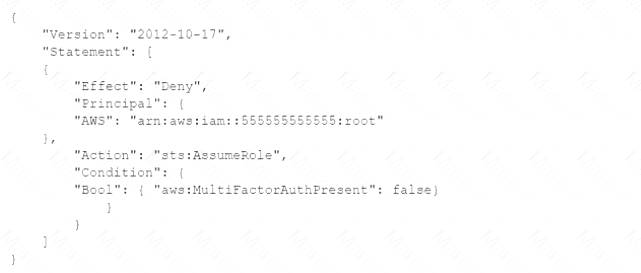
The Security Auditor finds that the users who are able to assume roles without MFA are alt coming from the IAM CLI. These users are using long-term IAM credentials. Which changes should a Security Engineer implement to resolve this security issue? (Select TWO.)
A)
B)
C)
D)
E)
- A. Option A
- B. Option B
- C. Option C
- D. Option D
- E. Option E
Answer: AD
NEW QUESTION 6
A company stores sensitive documents in Amazon S3 by using server-side encryption with an IAM Key Management Service (IAM KMS) CMK. A new requirement mandates that the CMK that is used for these documents can be used only for S3 actions.
Which statement should the company add to the key policy to meet this requirement?
A)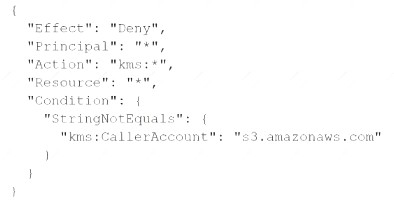
B)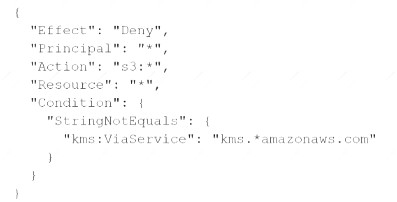
- A. Option A
- B. Option B
Answer: A
NEW QUESTION 7
A company hosts business-critical applications on Amazon EC2 instances in a VPC. The VPC uses default DHCP options sets. A security engineer needs to log all DNS queries that internal resources make in the VPC. The security engineer also must create a list of the most common DNS queries over time.
Which solution will meet these requirements?
- A. Install the Amazon CloudWatch agent on each EC2 instance in the VP
- B. Use the CloudWatch agent to stream the DNS query logs to an Amazon CloudWatch Logs log grou
- C. Use CloudWatch metric filters to automatically generate metrics that list the most common ONS queries.
- D. Install a BIND DNS server in the VP
- E. Create a bash script to list the DNS request number of common DNS queries from the BIND logs.
- F. Create VPC flow logs for all subnets in the VP
- G. Stream the flow logs to an Amazon CloudWatch Logs log grou
- H. Use CloudWatch Logs Insights to list the most common DNS queries for the log group in a custom dashboard.
- I. Configure Amazon Route 53 Resolver query loggin
- J. Add an Amazon CloudWatch Logs log group as the destinatio
- K. Use Amazon CloudWatch Contributor Insights to analyze the data and create time series that display the most common DNS queries.
Answer: D
Explanation:
https://aws.amazon.com/blogs/aws/log-your-vpc-dns-queries-with-route-53-resolver-query-logs/
NEW QUESTION 8
A company deploys a set of standard IAM roles in AWS accounts. The IAM roles are based on job functions within the company. To balance operational efficiency and security, a security engineer implemented AWS Organizations SCPs to restrict access to critical security services in all company accounts.
All of the company's accounts and OUs within AWS Organizations have a default FullAWSAccess SCP that is attached. The security engineer needs to ensure that no one can disable Amazon GuardDuty and AWS Security Hub. The security engineer also must not override other permissions that are granted by IAM policies that are defined in the accounts.
Which SCP should the security engineer attach to the root of the organization to meet these requirements? A)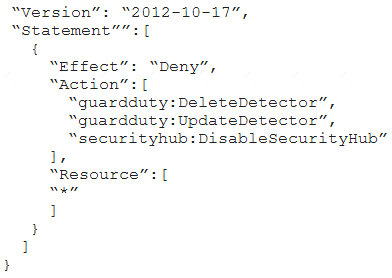
B)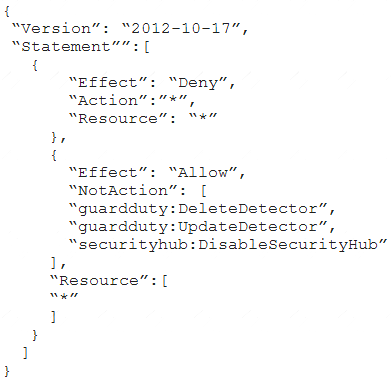
C)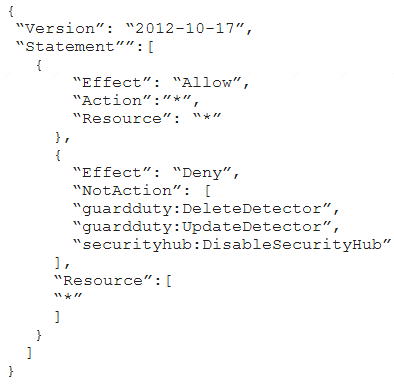
D)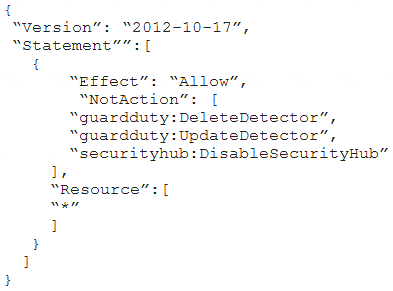
- A. Option A
- B. Option B
- C. Option C
- D. Option D
Answer: A
NEW QUESTION 9
A company has an application that uses dozens of Amazon DynamoDB tables to store data. Auditors find that the tables do not comply with the company's data protection policy.
The company's retention policy states that all data must be backed up twice each month: once at midnight on the 15th day of the month and again at midnight on the 25th day of the month. The company must retain the backups for 3 months.
Which combination of steps should a security engineer take to meet these re-quirements? (Select TWO.)
- A. Use the DynamoDB on-demand backup capability to create a backup pla
- B. Con-figure a lifecycle policy to expire backups after 3 months.
- C. Use AWS DataSync to create a backup pla
- D. Add a backup rule that includes a retention period of 3 months.
- E. Use AVVS Backup to create a backup pla
- F. Add a backup rule that includes a retention period of 3 months.
- G. Set the backup frequency by using a cron schedule expressio
- H. Assign each DynamoDB table to the backup plan.
- I. Set the backup frequency by using a rate schedule expressio
- J. Assign each DynamoDB table to the backup plan.
Answer: AD
NEW QUESTION 10
A company manages three separate IAM accounts for its production, development, and test environments, Each Developer is assigned a unique IAM user under the development account. A new application hosted on an Amazon EC2 instance in the developer account requires read access to the archived documents stored in an Amazon S3 bucket in the production account.
How should access be granted?
- A. Create an IAM role in the production account and allow EC2 instances in the development account to assume that role using the trust polic
- B. Provide read access for the required S3 bucket to this role.
- C. Use a custom identity broker to allow Developer IAM users to temporarily access the S3 bucket.
- D. Create a temporary IAM user for the application to use in the production account.
- E. Create a temporary IAM user in the production account and provide read access to Amazon S3.Generate the temporary IAM user's access key and secret key and store these on the EC2 instance used by the application in the development account.
Answer: A
Explanation:
https://IAM.amazon.com/premiumsupport/knowledge-center/cross-account-access-s3/
NEW QUESTION 11
A company has an application that uses an Amazon RDS PostgreSQL database. The company is developing an application feature that will store sensitive information for an individual in the database.
During a security review of the environment, the company discovers that the RDS DB instance is not encrypting data at rest. The company needs a solution that will provide encryption at rest for all the existing data and for any new data that is entered for an individual.
Which combination of options can the company use to meet these requirements? (Select TWO.)
- A. Create a snapshot of the DB instanc
- B. Copy the snapshot to a new snapshot, and enable encryption for the copy proces
- C. Use the new snapshot to restore the DB instance.
- D. Modify the configuration of the DB instance by enabling encryptio
- E. Create a snapshot of the DB instanc
- F. Use the snapshot to restore the DB instance.
- G. Use IAM Key Management Service (IAM KMS) to create a new default IAM managed awa/rds key.Select this key as the encryption key for operations with Amazon RDS.
- H. Use IAM Key Management Service (IAM KMS] to create a new CM
- I. Select this key as the encryption key for operations with Amazon RDS.
- J. Create a snapshot of the DB instanc
- K. Enable encryption on the snapshoVUse the snapshot to restore the DB instance.
Answer: CE
NEW QUESTION 12
A company's security engineer is developing an incident response plan to detect suspicious activity in an AWS account for VPC hosted resources. The security engineer needs to provide visibility for as many AWS Regions as possible.
Which combination of steps will meet these requirements MOST cost-effectively? (Select TWO.)
- A. Turn on VPC Flow Logs for all VPCs in the account.
- B. Activate Amazon GuardDuty across all AWS Regions.
- C. Activate Amazon Detective across all AWS Regions.
- D. Create an Amazon Simple Notification Service (Amazon SNS) topi
- E. Create an Amazon EventBridge rule that responds to findings and publishes the find-ings to the SNS topic.
- F. Create an AWS Lambda functio
- G. Create an Amazon EventBridge rule that in-vokes the Lambda function to publish findings to Amazon Simple Email Ser-vice (Amazon SES).
Answer: BD
Explanation:
To detect suspicious activity in an AWS account for VPC hosted resources, the security engineer needs to use a service that can monitor network traffic and API calls across all AWS Regions. Amazon GuardDuty is a threat detection service that can do this by analyzing VPC Flow Logs, AWS CloudTrail event logs, and DNS logs. By activating GuardDuty across all AWS Regions, the security engineer can provide visibility for as many regions as possible. GuardDuty generates findings that contain details about the potential threats detected in the account. To respond to these findings, the security engineer needs to create a mechanism that can notify the relevant stakeholders or take remedial actions. One way to do this is to use Amazon EventBridge, which is a serverless event bus service that can connect AWS services and third-party applications. By creating an EventBridge rule that responds to GuardDuty findings and publishes them to an Amazon Simple Notification Service (Amazon SNS) topic, the security engineer can enable subscribers of the topic to receive notifications via email, SMS, or other methods. This is a cost-effective solution that does not require any additional infrastructure or code.
NEW QUESTION 13
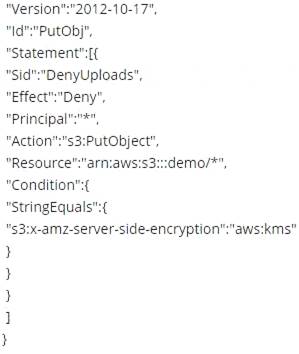
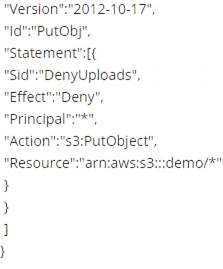
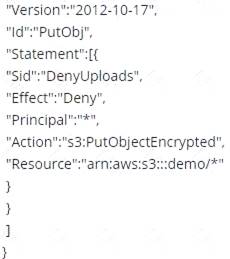
Which of the following bucket policies will ensure that objects being uploaded to a bucket called 'demo' are encrypted.
Please select:
- A. C:\Users\wk\Desktop\mudassar\Untitled.jpg
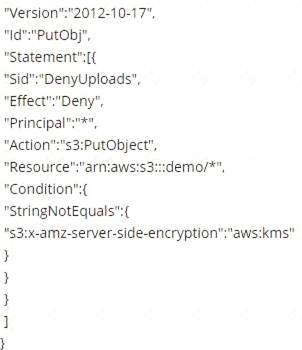
- B. C:\Users\wk\Desktop\mudassar\Untitled.jpg
- C. C:\Users\wk\Desktop\mudassar\Untitled.jpg
- D. C:\Users\wk\Desktop\mudassar\Untitled.jpg
Answer: A
Explanation:
The condition of "s3:x-amz-server-side-encryption":"IAM:kms" ensures that objects uploaded need to be encrypted.
Options B,C and D are invalid because you have to ensure the condition of ns3:x-amz-server-side-encryption":"IAM:kms" is present
For more information on IAM KMS best practices, just browse to the below URL: https://dl.IAMstatic.com/whitepapers/IAM-kms-best-praaices.pdf
Submit your Feedback/Queries to our Expert
NEW QUESTION 14
A company is using Amazon Macie, AWS Firewall Manager, Amazon Inspector, and AWS Shield Advanced in its AWS account. The company wants to receive alerts if a DDoS attack occurs against the account.
Which solution will meet this requirement?
- A. Use Macie to detect an active DDoS even
- B. Create Amazon CloudWatch alarms that respond to Macie findings.
- C. Use Amazon Inspector to review resources and to invoke Amazon CloudWatch alarms for any resources that are vulnerable to DDoS attacks.
- D. Create an Amazon CloudWatch alarm that monitors Firewall Manager metrics for an active DDoS event.
- E. Create an Amazon CloudWatch alarm that monitors Shield Advanced metrics for an active DDoS event.
Answer: D
Explanation:
This answer is correct because AWS Shield Advanced is a service that provides comprehensive protection
against DDoS attacks of any size or duration. It also provides metrics and reports on the DDoS attack vectors, duration, and size. You can create an Amazon CloudWatch alarm that monitors Shield Advanced metrics such as DDoSAttackBitsPerSecond, DDoSAttackPacketsPerSecond, and DDoSAttackRequestsPerSecond to receive alerts if a DDoS attack occurs against your account.
For more information, see Monitoring AWS Shield Advanced with Amazon CloudWatch and AWS Shield Advanced metrics and alarms.
NEW QUESTION 15
A company uses an external identity provider to allow federation into different IAM accounts. A security engineer for the company needs to identify the federated user that terminated a production Amazon EC2 instance a week ago.
What is the FASTEST way for the security engineer to identify the federated user?
- A. Review the IAM CloudTrail event history logs in an Amazon S3 bucket and look for the Terminatelnstances event to identify the federated user from the role session name.
- B. Filter the IAM CloudTrail event history for the Terminatelnstances event and identify the assumed IAM rol
- C. Review the AssumeRoleWithSAML event call in CloudTrail to identify the corresponding username.
- D. Search the IAM CloudTrail logs for the Terminatelnstances event and note the event tim
- E. Review the IAM Access Advisor tab for all federated role
- F. The last accessed time should match the time when the instance was terminated.
- G. Use Amazon Athena to run a SQL query on the IAM CloudTrail logs stored in an Amazon S3 bucket and filter on the Terminatelnstances even
- H. Identify the corresponding role and run another query to filter the AssumeRoleWithWebldentity event for the user name.
Answer: B
Explanation:
The fastest way to identify the federated user who terminated a production Amazon EC2 instance is to filter the IAM CloudTrail event history for the TerminateInstances event and identify the assumed IAM role. Then, review the AssumeRoleWithSAML event call in CloudTrail to identify the corresponding username. This method does not require any additional tools or queries, and it directly links the IAM role with the federated user.
Option A is incorrect because the role session name may not be the same as the federated user name, and it may not be unique or descriptive enough to identify the user.
Option C is incorrect because the IAM Access Advisor tab only shows when a role was last accessed, not by whom or for what purpose. It also does not show the specific time of access, only the date.
Option D is incorrect because using Amazon Athena to run SQL queries on the IAM CloudTrail logs is not the fastest way to identify the federated user, as it requires creating a table schema and running multiple queries. It also assumes that the federation is done using web identity providers, not SAML providers, as indicated by the AssumeRoleWithWebIdentity event.
References: AWS Identity and Access Management Logging AWS STS API Calls with AWS CloudTrail [Using Amazon Athena to Query S3 Data for CloudTrail Analysis]
NEW QUESTION 16
A security engineer receives a notice from the AWS Abuse team about suspicious activity from a Linux-based Amazon EC2 instance that uses Amazon Elastic Block Store (Amazon EBS>-based storage The instance is making connections to known malicious addresses
The instance is in a development account within a VPC that is in the us-east-1 Region The VPC contains an internet gateway and has a subnet in us-east-1a and us-easMb Each subnet is associate with a route table that uses the internet gateway as a default route Each subnet also uses the default network ACL The suspicious EC2 instance runs within the us-east-1 b subnet. During an initial investigation a security engineer discovers that the suspicious instance is the only instance that runs in the subnet
Which response will immediately mitigate the attack and help investigate the root cause?
- A. Log in to the suspicious instance and use the netstat command to identify remote connections Use the IP addresses from these remote connections to create deny rules in the security group of the instance Install diagnostic tools on the instance for investigation Update the outbound network ACL for the subnet inus-east- lb to explicitly deny all connections as the first rule during the investigation of the instance
- B. Update the outbound network ACL for the subnet in us-east-1b to explicitly deny all connections as the first rule Replace the security group with a new security group that allows connections only from a diagnostics security group Update the outbound network ACL for the us-east-1b subnet to remove the deny all rule Launch a new EC2 instance that has diagnostic tools Assign the new security group to the new EC2 instance Use the new EC2 instance to investigate the suspicious instance
- C. Ensure that the Amazon Elastic Block Store (Amazon EBS) volumes that are attached to the suspicious EC2 instance will not delete upon termination Terminate the instance Launch a new EC2 instance inus-east-1a that has diagnostic tools Mount the EBS volumes from the terminated instance for investigation
- D. Create an AWS WAF web ACL that denies traffic to and from the suspicious instance Attach the AWS WAF web ACL to the instance to mitigate the attack Log in to the instance and install diagnostic tools to investigate the instance
Answer: B
Explanation:
This option suggests updating the outbound network ACL for the subnet in us-east-1b to explicitly deny all connections as the first rule, replacing the security group with a new one that only allows connections from a diagnostics security group, and launching a new EC2 instance with diagnostic tools to investigate the suspicious instance. This option will immediately mitigate the attack and provide the necessary tools for investigation.
NEW QUESTION 17
A developer signed in to a new account within an IAM Organization organizational unit (OU) containing multiple accounts. Access to the Amazon $3 service is restricted with the following SCP.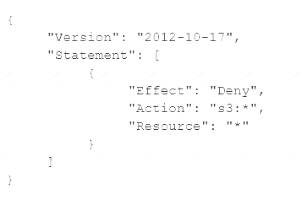
How can the security engineer provide the developer with Amazon $3 access without affecting other account?
- A. Move the SCP to the root OU of organization to remove the restriction to access Amazon $3.
- B. Add an IAM policy for the developer, which grants $3 access.
- C. Create a new OU without applying the SCP restricting $3 acces
- D. Move the developer account to this new OU.
- E. Add an allow list for the developer account for the $3 service.
Answer: C
NEW QUESTION 18
......
P.S. Easily pass SCS-C02 Exam with 372 Q&As DumpSolutions.com Dumps & pdf Version, Welcome to Download the Newest DumpSolutions.com SCS-C02 Dumps: https://www.dumpsolutions.com/SCS-C02-dumps/ (372 New Questions)