
Exam Code: SCS-C02 (Practice Exam Latest Test Questions VCE PDF)
Exam Name: AWS Certified Security - Specialty
Certification Provider: Amazon-Web-Services
Free Today! Guaranteed Training- Pass SCS-C02 Exam.
Free demo questions for Amazon-Web-Services SCS-C02 Exam Dumps Below:
NEW QUESTION 1
A security engineer must use AWS Key Management Service (AWS KMS) to design a key management solution for a set of Amazon Elastic Block Store (Amazon EBS) volumes that contain sensitive data. The solution needs to ensure that the key material automatically expires in 90 days.
Which solution meets these criteria?
- A. A customer managed CMK that uses customer provided key material
- B. A customer managed CMK that uses AWS provided key material
- C. An AWS managed CMK
- D. Operation system-native encryption that uses GnuPG
Answer: A
Explanation:
https://awscli.amazonaws.com/v2/documentation/api/latest/reference/kms/import-key-material.html aws kms import-key-material \
--key-id 1234abcd-12ab-34cd-56ef-1234567890ab \
--encrypted-key-material fileb://EncryptedKeyMaterial.bin \
--import-token fileb://ImportToken.bin \
--expiration-model KEY_MATERIAL_EXPIRES \
--valid-to 2021-09-21T19:00:00Z
The correct answer is A. A customer managed CMK that uses customer provided key material.
A customer managed CMK is a KMS key that you create, own, and manage in your AWS account. You have full control over the key configuration, permissions, rotation, and deletion. You can use a customer managed CMK to encrypt and decrypt data in AWS services that are integrated with AWS KMS, such as Amazon EBS1.
A customer managed CMK can use either AWS provided key material or customer provided key material. AWS provided key material is generated by AWS KMS and never leaves the service unencrypted. Customer provided key material is generated outside of AWS KMS and imported into a customer managed CMK. You can specify an expiration date for the imported key material, after which the CMK becomes unusable until you reimport new key material2.
To meet the criteria of automatically expiring the key material in 90 days, you need to use customer provided key material and set the expiration date accordingly. This way, you can ensure that the data encrypted with the CMK will not be accessible after 90 days unless you reimport new key material and re-encrypt the data.
The other options are incorrect for the following reasons:
* B. A customer managed CMK that uses AWS provided key material does not expire automatically. You can enable automatic rotation of the key material every year, but this does not prevent access to the data encrypted with the previous key material. You would need to manually delete the CMK and its backing key material to make the data inaccessible3.
* C. An AWS managed CMK is a KMS key that is created, owned, and managed by an AWS service on your behalf. You have limited control over the key configuration, permissions, rotation, and deletion. You cannot use an AWS managed CMK to encrypt data in other AWS services or applications. You also cannot set an expiration date for the key material of an AWS managed CMK4.
* D. Operation system-native encryption that uses GnuPG is not a solution that uses AWS KMS. GnuPG is a command line tool that implements the OpenPGP standard for encrypting and signing data. It does not integrate with Amazon EBS or other AWS services. It also does not provide a way to automatically expire the key material used for encryption5.
References:
1: Customer Managed Keys - AWS Key Management Service 2: [Importing Key Material in AWS Key Management Service (AWS KMS) - AWS Key Management Service] 3: [Rotating Customer Master Keys - AWS Key Management Service] 4: [AWS Managed Keys - AWS Key Management Service] 5: The GNU Privacy Guard
NEW QUESTION 2
Your development team is using access keys to develop an application that has access to S3 and DynamoDB. A new security policy has outlined that the credentials should not be older than 2 months, and should be rotated. How can you achieve this?
Please select:
- A. Use the application to rotate the keys in every 2 months via the SDK
- B. Use a script to query the creation date of the key
- C. If older than 2 months, create new access key and update all applications to use it inactivate the old key and delete it.
- D. Delete the user associated with the keys after every 2 month
- E. Then recreate the user again.
- F. Delete the IAM Role associated with the keys after every 2 month
- G. Then recreate the IAM Role again.
Answer: B
Explanation:
One can use the CLI command list-access-keys to get the access keys. This command also returns the "CreateDate" of the keys. If the CreateDate is older than 2 months, then the keys can be deleted.
The Returns list-access-keys CLI command returns information about the access key IDs associated with the specified IAM user. If there are none, the action returns an empty list
Option A is incorrect because you might as use a script for such maintenance activities Option C is incorrect because you would not rotate the users themselves
Option D is incorrect because you don't use IAM roles for such a purpose For more information on the CLI command, please refer to the below Link: http://docs.IAM.amazon.com/cli/latest/reference/iam/list-access-keys.htmll
The correct answer is: Use a script to query the creation date of the keys. If older than 2 months, create new access key and update all applications to use it inactivate the old key and delete it.
Submit your Feedback/Queries to our Experts
NEW QUESTION 3
A company that uses AWS Organizations wants to see AWS Security Hub findings for many AWS accounts and AWS Regions. Some of the accounts are in the company's organization, and some accounts are in organizations that the company manages for customers. Although the company can see findings in the Security Hub administrator account for accounts in the company's organization, there are no findings from accounts in other organizations.
Which combination of steps should the company take to see findings from accounts that are outside the organization that includes the Security Hub administrator account? (Select TWO.)
- A. Use a designated administration account to automatically set up member accounts.
- B. Create the AWS Service Role ForSecurrty Hub service-linked rote for Security Hub.
- C. Send an administration request from the member accounts.
- D. Enable Security Hub for all member accounts.
- E. Send invitations to accounts that are outside the company's organization from the Security Hub administrator account.
Answer: CE
Explanation:
To see Security Hub findings for accounts that are outside the organization that includes the Security Hub administrator account, the following steps are required: Send invitations to accounts that are outside the company’s organization from the Security Hub administrator account. This will allow the administrator account to view and manage findings from those accounts. The administrator account can send invitations by using the Security Hub console, API, or CLI. For more information, see Sending invitations to member accounts. Send an administration request from the member accounts. This will allow the member accounts to accept the invitation from the administrator account and establish a relationship with it. The member accounts can send administration requests by using the Security Hub console, API, or CLI. For more information, see Sending administration requests.
This solution will enable the company to see Security Hub findings for many AWS accounts and AWS Regions, including accounts that are outside its own organization.
The other options are incorrect because they either do not establish a relationship between the administrator and member accounts (A, B), do not enable Security Hub for all member accounts (D), or do not use a valid service for Security Hub (F).
Verified References: https://docs.aws.amazon.com/securityhub/latest/userguide/securityhub-member-accounts.html
NEW QUESTION 4
A company is running internal microservices on Amazon Elastic Container Service (Amazon ECS) with the Amazon EC2 launch type. The company is using Amazon Elastic Container Registry (Amazon ECR) private repositories.
A security engineer needs to encrypt the private repositories by using AWS Key Management Service (AWS KMS). The security engineer also needs to analyze the container images for any common vulnerabilities and exposures (CVEs).
Which solution will meet these requirements?
- A. Enable KMS encryption on the existing ECR repositorie
- B. Install Amazon Inspector Agent from the ECS container instances’ user dat
- C. Run an assessment with the CVE rules.
- D. Recreate the ECR repositories with KMS encryption and ECR scanning enable
- E. Analyze the scan report after the next push of images.
- F. Recreate the ECR repositories with KMS encryption and ECR scanning enable
- G. Install AWS Systems Manager Agent on the ECS container instance
- H. Run an inventory report.
- I. Enable KMS encryption on the existing ECR repositorie
- J. Use AWS Trusted Advisor to check the ECS container instances and to verily the findings against a list of current CVEs.
Answer: B
NEW QUESTION 5
A company is undergoing a layer 3 and layer 4 DDoS attack on its web servers running on IAM.
Which combination of IAM services and features will provide protection in this scenario? (Select THREE).
- A. Amazon Route 53
- B. IAM Certificate Manager (ACM)
- C. Amazon S3
- D. IAM Shield
- E. Elastic Load Balancer
- F. Amazon GuardDuty
Answer: DEF
NEW QUESTION 6
A security engineer wants to evaluate configuration changes to a specific AWS resource to ensure that the resource meets compliance standards. However, the security engineer is concerned about a situation in which several configuration changes are made to the resource in quick succession. The security engineer wants to record only the latest configuration of that resource to indicate the cumulative impact of the set of changes.
Which solution will meet this requirement in the MOST operationally efficient way?
- A. Use AWS CloudTrail to detect the configuration changes by filtering API calls to monitor the changes.Use the most recent API call to indicate the cumulative impact of multiple calls
- B. Use AWS Config to detect the configuration changes and to record the latest configuration in case of multiple configuration changes.
- C. Use Amazon CloudWatch to detect the configuration changes by filtering API calls to monitor the change
- D. Use the most recent API call to indicate the cumulative impact of multiple calls.
- E. Use AWS Cloud Map to detect the configuration change
- F. Generate a report of configuration changes from AWS Cloud Map to track the latest state by using a sliding time window.
Answer: B
Explanation:
AWS Config is a service that enables you to assess, audit, and evaluate the configurations of your AWS resources. AWS Config continuously monitors and records your AWS resource configurations and allows you to automate the evaluation of recorded configurations against desired configurations.
To evaluate configuration changes to a specific AWS resource and ensure that it meets compliance standards, the security engineer should use AWS Config to detect the configuration changes and to record the latest configuration in case of multiple configuration changes. This will allow the security engineer to view the current state of the resource and its compliance status, as well as its configuration history and timeline.
AWS Config records configuration changes as ConfigurationItems, which are point-in-time snapshots of the resource’s attributes, relationships, and metadata. If multiple configuration changes occur within a short period of time, AWS Config records only the latest ConfigurationItem for that resource. This indicates the cumulative impact of the set of changes on the resource’s configuration.
This solution will meet the requirement in the most operationally efficient way, as it leverages AWS Config’s features to monitor, record, and evaluate resource configurations without requiring additional tools or services.
The other options are incorrect because they either do not record the latest configuration in case of multiple configuration changes (A, C), or do not use a valid service for evaluating resource configurations (D).
Verified References: https://docs.aws.amazon.com/config/latest/developerguide/WhatIsConfig.html
 https://docs.aws.amazon.com/config/latest/developerguide/config-item-table.html
NEW QUESTION 7
A web application gives users the ability to log in verify their membership's validity and browse artifacts that are stored in an Amazon S3 bucket. When a user attempts to download an object, the application must verify the permission to access the object and allow the user to download the object from a custom domain name such as example com.
What is the MOST secure way for a security engineer to implement this functionality?
- A. Configure read-only access to the object by using a bucket AC
- B. Remove the access after a set time has elapsed.
- C. Implement an IAM policy to give the user read access to the S3 bucket.
- D. Create an S3 presigned URL Provide the S3 presigned URL to the user through the application.
- E. Create an Amazon CloudFront signed UR
- F. Provide the CloudFront signed URL to the user through the application.
Answer: D
Explanation:
For this scenario you would need to set up static website hosting because a custom domain name is listed as a requirement. "Amazon S3 website endpoints do not support HTTPS or access points. If you want to use HTTPS, you can use Amazon CloudFront to serve a static website hosted on Amazon S3." This is not secure. https://docs.aws.amazon.com/AmazonS3/latest/userguide/website-hosting-custom-domain-walkthrough.html CloudFront signed URLs allow much more fine-grained control as well as HTTPS access with custom domain names:
https://docs.aws.amazon.com/AmazonCloudFront/latest/DeveloperGuide/private-content-signed-urls.html
NEW QUESTION 8
A company uses Amazon GuardDuty. The company's security team wants all High severity findings to automatically generate a ticket in a third-party ticketing system through email integration.
Which solution will meet this requirement?
- A. Create a verified identity for the third-party ticketing email system in Amazon Simple Email Service (Amazon SES). Create an Amazon EventBridge rule that includes an event pattern that matches High severity GuardDuty finding
- B. Specify the SES identity as the target for the EventBridge rule.
- C. Create an Amazon Simple Notification Service (Amazon SNS) topi
- D. Subscribe the third-party ticketing email system to the SNS topi
- E. Create an Amazon EventBridge rule that includes an event pattern that matches High severity GuardDuty finding
- F. Specify the SNS topic as the target for the EventBridge rule.
- G. Use the GuardDuty CreateFilter API operation to build a filter in GuardDuty to monitor for High severity finding
- H. Export the results of the filter to an Amazon Simple Notification Service (Amazon SNS) topi
- I. Subscribe the third-party ticketing email system to the SNS topic.
- J. Use the GuardDuty CreateFilter API operation to build a filter in GuardDuty to monitor for High severity finding
- K. Create an Amazon Simple Notification Service (Amazon SNS) topi
- L. Subscribe the third-party ticketing email system to the SNS topi
- M. Create an Amazon EventBridge rule that includes an event pattern that matches GuardDuty findings that are selected by the filte
- N. Specify the SNS topic as the target for the EventBridge rule.
Answer: B
Explanation:
The correct answer is B. Create an Amazon Simple Notification Service (Amazon SNS) topic. Subscribe the third-party ticketing email system to the SNS topic. Create an Amazon EventBridge rule that includes an event pattern that matches High severity GuardDuty findings. Specify the SNS topic as the target for the
Event-Bridge rule.
According to the AWS documentation1, you can use Amazon EventBridge to create rules that match events from GuardDuty and route them to targets such as Amazon SNS topics. You can use event patterns to filter events based on criteria such as severity, type, or resource. For example, you can create a rule that matches only High severity findings and sends them to an SNS topic that is subscribed by a third-party ticketing email system. This way, you can automate the creation of tickets for High severity findings and notify the security team.
NEW QUESTION 9
An IAM user receives an Access Denied message when the user attempts to access objects in an Amazon S3 bucket. The user and the S3 bucket are in the same AWS account. The S3 bucket is configured to use server-side encryption with AWS KMS keys (SSE-KMS) to encrypt all of its objects at rest by using a customer managed key from the same AWS account. The S3 bucket has no bucket policy defined. The IAM user has been granted permissions through an IAM policy that allows the kms:Decrypt permission to the customer managed key. The IAM policy also allows the s3:List* and s3:Get* permissions for the S3 bucket and its objects.
Which of the following is a possible reason that the IAM user cannot access the objects in the S3 bucket?
- A. The IAM policy needs to allow the kms:DescribeKey permission.
- B. The S3 bucket has been changed to use the AWS managed key to encrypt objects at rest.
- C. An S3 bucket policy needs to be added to allow the IAM user to access the objects.
- D. The KMS key policy has been edited to remove the ability for the AWS account to have full access to the key.
Answer: D
Explanation:
The possible reason that the IAM user cannot access the objects in the S3 bucket is D. The KMS key policy has been edited to remove the ability for the AWS account to have full access to the key.
This answer is correct because the KMS key policy is the primary way to control access to the KMS key, and it must explicitly allow the AWS account to have full access to the key. If the KMS key policy has been edited to remove this permission, then the IAM policy that grants kms:Decrypt permission to the IAM user has no effect, and the IAM user cannot decrypt the objects in the S3 bucket12.
The other options are incorrect because: A. The IAM policy does not need to allow the kms:DescribeKey permission, because this permission is not required for decrypting objects in S3 using SSE-KMS. The kms:DescribeKey permission allows getting information about a KMS key, such as its creation date, description, and key state3. B. The S3 bucket has not been changed to use the AWS managed key to encrypt objects at rest, because this would not cause an Access Denied message for the IAM user. The AWS managed key is a default KMS key that is created and managed by AWS for each AWS account and Region. The IAM user does not need any permissions on this key to use it for SSE-KMS4.
 C. An S3 bucket policy does not need to be added to allow the IAM user to access the objects, because the IAM user already has s3:List* and s3:Get* permissions for the S3 bucket and its objects through an IAM policy. An S3 bucket policy is an optional way to grant cross-account access or public access to an S3 bucket5.
References:
1: Key policies in AWS KMS 2: Using server-side encryption with AWS KMS keys (SSE-KMS) 3: AWS KMS API Permissions Reference 4: Using server-side encryption with Amazon S3 managed keys (SSE-S3) 5: Bucket policy examples
NEW QUESTION 10
A company uses AWS Organizations to manage a small number of AWS accounts. However, the company plans to add 1 000 more accounts soon. The company allows only a centralized security team to create IAM roles for all AWS accounts and teams. Application teams submit requests for IAM roles to the security team. The security team has a backlog of IAM role requests and cannot review and provision the IAM roles quickly.
The security team must create a process that will allow application teams to provision their own IAM roles. The process must also limit the scope of IAM roles and prevent privilege escalation.
Which solution will meet these requirements with the LEAST operational overhead?
- A. Create an IAM group for each application tea
- B. Associate policies with each IAM grou
- C. Provision IAM users for each application team membe
- D. Add the new IAM users to the appropriate IAM group by using role-based access control (RBAC).
- E. Delegate application team leads to provision IAM rotes for each tea
- F. Conduct a quarterly review of the IAM rotes the team leads have provisione
- G. Ensure that the application team leads have the appropriate training to review IAM roles.
- H. Put each AWS account in its own O
- I. Add an SCP to each OU to grant access to only the AWS services that the teams plan to us
- J. Include conditions tn the AWS account of each team.
- K. Create an SCP and a permissions boundary for IAM role
- L. Add the SCP to the root OU so that only roles that have the permissions boundary attached can create any new IAM roles.
Answer: D
Explanation:
To create a process that will allow application teams to provision their own IAM roles, while limiting the scope of IAM roles and preventing privilege escalation, the following steps are required: Create a service control policy (SCP) that defines the maximum permissions that can be granted to any IAM role in the organization. An SCP is a type of policy that you can use with AWS Organizations to manage permissions for all accounts in your organization. SCPs restrict permissions for entities in member accounts, including each AWS account root user, IAM users, and roles. For more information, see Service control policies overview. Create a permissions boundary for IAM roles that matches the SCP. A permissions boundary is an advanced feature for using a managed policy to set the maximum permissions that an identity-based policy can grant to an IAM entity. A permissions boundary allows an entity to perform only the actions
that are allowed by both its identity-based policies and its permissions boundaries. For more information, see Permissions boundaries for IAM entities. Add the SCP to the root organizational unit (OU) so that it applies to all accounts in the organization.
This will ensure that no IAM role can exceed the permissions defined by the SCP, regardless of how it is created or modified. Instruct the application teams to attach the permissions boundary to any IAM role they create. This will prevent them from creating IAM roles that can escalate their own privileges or access resources they are not authorized to access.
This solution will meet the requirements with the least operational overhead, as it leverages AWS Organizations and IAM features to delegate and limit IAM role creation without requiring manual reviews or approvals.
The other options are incorrect because they either do not allow application teams to provision their own IAM roles (A), do not limit the scope of IAM roles or prevent privilege escalation (B), or do not take advantage of managed services whenever possible ©.
Verified References:https://docs.aws.amazon.com/IAM/latest/UserGuide/access_policies_boundaries.html
NEW QUESTION 11
A security engineer needs to configure an Amazon S3 bucket policy to restrict access to an S3 bucket that is named DOC-EXAMPLE-BUCKET. The policy must allow access to only DOC-EXAMPLE-BUCKET from only the following endpoint: vpce-1a2b3c4d. The policy must deny all access to DOC-EXAMPLE-BUCKET if the specified endpoint is not used.
Which bucket policy statement meets these requirements?
- A. A computer code with black text Description automatically generated
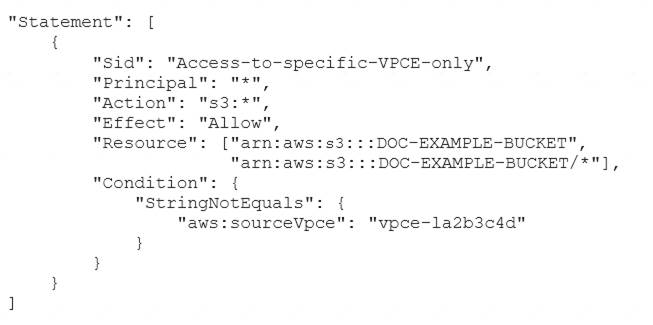
- B. A computer code with black text Description automatically generated
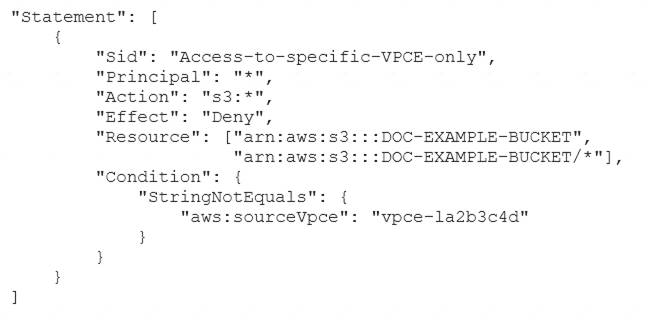
- C. A computer code with black text Description automatically generated
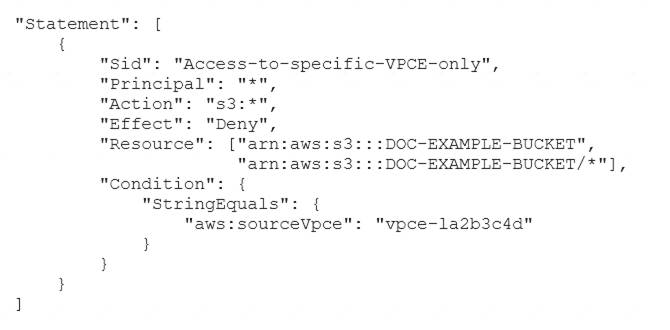
- D. A computer code with black text Description automatically generated
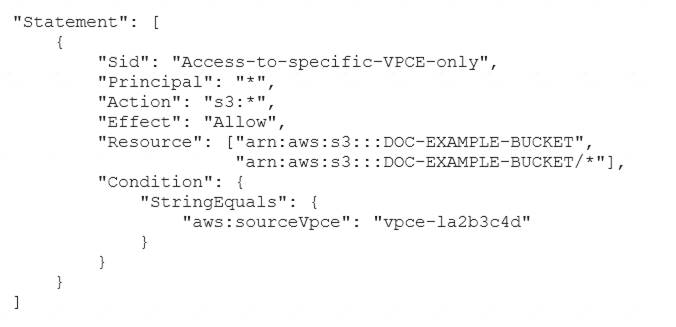
Answer: B
Explanation:
https://docs.aws.amazon.com/AmazonS3/latest/userguide/example-bucket-policies-vpc-endpoint.html
NEW QUESTION 12
A company's cloud operations team is responsible for building effective security for IAM cross-account access. The team asks a security engineer to help troubleshoot why some developers in the developer account (123456789012) in the developers group are not able to assume a cross-account role (ReadS3) into a production account (999999999999) to read the contents of an Amazon S3 bucket (productionapp). The two account policies are as follows: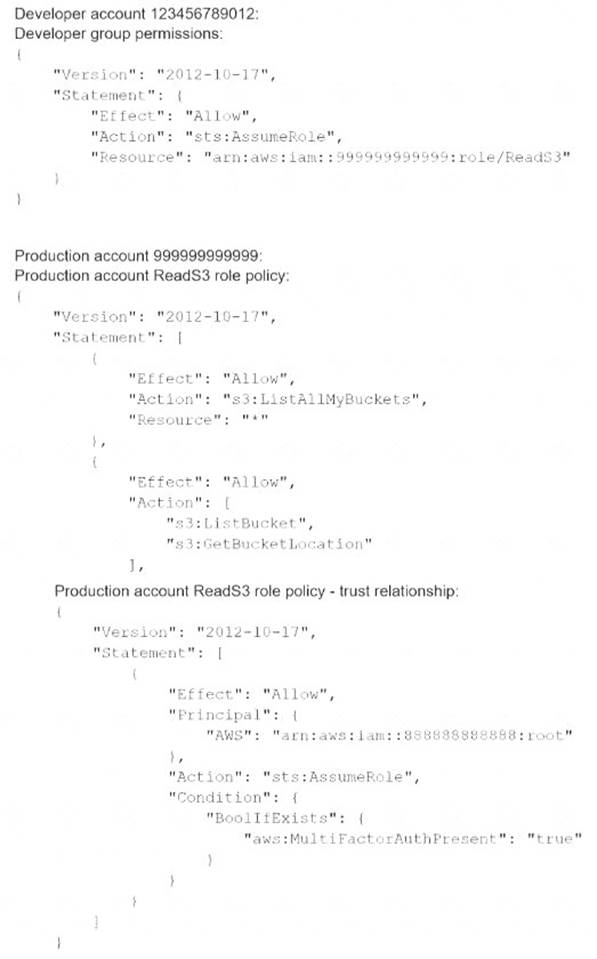
Which recommendations should the security engineer make to resolve this issue? (Select TWO.)
- A. Ask the developers to change their password and use a different web browser.
- B. Ensure that developers are using multi-factor authentication (MFA) when they log in to their developer account as the developer role.
- C. Modify the production account ReadS3 role policy to allow the PutBucketPolicy action on the productionapp S3 bucket.
- D. Update the trust relationship policy on the production account S3 role to allow the account number of the developer account.
- E. Update the developer group permissions in the developer account to allow access to the productionapp S3 bucket.
Answer: AD
NEW QUESTION 13
A company's security team is building a solution for logging and visualization. The solution will assist the company with the large variety and velocity of data that it receives from IAM across multiple accounts. The security team has enabled IAM CloudTrail and VPC Flow Logs in all of its accounts. In addition, the company has an organization in IAM Organizations and has an IAM Security Hub master account.
The security team wants to use Amazon Detective However the security team cannot enable Detective and is unsure why
What must the security team do to enable Detective?
- A. Enable Amazon Macie so that Secunty H jb will allow Detective to process findings from Macie.
- B. Disable IAM Key Management Service (IAM KMS) encryption on CtoudTrail logs in every member account of the organization
- C. Enable Amazon GuardDuty on all member accounts Try to enable Detective in 48 hours
- D. Ensure that the principal that launches Detective has the organizations ListAccounts permission
Answer: D
NEW QUESTION 14
Developers in an organization have moved from a standard application deployment to containers. The Security Engineer is tasked with ensuring that the containers are secure. Which strategies will reduce the attack surface and enhance the security of the containers? (Select TWO.)
- A. Use the containers to automate security deployments.
- B. Limit resource consumption (CPU, memory), networking connections, ports, and unnecessary container libraries.
- C. Segregate containers by host, function, and data classification.
- D. Use Docker Notary framework to sign task definitions.
- E. Enable container breakout at the host kernel.
Answer: AC
Explanation:
these are the strategies that can reduce the attack surface and enhance the security of the containers. Containers are a method of packaging and running applications in isolated environments. Using containers to automate security deployments can help ensure that security patches and updates are applied consistently and quickly across the container fleet. Segregating containers by host, function, and data classification can help limit the impact of a compromise and enforce the principle of least privilege. The other options are either irrelevant or risky for securing containers.
NEW QUESTION 15
A security engineer is designing a cloud architecture to support an application. The application runs on Amazon EC2 instances and processes sensitive information, including credit card numbers.
The application will send the credit card numbers to a component that is running in an isolated environment. The component will encrypt, store, and decrypt the numbers.
The component then will issue tokens to replace the numbers in other parts of the application.
The component of the application that manages the tokenization process will be deployed on a separate set of EC2 instances. Other components of the application must not be able to store or access the credit card numbers.
Which solution will meet these requirements?
- A. Use EC2 Dedicated Instances for the tokenization component of the application.
- B. Place the EC2 instances that manage the tokenization process into a partition placement group.
- C. Create a separate VP
- D. Deploy new EC2 instances into the separate VPC to support the data tokenization.
- E. Deploy the tokenization code onto AWS Nitro Enclaves that are hosted on EC2 instances.
Answer: D
Explanation:
AWS Nitro Enclaves are isolated and hardened virtual machines that run on EC2 instances and provide a secure environment for processing sensitive data. Nitro Enclaves have no persistent storage, interactive access, or external networking, and they can only communicate with the parent instance through a secure local channel. Nitro Enclaves also support cryptographic attestation, which allows verifying the identity and integrity of the enclave and its code. Nitro Enclaves are ideal for implementing data protection solutions such as tokenization, encryption, and key management.
Using Nitro Enclaves for the tokenization component of the application meets the requirements of isolating the sensitive data from other parts of the application, encrypting and storing the credit card numbers securely, and issuing tokens to replace the numbers. Other components of the application will not be able to access or store the credit card numbers, as they are only available within the enclave.
NEW QUESTION 16
An organization must establish the ability to delete an IAM KMS Customer Master Key (CMK) within a
24- hour timeframe to keep it from being used for encrypt or decrypt operations Which of tne following actions will address this requirement?
- A. Manually rotate a key within KMS to create a new CMK immediately
- B. Use the KMS import key functionality to execute a delete key operation
- C. Use the schedule key deletion function within KMS to specify the minimum wait period for deletion
- D. Change the KMS CMK alias to immediately prevent any services from using the CMK.
Answer: C
Explanation:
the schedule key deletion function within KMS allows you to specify a waiting period before deleting a customer master key (CMK)4. The minimum waiting period is 7 days and the maximum is 30 days5. This function prevents the CMK from being used for encryption or decryption operations during the waiting period4. The other options are either invalid or ineffective for deleting a CMK within a 24-hour timeframe.
NEW QUESTION 17
A company uses a third-party application to store encrypted data in Amazon S3. The company uses another third-party application trial decrypts the data from Amazon S3 to ensure separation of duties Between the applications A Security Engineer warns to separate the permissions using IAM roles attached to Amazon EC2 instances. The company prefers to use native IAM services.
Which encryption method will meet these requirements?
- A. Use encrypted Amazon EBS volumes with Amazon default keys (IAM EBS)
- B. Use server-side encryption with customer-provided keys (SSE-C)
- C. Use server-side encryption with IAM KMS managed keys (SSE-KMS)
- D. Use server-side encryption with Amazon S3 managed keys (SSE-S3)
Answer: C
NEW QUESTION 18
......
P.S. Allfreedumps.com now are offering 100% pass ensure SCS-C02 dumps! All SCS-C02 exam questions have been updated with correct answers: https://www.allfreedumps.com/SCS-C02-dumps.html (372 New Questions)