
Ucertify Terraform-Associate-003 Questions are updated and all Terraform-Associate-003 answers are verified by experts. Once you have completely prepared with our Terraform-Associate-003 exam prep kits you will be ready for the real Terraform-Associate-003 exam without a problem. We have Renew HashiCorp Terraform-Associate-003 dumps study guide. PASSED Terraform-Associate-003 First attempt! Here What I Did.
Online Terraform-Associate-003 free questions and answers of New Version:
NEW QUESTION 1
Where does the Terraform local backend store its state?
- A. In the terraform file
- B. In the /tmp directory
- C. In the terraform,tfstate file
- D. In the user??s terraform,state file
Answer: C
Explanation:
This is where the Terraform local backend stores its state, by default, unless you specify a different file name or location in your configuration. The local backend is the simplest backend type that stores the state file on your local disk.
NEW QUESTION 2
When does Terraform create the .terraform.lock.hc1 file?
- A. After your first terraform plan
- B. After your first terraform apply
- C. After your first terraform init
- D. When you enable state locking
Answer: C
Explanation:
Terraform creates the .terraform.lock.hcl file after the first terraform init command. This lock file ensures that the dependencies for your project are consistent across different runs by locking the versions of the providers and modules used.
NEW QUESTION 3
How could you reference an attribute from the vsphere_datacenter data source for use with the datacenter_id argument within the vsphere_folder resource in the following configuration?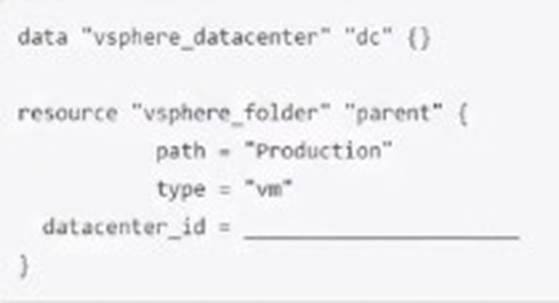
- A. Data.vsphere_datacenter.DC.id
- B. Vsphere_datacenter.dc.id
- C. Data,dc,id
- D. Data.vsphere_datacenter,dc
Answer: A
Explanation:
The correct way to reference an attribute from the vsphere_datacenter data source for use with the datacenter_id argument within the vsphere_folder resource in the following configuration is data.vsphere_datacenter.dc.id. This follows the syntax for accessing data source attributes, which is data.TYPE.NAME.ATTRIBUTE. In this case, the data source type is vsphere_datacenter, the data source name is dc, and the attribute we want to access is id. The other options are incorrect because they either use the wrong syntax, the wrong punctuation, or the wrong case. References = [Data Source: vsphere_datacenter], [Data Source: vsphere_folder], [Expressions: Data Source References]
NEW QUESTION 4
As a member of an operations team that uses infrastructure as code (lac) practices, you are tasked with making a change to an infrastructure stack running in a public cloud. Which pattern would follow laC best practices for making a change?
- A. Make the change via the public cloud API endpoint
- B. Clone the repository containing your infrastructure code and then run the code
- C. Use the public cloud console to make the change after a database record has been approved
- D. Make the change programmatically via the public cloud CLI
- E. Submit a pull request and wait for an approved merge of the proposed changes
Answer: E
Explanation:
You do not need to use different Terraform commands depending on the cloud provider you use. Terraform commands are consistent across different providers, as they operate on the Terraform configuration files and state files, not on the provider APIs directly.
NEW QUESTION 5
Which of these commands makes your code more human readable?
- A. Terraform validate
- B. Terraform output
- C. Terraform show
- D. Terraform fmt
Answer: D
Explanation:
The command that makes your code more human readable is terraform fmt. This command is used to rewrite Terraform configuration files to a canonical format and style, following the Terraform language style conventions and other minor adjustments for
readability. The command is optional, opinionated, and has no customization options, but it is recommended to ensure consistency of style across different Terraform codebases. Consistency can help your team understand the code more quickly and easily, making the use of terraform fmt very important. You can run this command on your configuration files before committing them to source control or as part of your CI/CD pipeline. References =
: Command: fmt : Using Terraform fmt Command to Format Your Terraform Code
NEW QUESTION 6
You have multiple team members collaborating on infrastructure as code (IaC) using Terraform, and want to apply formatting standards for readability.
How can you format Terraform HCL (HashiCorp Configuration Language) code according to standard Terraform style convention?
- A. Run the terraform fmt command during the code linting phase of your CI/CD process Most Voted
- B. Designate one person in each team to review and format everyone's code
- C. Manually apply two spaces indentation and align equal sign "=" characters in every Terraform file (*.tf)
- D. Write a shell script to transform Terraform files using tools such as AWK, Python, and sed
Answer: A
Explanation:
The terraform fmt command is used to rewrite Terraform configuration files to a canonical format and style. This command applies a subset of the Terraform language style conventions, along with other minor adjustments for readability. Running this command on your configuration files before committing them to source control can help ensure consistency of style between different Terraform codebases, and can also make diffs easier to read. You can also use the -check and -diff options to check if the files are formatted and display the formatting changes respectively2. Running the terraform fmt command during the code linting phase of your CI/CD process can help automate this
process and enforce the formatting standards for your team. References = [Command: fmt]2
NEW QUESTION 7
In a Terraform Cloud workpace linked to a version control repository speculative plan rum start automatically commit changes to version control.
- A. True
- B. False
Answer: A
Explanation:
When you use a remote backend that needs authentication, HashiCorp recommends that you:
NEW QUESTION 8
Define the purpose of state in Terraform.
- A. State maps real world resources to your configuration and keeps track of metadata
- B. State lets you enforce resource configurations that relate to compliance policies
- C. State stores variables and lets you quickly reuse existing code
- D. State codifies the dependencies of related resources
Answer: A
Explanation:
The purpose of state in Terraform is to keep track of the real-world resources managed by Terraform, mapping them to the configuration. The state file contains metadata about these resources, such as resource IDs and other important attributes, which Terraform uses to plan and manage infrastructure changes. The state enables Terraform to know what resources are managed by which configurations and helps in maintaining the desired state of the infrastructure.References = This role of state in Terraform is outlined in Terraform's official documentation, emphasizing its function in mapping configuration to real-world resources and storing vital metadata .
NEW QUESTION 9
What Terraform command always causes a state file to be updated with changes that might have been made outside of Terraform?
- A. Terraform plan –refresh-only
- B. Terraform show –json
- C. Terraform apply –lock-false
- D. Terraform plan target-state
Answer: A
Explanation:
This is the command that always causes a state file to be updated with changes that might have been made outside of Terraform, as it will only refresh the state file with the current status of the real resources, without making any changes to them or creating a plan.
NEW QUESTION 10
Which command should you run to check if all code in a Terraform configuration that references multiple modules is properly formatted without making changes?
- A. terraform fmt -write-false
- B. terraform fmt -list -recursive
- C. terraform fmt -check -recursive
- D. terraform fmt -check
Answer: C
Explanation:
This command will check if all code in a Terraform configuration that references multiple modules is properly formatted without making changes, and will return a non-zero exit code if any files need formatting. The other commands will either make changes, list the files that need formatting, or not check the modules.
NEW QUESTION 11
How does Terraform determine dependencies between resources?
- A. Terraform requires resource dependencies to be defined as modules and sourced in order
- B. Terraform automatically builds a resource graph based on resources provisioners, special meta-parameters, and the stale file (if present}
- C. Terraform requires resources in a configuration to be listed m the order they will be created to determine dependencies
- D. Terraform requires all dependencies between resources to be specified using the depends_on parameter
Answer: B
Explanation:
This is how Terraform determines dependencies between resources, by using the references between them in the configuration files and other factors that affect the order of operations.
NEW QUESTION 12
You must use different Terraform commands depending on the cloud provider you use.
- A. True
- B. False
Answer: B
Explanation:
You do not need to use different Terraform commands depending on the cloud provider you use. Terraform commands are consistent across different providers, as they operate on the Terraform configuration files and state files, not on the provider APIs directly.
NEW QUESTION 13
Which Terraform command checks that your configuration syntax is correct?
- A. terraform validate
- B. terraform init
- C. terraform show
- D. terraform fmt
Answer: A
Explanation:
The terraform validate command is used to check that your Terraform configuration files are syntactically valid and internally consistent. It is a useful command for ensuring your Terraform code is error-free before applying any changes to your infrastructure.
NEW QUESTION 14
You cannot install third party plugins using terraform init.
- A. True
- B. False
Answer: B
Explanation:
You can install third party plugins using terraform init, as long as you specify the plugin directory in your configuration or as a command-line argument. You can also use the terraform providers mirror command to create a local mirror of providers from any source.
NEW QUESTION 15
backends support state locking.
- A. All
- B. No
- C. Some
- D. Only local
Answer: C
Explanation:
Some backends support state locking, which prevents other users from modifying the state file while a Terraform operation is in progress. This prevents conflicts and data loss. Not all backends support this feature, and you can check the documentation for each backend type to see if it does.
NEW QUESTION 16
......
Thanks for reading the newest Terraform-Associate-003 exam dumps! We recommend you to try the PREMIUM Certshared Terraform-Associate-003 dumps in VCE and PDF here: https://www.certshared.com/exam/Terraform-Associate-003/ (195 Q&As Dumps)