Cause all that matters here is passing the Microsoft az-500 exam. Cause all that you need is a high score of az-500 Microsoft Azure Security Technologies exam. The only one thing you need to do is downloading Certleader az-500 exam study guides now. We will not let you down with our money-back guarantee.
Online az-500 free questions and answers of New Version:
NEW QUESTION 1
Lab Task
Task 4
You need to ensure that when administrators deploy resources by using an Azure Resource Manager template, the deployment can access secrets in an Azure key vault named KV31330471.
Solution:
Grant permission to the application that is used to deploy the resources to access the secrets in the key vault. You can use the Azure portal, Azure PowerShell, or the Azure CLI to do this. You need to assign the Key Vault Secrets User role to the application at the scope of the key vault or individual secrets.
Enable template deployment for the key vault. You can use the Azure portal, Azure PowerShell, or the Azure CLI to do this. You need to set the enabledForTemplateDeployment property of the key vault to true.
Reference the secrets in the template by using their resource ID. You can use the listSecrets function to get the resource ID of a secret in the key vault. You need to specify the name of the key vault and the name of the secret as parameters.
Deploy the template by using Azure PowerShell, Azure CLI, or REST API. You can use the
New-AzResourceGroupDeployment cmdlet, the az deployment group create command, or the Deployments - Create Or Update REST API to do this. You need to provide the template file or URI and any required parameters.
Does this meet the goal?
- A. Yes
- B. Not Mastered
Answer: A
NEW QUESTION 2
You have a file named File1.yaml that contains the following contents.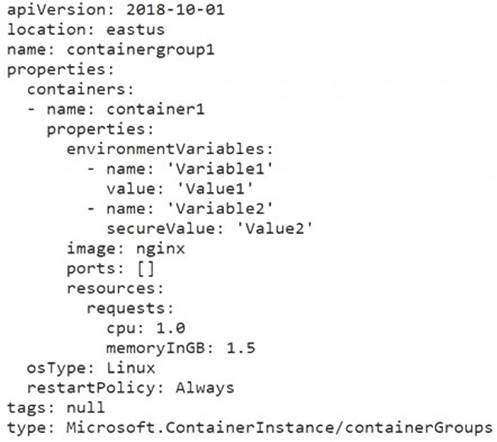
You create an Azure container instance named container1 by using File1.yaml. You need to identify where you can access the values of Variable1 and Variable2.
What should you identify? To answer, select the appropriate options in the answer area. NOTE: Each correct selection is worth one point.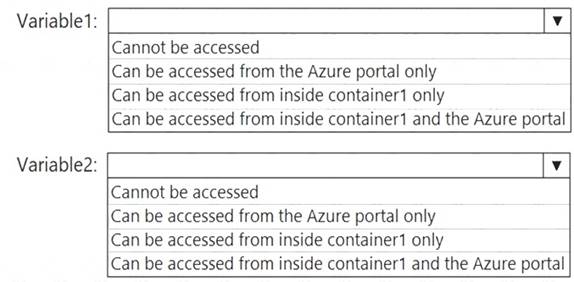
Solution:
Reference:
https://docs.microsoft.com/en-us/azure/container-instances/container-instances-environment-variables
Does this meet the goal?
- A. Yes
- B. Not Mastered
Answer: A
NEW QUESTION 3
You have an Azure subscription named Subscription1.
You deploy a Linux virtual machine named VM1 to Subscription1. You need to monitor the metrics and the logs of VM1. D18912E1457D5D1DDCBD40AB3BF70D5D
What should you use?
- A. the AzurePerformanceDiagnostics extension
- B. Azure HDInsight
- C. Linux Diagnostic Extension (LAD) 3.0
- D. Azure Analysis Services
Answer: A
NEW QUESTION 4
You have an Azure Active Directory (Azure AD) tenant and a root management group. You create 10 Azure subscriptions and add the subscriptions to the rout management group.
You need to create an Azure Blueprints definition that will be stored in the root management group. What should you do first?
- A. Add an Azure Policy definition to the root management group.
- B. Modify the role-based access control (RBAC) role assignments for the root management group.
- C. Create a user-assigned identity.
- D. Create a service principal.
Answer: B
Explanation:
Reference:
https://docs.microsoft.com/en-us/azure/role-based-access-control/elevate-access-global-admin
NEW QUESTION 5
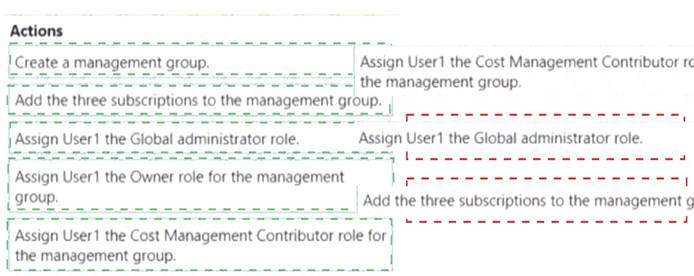
You have three Azure subscriptions and a user named User1.
You need to provide User1 with the ability to manage and view costs for the resources across all three subscriptions. The solution must use the principle of least privilege.
Which three actions should you perform in sequence? To answer, move the appropriate actions from the list of actions to the answer area and arrange them in the correct order.
NOTE: More than one order of answer choices is correct. You will receive credit for any of the correct orders you select.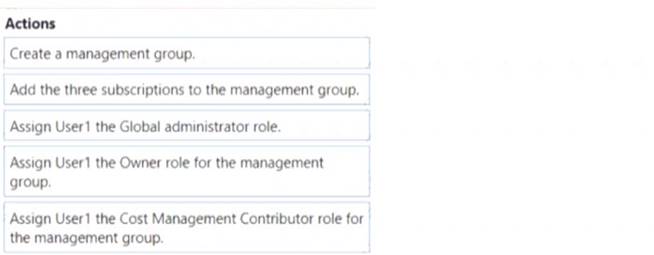
Solution:
Does this meet the goal?
- A. Yes
- B. Not Mastered
Answer: A
NEW QUESTION 6
You have an Azure subscription that contains the resources shown in the following table.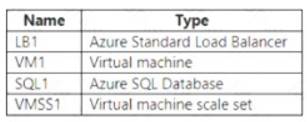
You plan to deploy an Azure Private Link service named APL1. Which resource must you reference during the creation of APL1?
- A. VMSS1
- B. VM1
- C. SQL
- D. LB1
Answer: D
NEW QUESTION 7
You have three on-premises servers named Server1, Server2, and Server3 that run Windows Server1 and Server2 and located on the Internal network. Server3 is located on the premises network. All servers have access to Azure.
From Azure Sentinel, you install a Windows firewall data connector.
You need to collect Microsoft Defender Firewall data from the servers for Azure Sentinel. What should you do?
- A. Create an event subscription from Server1, Server2 and Server3
- B. Install the On-premises data gateway on each server.
- C. Install the Microsoft Agent on each server.
- D. Install the Microsoft Agent on Server1 and Server2 install the on-premises data gateway on Server3.
Answer: C
Explanation:
Reference:
https://docs.microsoft.com/en-us/azure/sentinel/connect-windows-firewall
NEW QUESTION 8
You have an Azure subscription name Sub1 that contains an Azure Policy definition named Policy1. Policy1 has the following settings: Definition location: Tenant Root Group Category: Monitoring
You need to ensure that resources that are noncompliant with Policy1 are listed in the Azure Security Center dashboard.
What should you do first?
- A. Change the Category of Policy1 to Security Center.
- B. Add Policy1 to a custom initiative.
- C. Change the Definition location of Policy1 to Sub1.
- D. Assign Policy1 to Sub1.
Answer: D
Explanation:
Reference:
https://docs.microsoft.com/en-us/azure/governance/policy/overview
NEW QUESTION 9
You have an Azure subscription named Subcription1 that contains an Azure Active Directory (Azure AD) tenant named contosos.com and a resource group named RG1.
You create a custom role named Role1 for contoso.com.
You need to identify where you can use Role1 for permission delegation. What should you identify?
- A. contoso.com only
- B. contoso.com and RGT only
- C. contoso.com and Subscription1 only
- D. contoso.com, RG1, and Subcription1
Answer: A
Explanation:
https://docs.microsoft.com/en-us/azure/role-based-access-control/custom-roles
NEW QUESTION 10
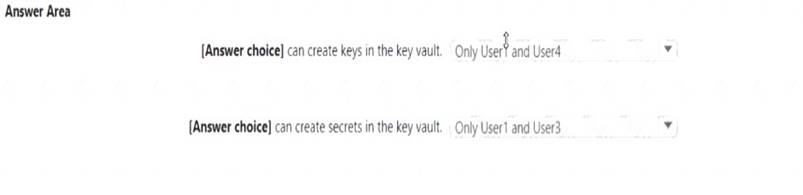
You have an Azure subscription that contains an Azure key vault. The role assignments for the key vault are shown in the following exhibit.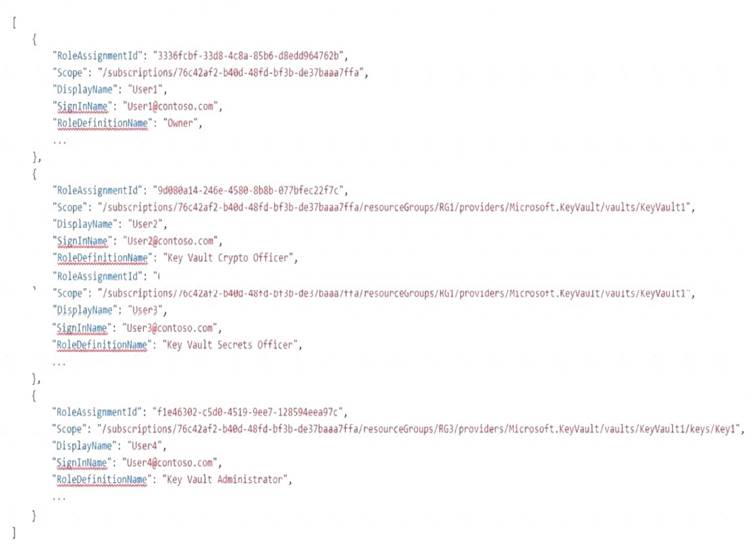
Use the drop-down menus to select the answer choice that completes each statement based on the information presented in the graphic. NOTE: Each correct selection is worth one point.
Solution:
Does this meet the goal?
- A. Yes
- B. Not Mastered
Answer: A
NEW QUESTION 11
You have an Azure AD tenant that contains the users shown in the following table.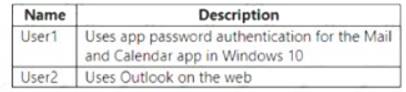
You need to ensure that the users cannot create app passwords. The solution must ensure that User1 can continue to use the Mail and Calendar app.
What should you do?
- A. Assign User! the Authentication Policy Administrator role.
- B. Enable Azure AD Password Protection.
- C. Configure a multi-factor authentication (MFA) registration policy.
- D. Create a new app registration.
Answer: C
NEW QUESTION 12
You need to ensure that you can meet the security operations requirements. What should you do first?
- A. Turn on Auto Provisioning in Security Center.
- B. Integrate Security Center and Microsoft Cloud App Security.
- C. Upgrade the pricing tier of Security Center to Standard.
- D. Modify the Security Center workspace configuration.
Answer: C
Explanation:
The Standard tier extends the capabilities of the Free tier to workloads running in private and other public clouds, providing unified security management and threat protection across your hybrid cloud workloads. The Standard tier also adds advanced threat detection capabilities, which uses built-in behavioral analytics and machine learning to identify attacks and zero-day exploits, access and application controls to reduce exposure to network attacks and malware, and more.
Scenario: Security Operations Requirements
Litware must be able to customize the operating system security configurations in Azure Security Center. References:
https://docs.microsoft.com/en-us/azure/security-center/security-center-pricing
NEW QUESTION 13
Note: The question is included in a number of questions that depicts the identical set-up. However, every question has a distinctive result. Establish if the solution satisfies the requirements.
Your company has an Active Directory forest with a single domain, named weylandindustries.com. They also have an Azure Active Directory (Azure AD) tenant with the same name.
You have been tasked with integrating Active Directory and the Azure AD tenant. You intend to deploy Azure AD Connect.
Your strategy for the integration must make sure that password policies and user logon limitations affect user accounts that are synced to the Azure AD tenant, and that the amount of necessary servers are reduced.
Solution: You recommend the use of pass-through authentication and seamless SSO with password hash synchronization.
Does the solution meet the goal?
- A. Yes
- B. No
Answer: A
Explanation:
https://docs.microsoft.com/en-us/azure/active-directory/hybrid/choose-ad-authn
NEW QUESTION 14
You have an Azure subscription that contains the storage accounts shown in the following table.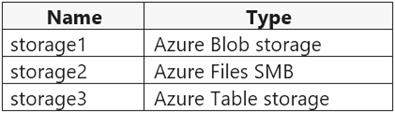
You need to configure authorization access.
Which authorization types can you use for each storage account? To answer, select the appropriate options in the answer area.
NOTE: Each correct selection is worth one point.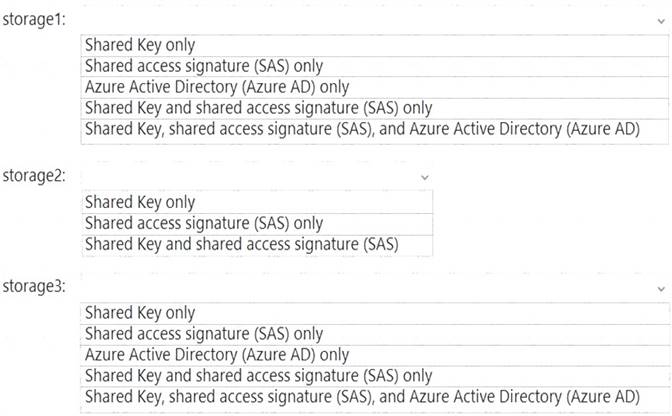
Solution:
Graphical user interface, text, application, email Description automatically generated
Reference:
https://docs.microsoft.com/en-us/azure/storage/common/authorize-data-access
Does this meet the goal?
- A. Yes
- B. Not Mastered
Answer: A
NEW QUESTION 15
You have an Azure subscription that contains the virtual machines shown in the following table.
You create the Azure policies shown in the following table.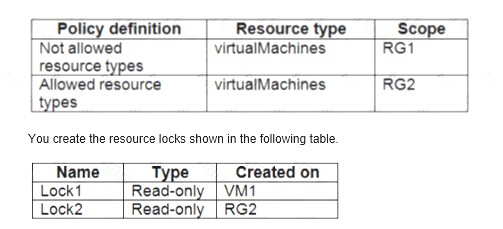
For each of the following statements, select Yes if the statement is true. Otherwise, select No. NOTE: Each correct selection is worth one point.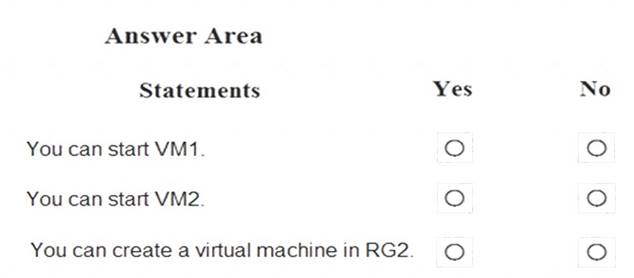
Solution:
References:
https://docs.microsoft.com/en-us/azure/governance/blueprints/concepts/resource-locking
Does this meet the goal?
- A. Yes
- B. Not Mastered
Answer: A
NEW QUESTION 16
You have an Azure subscription that contains the virtual machines shown in the following table.
Subnet1 and Subnet2 have a network security group {NSG). The NSG has an outbound rule that has the following configurations:
• Port; Any
• Source: Any
• Priority: 100
• Action: Deny
• Protocol: Any
• Destination: Storage
The subscription contains a storage account named storage1.
You create a private endpoint named Private1 that has the following settings:
• Resource type: Microsoft.Storage/storageAccounts
• Resource: storage1
• Target sub-resource: blob
• Virtual network: VNet1
• Subnet: Subnet1
For each of the following statements, select Yes if the statement is true. Otherwise, select No. NOTE: Each correct selection is worth one point.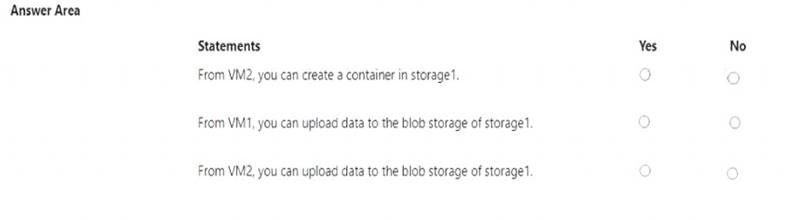
Solution:
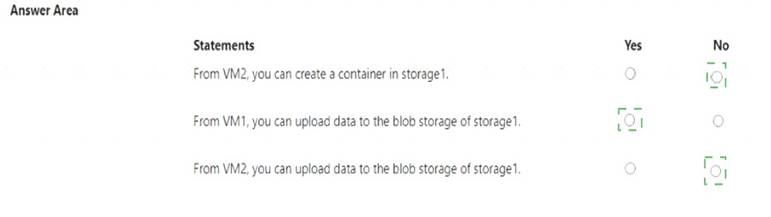
Does this meet the goal?
- A. Yes
- B. Not Mastered
Answer: A
NEW QUESTION 17
You have an Azure subscription.
You plan to create a custom role-based access control (RBAC) role that will provide permission to read the Azure Storage account.
Which property of the RBAC role definition should you configure?
- A. NotActions []
- B. DataActions []
- C. AssignableScopes []
- D. Actions []
Answer: D
Explanation:
To ‘Read a storage account’, ie. list the blobs in the storage account, you need an ‘Action’ permission. To read the data in a storage account, ie. open a blob, you need a ‘DataAction’ permission.
Reference:
https://docs.microsoft.com/en-us/azure/role-based-access-control/role-definitions
NEW QUESTION 18
You create a new Azure subscription that is associated to a new Azure Active Directory (Azure AD) tenant. You create one active conditional access policy named Portal Policy. Portal Policy is used to provide access to the Microsoft Azure Management cloud app.
The Conditions settings for Portal Policy are configured as shown in the Conditions exhibit. (Click the Conditions tab.)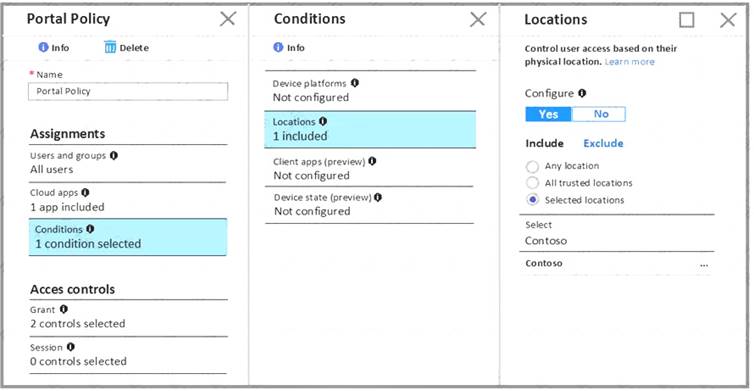
The Grant settings for Portal Policy are configured as shown in the Grant exhibit. (Click the Grant tab.)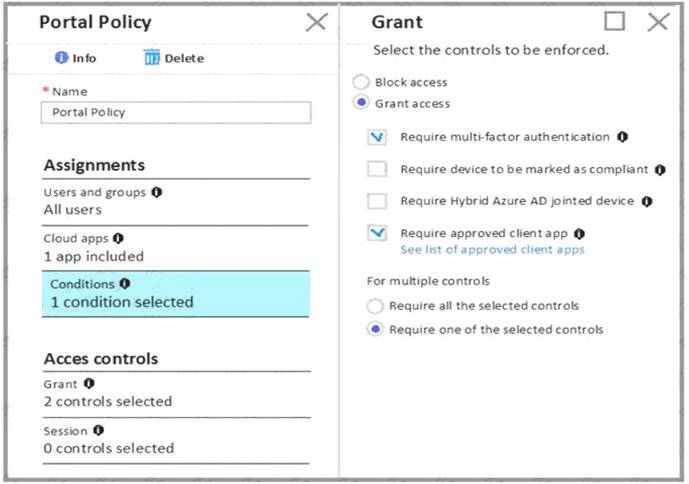
For each of the following statements, select Yes if the statement is true. Otherwise, select No. NOTE: Each correct selection is worth one point.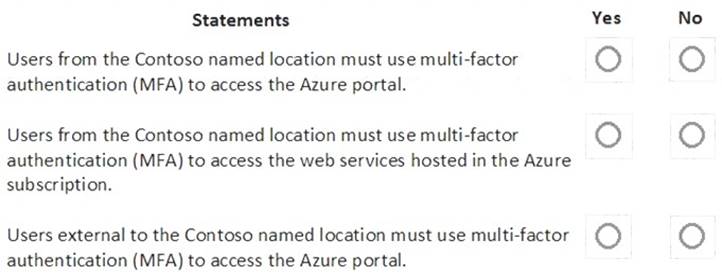
Solution:
Box 1: No
The Contoso location is excluded Box 2: NO
Box 3: NO
Reference:
https://docs.microsoft.com/en-us/azure/active-directory/conditional-access/location-condition
Does this meet the goal?
- A. Yes
- B. Not Mastered
Answer: A
NEW QUESTION 19
......
P.S. Dumps-hub.com now are offering 100% pass ensure az-500 dumps! All az-500 exam questions have been updated with correct answers: https://www.dumps-hub.com/az-500-dumps.html (416 New Questions)